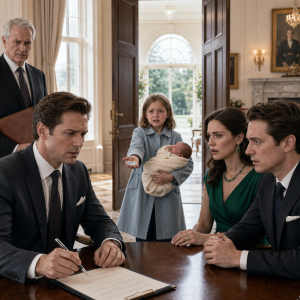
Richard Cole was a 45-year-old real estate mogul in Seattle. He had everything—money, a house on the hill, influence.
But for the last three years, none of it meant as much as his eight-year-old son, Ethan, who had lost the use of his legs in a car accident. Since then, Ethan had stopped smiling, stopped playing, barely ate.
Every day, Richard watched his child slowly lose the will to live—and felt completely helpless.
One evening, Richard left a business meeting early and got home ahead of schedule. As he opened the front door, he heard something he hadn’t heard in months: a child’s bright, genuine laughter.
Following the sound, he stepped into the living room—and froze. The new housekeeper, Maria, whom he’d hired just two weeks earlier, was kneeling on the floor beside Ethan, who was laughing uncontrollably.
“What is going on here?” Richard’s voice thundered through the room.
Maria jumped to her feet, wiping her hands nervously on her navy apron. Her brown eyes were wide, caught between fear and determination. “Mr. Cole, I can explain—” she began.
But Ethan, still grinning, cut in. “Dad, Aunt Maria was showing me some different exercises. Look!”
The blond boy focused hard and managed to move his right foot—just a little, but more than he had in months.
Richard felt his knees go weak. “That’s impossible,” he muttered.
Maria drew a steadying breath. She knew this wasn’t in her job description, she said, but seeing Ethan so sad had reminded her of techniques her grandmother had used in a small town in New Mexico. Her grandmother had cared for people with similar problems.
Richard snapped, accusing her of suggesting that an untrained woman could do what the best neurologists in the country could not. Tears welled in Maria’s eyes, but she didn’t back down.
She wasn’t claiming to know more than doctors, she said—only that she wanted to help the boy feel a little better.
Ethan looked at his father, blue eyes glowing with new hope. “Dad, I felt tingling in my leg,” he said. It was the first time in a long time he sounded excited.
Richard cut him off and sent him to his room, asking Maria to wheel him to the elevator and then come back. When she returned, she found Richard pacing, running a hand through his graying hair.
He asked if she had children. When she said no, he told her she couldn’t know what it was like to watch your child slowly stop wanting to live.
Maria listened in silence, then interrupted him gently but firmly. She had grown up watching her grandmother, Grandma Rose, treat people city doctors had already given up on.
Her grandmother had never claimed to replace medicine, but believed that sometimes the heart knows what the mind can’t explain.
Maria described “points of life”—places on the body that, when touched softly, could wake up sleeping energy.
She mentioned a girl in her town who regained movement in her arms, a man who walked again after losing feeling in his leg, and others who had improved. Richard stayed skeptical. He couldn’t risk his son’s health on stories from a small town.
He decided not to fire her—she was excellent at her job, and Ethan clearly trusted her—but demanded her word that she would never try anything like that with Ethan again without his permission. Maria agreed, sadness dimming her eyes.
Upstairs, she later found Ethan crying. He asked why his dad wouldn’t let her help. Maria told him his father loved him and was afraid. Ethan admitted that when she touched his legs, it felt like they were waking up from a long sleep.
Showing surprising maturity, he guessed his dad was scared he’d be even more crushed if nothing worked. Maria whispered that sometimes people just needed time to understand.