The Night the Doors Closed

The sleet had begun as rain somewhere north of Providence, but by the time it reached the old coastal estate outside Newport, it came sideways in hard silver sheets, striking my face and soaking through the shoulders of my field coat as I stood at the end of the circular drive with my six children gathered around me.
My youngest, ten-month-old Maisie, was pressed against my chest beneath the open front of my coat. She had been warm all afternoon, but now her little body felt far too hot, and each breath came with a faint roughness that made every instinct in me tighten. Behind me stood my other five children, ranging from six to fourteen, their hair wet, their shoes filling with icy water, their belongings stuffed into grocery sacks and old moving boxes that had been pushed onto the pavement as if they were things no one wanted.
My husband, Scott, had been gone for nine days.
Nine days since the memorial chapel at Hanscom Air Force Base had filled with blue uniforms, folded flags, and people telling me what an extraordinary man he had been.
Nine days since his parents had embraced my children in public and called them Scott’s greatest legacy.
And less than an hour since those same people had ordered us out of the only house my children remembered as home.
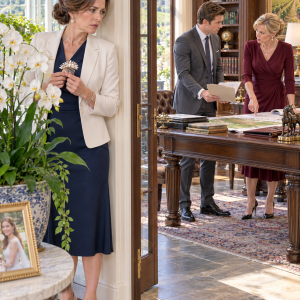
My father-in-law, Harrison Vale, stood beneath the wide stone portico, perfectly dry in a camel cashmere coat. He was a retired commercial real-estate developer who had spent forty years building luxury hotels along the New England coast, and he carried himself with the confidence of a man who believed ownership was not a legal condition but a personality trait.
Beside him stood his wife, Judith, elegant as always, silver-blonde hair smooth despite the weather, one hand resting on the carved front door.
Harrison pointed toward the gates.
“You heard me, Meredith. This is a family property. Scott is no longer here to justify your presence.”
My fourteen-year-old son, Owen, stiffened beside me.
I put one hand against his shoulder before he could speak.
For thirteen years I had done that in one form or another. I had quieted the children, redirected conversations, ignored remarks at Thanksgiving, swallowed insults at Christmas, and told myself that dignity sometimes meant choosing peace over response. Scott loved his parents despite everything complicated between them, and because I loved Scott, I had spent years making excuses for people who had never once extended the same generosity to me.
But that night, standing in freezing rain with a feverish baby against my heart, peace no longer looked noble.
It looked like permission.
“Harrison,” I said, keeping my voice level, “these are your grandchildren. Scott wanted them raised here. You know that.”
Judith gave a small, humorless smile.
“Scott was sentimental. That was one of his weaknesses.”
Owen moved before I could stop him.
“Dad said this would always be our house.”
Harrison turned so quickly that my younger children recoiled.
“You will not lecture me about my own son.”
Something changed inside me then—not loudly, not dramatically, but completely.
I stepped between Harrison and my boy.
“You will never speak to my child that way again.”
Harrison stared at me for half a second, then laughed.
“And what exactly will you do about it? Summon the Air Force?”
Judith lifted another plastic sack from beside the doorway and let it fall into the wet driveway. A stuffed rabbit, two school notebooks, a framed photograph, and several small sweaters spilled into the water.
My eight-year-old daughter, Paige, made a soft sound beside me.
The photograph showed Scott kneeling on the lawn with three of the children piled on his back.
I looked toward the mansion.
Every window glowed.
Relatives were inside. Neighbors. Business partners. Old family friends who had attended Scott’s memorial service and told me to call if I needed anything.
They watched from behind glass.
No one opened the door.
What Harrison did not know was that I had spent most of my adult life in rooms where panic was expensive. I had commanded Air Force cyber-defense operations across three continents, advised senior national-security officials, and carried responsibilities I rarely discussed outside secure facilities. My official title was Lieutenant General Meredith Rowe, though the Vale family had always preferred to describe me simply as Scott’s wife who traveled too much.
For years I had let them underestimate me because correcting them had seemed unnecessary.
That night, their ignorance became almost useful.
Inside the waterproof document case beneath my coat was a cream envelope Scott had placed in my hands four weeks before his final overseas assignment.
He had looked unusually serious when he gave it to me.
“Merry, promise me something.”
“That depends.”
He had smiled at my answer, but only briefly.
“If my parents ever tell you the children don’t belong in that house, open this. Not before.”
I had tried to question him, but Scott had kissed my forehead and said he was probably being overly cautious.
Now, with sleet running down my sleeves, I pulled out the envelope.
My fingers were stiff as I broke the seal.
There were legal documents inside.
A deed.
A trust agreement.
A letter.
And a business card for a Boston attorney named Evelyn Hart.
I read the first page once.
Then again.
When I lifted my head, Harrison was still watching me with that same expression of practiced superiority.
“Before you lock the door,” I said, “you may want to read this.”
He frowned.
I held up the deed.
“You are not the legal owner of this property.”
Judith’s smile disappeared.
Harrison stepped down one stair.
“What did you say?”
“The title is in my name.”
For the first time that evening, no one moved.
Then headlights swept across the iron gates.
A black government vehicle entered the drive, followed by two official security cars. Doors opened. Uniformed personnel stepped into the sleet, and behind them came General Raymond Beckett, the four-star commander under whom I had served during one of the most difficult periods of my career.
He crossed the driveway, stopped in front of me, and raised his hand in salute.
I returned it automatically while holding Maisie close.
“General Rowe,” he said, loudly enough for everyone beneath the portico to hear, “we’ve been trying to reach you. Your protective detail is ready, ma’am.”
Behind Harrison, faces appeared more clearly in the windows.
The night became very quiet.
The woman the Vale family had just pushed into a winter storm was not merely the unwanted wife of their son.
And the house they believed they controlled had not belonged to them for quite some time.
What Scott Had Prepared

General Beckett lowered his hand and immediately looked at the children.
He had known me for eleven years and understood without explanation that rank meant very little when a baby was unwell.
“What do you need first?” he asked.
I looked down at Maisie.
“Warmth. Dry clothes. A medical evaluation.”
He nodded once.
Two members of the security team moved forward, not aggressively but with the calm efficiency of people accustomed to uncertainty. One offered a coat to Owen. Another crouched near my six-year-old twins, Finn and Miles, and introduced herself gently.
Miles backed closer to his brother.
“We’re staying with Mom.”
The officer’s expression softened.
“Absolutely. Nobody is separating you.”
Only then did the twins relax.
Harrison finally seemed to recover.
“This is private property. You cannot bring a federal entourage into my home.”
General Beckett glanced at the deed in my hand.
“The question of private property appears to be exactly the issue.”
I did not wait for another argument.
“The children are going inside.”
Judith drew herself up.
“You cannot simply take over this house because Scott signed some document.”
“I’m not taking anything over,” I replied. “I’m taking my children out of the cold.”