The Divorce Agreement
The divorce papers were placed in front of me like a finished decision.
Not a discussion. Not a negotiation. A conclusion already reached without me.
The forty-eighth floor of Whitmore Tower stretched around us in glass and steel, Chicago flattened beneath like something distant enough to discard. Eleanor Whitmore didn’t look at me when she spoke. She looked at outcomes, timelines, consequences already sorted into order.
“Name your price, Cassandra,” she said. “Sign today. Leave quietly before those twins are born.”
Twins.
The word didn’t feel real at first. It hovered somewhere outside my body, waiting for permission to land.
Across the table, Grant Whitmore—my husband—still didn’t look at me. Eight years of marriage reduced to a posture of avoidance.
Beside him, Maren Collins rested one hand over her barely visible pregnancy with the calm precision of someone who understood exactly what she represented in the room.
A future.
And I wasn’t part of it.
I looked at the contract. Thick. Detailed. Expensive in a way that had nothing to do with money and everything to do with control.
Eleanor tapped the pen once.
“Twenty-eight million dollars. Properties. Security. You will never need anything again.”
Never need anything again.
As if need was the only thing that defined me.
Grant finally spoke, voice low, carefully neutral.
“Cassandra, this doesn’t have to become painful.”
I almost laughed.
Because it already was.
It had been painful long before I walked into this room.
I picked up the pen.
And signed.
Not because I agreed.
But because I needed them to believe I had.
And because three days earlier, a nurse from Lakeshore Fertility Clinic had called me in a voice she could barely steady.
Something in your file doesn’t match what you were told.
I didn’t yet know what that meant.
But I knew it wasn’t nothing.
After the Fall
The Charleston house was part of the settlement.
A final gesture disguised as generosity.
I expected emptiness.
What I didn’t expect was how loud silence could be when it belonged only to me.
Sunlight poured through tall windows. Rooms too large for a single life. Spaces designed for a family that had never intended to include me in permanence.
I moved through it slowly, touching things I didn’t remember choosing.
A ceramic bowl with a faint crack along the rim.
A linen curtain slightly uneven at the hem.
Evidence of a life not curated by Whitmore precision.
And for reasons I didn’t fully understand, that imperfection made my chest tighten.
Because it meant this place had never been meant to impress anyone.
It had been meant to be lived in.
Without them.
Without him.
Without permission.
I sat at the kitchen table that first night and realized something unsettling.
I wasn’t waiting to be told what came next anymore.
I was already in it.

Daniel Hayes
I met Daniel Hayes the way people meet things they don’t realize will matter later.
Quietly.
Without announcement.
He was a pediatric surgeon at St. Augustine Medical Center. Tired eyes that never felt performative. Hands that always looked like they had done more fixing than speaking.
He didn’t ask about money.
He didn’t ask about Whitmore.
He didn’t ask why I sometimes went quiet mid-sentence like I was checking whether I was allowed to continue.
He just waited.
And that waiting felt like a different language.
“You don’t look like someone who’s escaping,” he said once.
I remember studying him for a moment too long.
“I’m not escaping,” I answered. “I’m rebuilding.”
He nodded as if both were equally real.
That was the first time I realized I didn’t have to explain myself to survive a conversation.
Weeks passed like that.
Unforced.
Unmonitored.
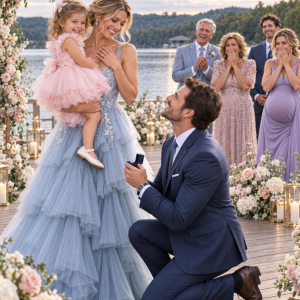
In spring, he proposed behind the Charleston house under magnolia trees beginning to bloom.
No audience. No announcement. No performance of certainty.
Just him, steady and unpolished.
“I don’t want to replace anything,” he said. “I just want to be part of what comes after it.”
I said yes before fear could argue.
And for a brief stretch of time, I believed the past had finally stopped moving toward me.
The File That Should Not Exist
The message arrived two weeks before the wedding.
Unknown number.
No explanation.
Just a file attachment.
I ignored it for hours.
Then longer.
Until ignoring it felt more dangerous than opening it.
A DNA report.
My name.
Grant Whitmore’s name.
And a result that didn’t belong in any version of my reality.
Paternity exclusion.
I read it once.
Then again.
Because the first reading felt like a mistake my brain was making on my behalf.
Then a second message appeared.
“Don’t let Eleanor Whitmore know you have this. You’re not supposed to see it yet.”
Yet.
That word stayed with me.
As if there was a timeline I had already broken without knowing it existed.
A second file loaded beneath it.
A scanned envelope.
My name written across it in careful, familiar handwriting.
Whitmore crest embossed in the corner like a seal of ownership.
I sat down at the kitchen table without remembering deciding to sit.
The house was quiet in the way that makes you start listening for things that aren’t there.
I opened the attachment.
And the first line didn’t feel like information.
It felt like collapse.
They paid you to disappear because you were never the infertile one.
The air changed.
Not metaphorically.
Physically.
Like the room had tightened around my lungs.
I read it again.
Slower this time.
As if repetition might soften the impact.
It didn’t.
It sharpened it.
Behind me, the house creaked as it settled into itself.
Or maybe into me.
Then my phone buzzed again.
A new file appeared.
LAKESHORE_ARCHIVE_7_YEARS
No sender.
No context.
Just waiting.
I stared at it for a long time.
And for the first time since the divorce, I understood something I hadn’t been allowed to see before:
I hadn’t been released from the Whitmores.
I had been relocated inside their secrets.
The Wedding That Wasn’t Mine Anymore
Two weeks before the wedding, the house stopped feeling like a beginning.
It started feeling like a threshold.
Something waiting on the other side of it was aware of me.
The file—LAKESHORE_ARCHIVE_7_YEARS—remained unopened on my phone longer than anything should have. Not because I didn’t want to know.
Because I understood, instinctively, that knowing would change what I could pretend was still intact.
Daniel noticed the shift before I spoke about it.
He always did.
“You’ve been somewhere else for days,” he said one morning, watching me over coffee.
I stirred my cup without drinking.
“I’m here,” I answered. “Just… not all of me.”
He didn’t push.
That was his way.
But silence, when it’s shared with the right person, stops feeling like avoidance.
It starts feeling like protection.