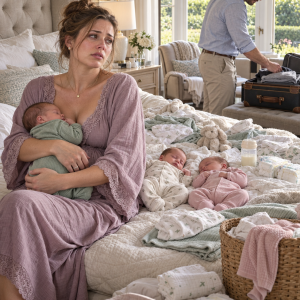
The Cry I Heard When I Came Home
The first thing I heard when I opened my front door was my baby boy crying.
It was not the strong, impatient cry of a newborn who simply wanted to be held. It was thin, tired, and broken, as if he had already learned that no one would come fast enough.
I stood in the entryway of my own house with my duffel bag still hanging from one shoulder.
After nearly eight months serving overseas, I had imagined this moment many times. I had imagined my wife running into my arms. I had imagined holding my son for the first time without a screen between us. I had imagined the smell of dinner, clean blankets, and home.
Instead, the house smelled like old milk, warm formula, and something deeply wrong.
From the living room, my mother’s voice floated toward me.
“Leave him alone,” she said calmly. “A baby has to learn that crying does not control a household.”
My hand tightened around the strap of my bag.
In all my years in uniform, I had learned to listen before reacting. A quiet room could tell you more than a shouting one.
And that house was speaking.
The air was too warm.
The baby’s cry stopped for too long between breaths.
No one sounded concerned.
I dropped my bag onto the floor and walked straight toward the nursery.
That was where I found my wife.
Madison was lying beside the crib.
At first, my mind refused to understand what I was seeing. She looked smaller than I remembered, curled on the floor with one arm wrapped around her ribs. Her hair was tangled around her face. Her lips were dry. There were dark marks around her wrists and along her arms, the kind a person tries to hide under long sleeves.
Then she lifted her head.
Her eyes met mine.
For one second, neither of us moved.
Then she whispered my name.
“Evan…”
Her voice cracked like she had spent weeks praying I would walk through that door, while also being afraid to believe I ever would.
I fell to my knees beside her.
“Madison, what happened?”
She reached for me with trembling fingers, but before she could answer, my mother appeared in the doorway.
Patricia stood there wearing one of Madison’s robes as if it belonged to her. Behind her, my younger sister Blair leaned against the wall, holding a glass of wine like this was an ordinary family evening.
Neither of them looked shocked that I was home early.
That told me even more.
Patricia crossed her arms.
“She has been dramatic for weeks,” she said. “Someone had to teach her how to manage a home.”
Blair rolled her eyes.
“And the baby is her responsibility. Not ours.”
I did not answer them.
I reached into the crib and lifted my son, Noah, into my arms.
The moment my hand touched his forehead, my stomach turned cold.
He was burning.
Not warm.
Burning.
“How long has he had a fever?” I asked.
Madison tried to speak.
“Since yesterday morning…”
Patricia cut in.
“Babies run warm. She panics over everything.”
Madison struggled to sit up against the crib.
“It was over one hundred four,” she whispered. “I begged them to let me call the doctor. They took my phone.”
Blair laughed under her breath.
“You always did like helpless women, Evan.”
I turned slowly and looked at them.
My anger did not explode.
It became quiet.
That was the kind of anger people should fear.
I looked around the nursery. The empty medicine bottle on the dresser. The diaper bag dumped open on the floor. The cracked picture frame near the rocking chair. Madison’s pale face. Noah’s weak breathing.
Every detail became evidence.
Finally, I asked one question.
“Why is my wife on the floor?”
Patricia smiled.
Not warmly.
Proudly.
“Because she forgot this is my house.”
That was when I knew she had lost touch with the truth.
The house was not hers.
It had never been hers.
Three years earlier, my grandfather left me a family trust. I used it to buy the home in Wilmington, North Carolina, close enough to my base that I could build a life when I was home. Patricia had been allowed to stay temporarily after her second divorce. She was not an owner. She was not in charge.
She was a guest.
And while I was gone, she had turned my home into a place my wife feared.
The Truth I Had Already Started Finding

People think betrayal begins when you see the proof.
It does not.
Sometimes it begins with short messages.
Madison used to send me pictures of Noah every morning. His tiny socks. His sleepy face. Her tired smile in the corner of the frame.
Then her messages changed.
They became brief.
Then formal.
Then rare.
Whenever I asked my mother, she always had an answer.
“Madison is exhausted.”
“The baby keeps her busy.”
“You know how emotional new mothers can be.”
I wanted to believe there was an innocent reason.
But something in me never fully did.
So six weeks before I came home, I asked for help quietly. My commanding officer connected me with the right people. A welfare concern was documented through proper channels. My attorney, Renee Calloway, began reviewing the house trust and financial records. I checked the local storage from the nursery camera, the one Patricia thought stopped working whenever she unplugged the internet router.
It had not stopped.
It had recorded everything.
I had come home early for a reason.
And Patricia had no idea.
I wrapped Noah in a blanket and moved toward the hallway.
Blair stepped in front of me.
“Where do you think you’re going?”
“To the hospital.”
Patricia lifted her chin.
“No one is leaving until we have a family discussion.”