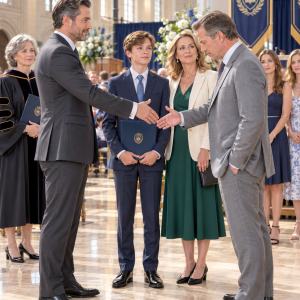
The Call That Changed Everything
The call came at 8:42 on a rainy Thursday evening, just as Graham Whitaker was signing the final page of a seven-hundred-million-dollar commercial redevelopment deal overlooking downtown Seattle.
His assistant glanced through the half-open office door.
“Mr. Whitaker, a restaurant manager insists it’s an emergency. He says he won’t speak to anyone else.”
Graham almost ignored it.
Almost.
He had built Whitaker Development over four decades by refusing to waste time on distractions.
Yet something in the young woman’s expression made him pick up the secure office phone.
“This is Graham.”
The man on the other end hesitated.
“Sir… my name is Eric Lawson. I manage The Alder Room. I think someone is trying to kill you.”
Silence.
Not shock.
Calculation.
Graham stood and walked toward the rain-covered windows.
“Explain.”
Eric swallowed hard.
“Our private dining room security cameras recorded something after your family left last night. I reviewed the footage because we were investigating missing wine inventory.”
Another pause.
“Your wife asked one of our bartenders if anyone would notice if a medication dissolved completely in bourbon.”
Graham’s fingers tightened around the receiver.
“And?”
“She wasn’t joking.”
An Ordinary Marriage That Suddenly Wasn’t
By every public measure, Graham Whitaker had won at life.
At sixty-eight, he was one of Washington State’s most respected developers.
His wife, Vivian, chaired museum galas and children’s charities.
Their only son, Owen, had recently joined the company’s executive board after earning his MBA.
His daughter-in-law, Claire, managed the Whitaker Family Foundation, distributing millions of dollars each year to community programs.
Magazines called them Seattle’s first family of philanthropy.
Investors admired them.
Politicians courted them.
Neighbors envied them.
Only Graham knew how lonely the top could become.
His marriage had grown polite instead of warm.
His son rarely visited without discussing business.
Claire always smiled, but somehow never looked him directly in the eyes.
Still…
Murder?
It sounded absurd.
Until Eric sent the video.
The Recording
The private dining room looked harmless.
Crystal glasses.
Mahogany walls.
A birthday cake waiting to be served.
The camera had no audio.
Only images.
Vivian looked toward the hallway before reaching into her designer handbag.
Claire slid Graham’s untouched bourbon closer.
Vivian opened a tiny amber prescription bottle.
A white tablet disappeared into the glass.
Seconds later, Claire stirred the drink with Graham’s own silver cocktail pick.
Both women smiled.
Not nervously.
Comfortably.
As though they had rehearsed it.
The recording ended before Graham returned from taking a phone call.
He watched it again.
Then again.
By the sixth viewing, his heartbeat had slowed.
Emotion never helped in a crisis.
Evidence did.
A Lawyer Who Asked the Right Question
Instead of confronting anyone, Graham drove to Mercer Island before sunrise.
Not to the police.
To Helen Brooks.
For thirty years, Helen had been his attorney.
More importantly, she had become one of the few people willing to tell him uncomfortable truths.
She watched the video twice.
Then pushed her glasses onto the desk.
“Do you still have the bourbon glass?”
“No.”
“Did you drink from it?”
“Half.”
“Have you felt unusual lately?”
He almost laughed.
Then stopped.
Fatigue.
Irregular heartbeat.
Blurred vision.
Nausea that came and went.
He had blamed stress.
Long hours.
Age.
Helen never smiled.
“I want you at a private medical clinic within the hour.”
The Test Results
Dr. Allison Greene specialized in occupational toxicology.
She listened without interrupting.
Blood.
Urine.
Hair samples.
Electrocardiograms.
Everything.
The first laboratory report arrived forty-eight hours later.
Dr. Greene closed the office door before speaking.
“Someone has been exposing you to small but repeated amounts of digoxin.”
The room became impossibly quiet.
“Could it be accidental?” Graham asked.
She shook her head.
“Not over several months.”
His stomach turned.
Months.
Someone hadn’t wanted him dead overnight.
Someone had wanted him weak.
Confused.
Easy to dismiss as an aging executive losing his edge.
Looking Back
Suddenly, forgotten moments returned with frightening clarity.
Vivian insisting on preparing his nightly tea herself.
Claire bringing homemade soups during board meetings.
Owen encouraging him to take early retirement.
The family doctor—recommended by Claire—explaining that fatigue was normal after sixty-five.
Even the dizziness during investor presentations.
Everything that had seemed disconnected now fit together with terrifying precision.
Someone had been building a story around his decline.
And he had believed it.
Following the Money
Helen hired forensic accountant Daniel Mercer.
Not through Whitaker Development.
Privately.
Quietly.
Daniel began with the family foundation.
Within a week, irregularities appeared.
Charitable grants routed through shell nonprofits.
Consulting contracts awarded to companies with no employees.
Administrative expenses that doubled in eighteen months.
Nothing obvious.
Nothing dramatic.
Small numbers.
Hidden inside enormous budgets.
Exactly the kind of fraud sophisticated people preferred.
Daniel looked up from the spreadsheets.
“This wasn’t done by amateurs.”
The Son Who Didn’t Know He Was Talking
A week later, Graham invited Owen fishing on Puget Sound.
They had not gone alone together in nearly ten years.
Cold wind swept across the water.
Neither man caught much.
Eventually Owen spoke first.
“Mom thinks you’ve been working too hard.”
Graham smiled faintly.
“Your mother worries.”
“She’s afraid you’ll never slow down.”
“And you?”
Owen stared toward the horizon.