Part 1 – The Envelope At The Lakeside Wedding
The envelope was heavy, cream-colored, and sealed with the navy crest my father used whenever he wanted cruelty to resemble tradition.
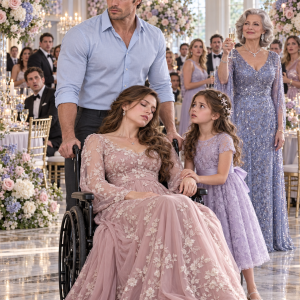
Henry Whitaker stood beside my table inside the glass ballroom of the Grand Mariner Hotel in Lake Geneva, Wisconsin, while nearly two hundred wedding guests watched through candlelight and reflected rain. My younger sister, Camille, remained several steps away in a pearl-beaded gown, one hand resting on the back of a chair and the other holding the smile she had practiced for photographs.
My father extended the envelope toward me.
“This is from the family, Laurel.”
The orchestra softened at exactly the right moment. Three cameras near the dance floor turned in my direction. Camille had arranged the humiliation carefully enough that nobody could later call it accidental.
I accepted the envelope, opened it, and read all four pages.
The letter formally removed me from Whitaker Harbor Group, denied me any authority to represent the family, terminated every discretionary trust payment, and declared that I would receive no future inheritance, property interest, or financial assistance connected to the Whitaker name.
My father had signed the final page. Camille and our uncle had signed as witnesses. The family attorney had notarized the document before dinner.
When I finished reading, I folded the pages, placed them inside my handbag, and smiled.
The smile unsettled them more than anger would have.
“What is amusing?” Henry asked.
“Nothing is amusing. I am grateful that you finally put everything in writing.”
Camille’s expression tightened.
“Please do not turn my wedding into one of your confrontations.”
“You placed cameras around my table and asked the orchestra to lower the music. This confrontation arrived before I did.”
A murmur moved through the ballroom. My father glanced toward the camera operators, and the first trace of fear entered his face.
“You should leave.”
“I intend to, but first I need confirmation that the recording includes sound.”
The lead videographer hesitated before nodding.
“The files upload automatically to our studio server.”
Henry moved toward him, but I raised one hand.
“Do not interfere with the recordings. They may become corporate evidence tomorrow morning.”
My new brother-in-law, Nolan Reeves, stepped beside Camille. He wore a perfectly cut tuxedo and the polished expression of a man whose charm had persuaded banks, investors, and my sister to trust him.
“Corporate evidence for what?”
“An emergency shareholder meeting concerning your debt acquisitions.”
His face changed for less than a second, although recognition moved through his eyes before discipline returned.
Camille looked from him to me.
“What debt acquisitions?”
The question confirmed that she knew nothing.
I opened my handbag and removed copies of loan assignments, beneficial-ownership filings, and wire records. For eight months, Nolan’s private fund had been purchasing Whitaker Harbor Group’s obligations through three concealed entities. If the company missed certain repayment targets, his firms could seize terminals, storage properties, and voting collateral.
My father had invited a creditor into the family and dressed him as a groom.
“Tomorrow the board will receive every document,” I said.
Nolan stepped closer.
“You will not leave this hotel with those papers.”
The nearest microphone captured every word.
“The originals are already with counsel.”
Camille struck me across the face. The sound carried across the ballroom.
“You came here to destroy me.”
I touched my cheek.
“No. You invited me because you wanted everyone to watch Father destroy me first.”
Henry seized my arm as I turned toward the exit.
“Withdraw your challenge,” he whispered, “and I will tell you where your mother is.”
My mother had supposedly died in a highway fire when I was thirteen.
The ballroom vanished around me.
“What did you say?”
His fingers tightened.
“Your mother is alive.”
Part 2 – The Clause My Grandmother Designed
I pulled free and demanded an explanation, but Henry’s face returned to its familiar stillness.
“Renounce the voting claim, and I will arrange contact.”
“You buried an empty casket.”
“This is not the place.”
“You made it the place.”
Camille approached, asking what he had said, but he dismissed her without looking away from me. That single gesture disturbed her more than the accusation about Nolan’s debt purchases.
I left the ballroom and found my attorney, Thomas Hale, waiting near a service corridor. He had spent six years preparing for the document now hidden inside my handbag.
My grandmother, Evelyn Whitaker, had founded the family shipping business with two lake freighters and a leased warehouse in Milwaukee. Before her death, she created a succession provision designed to prevent one heir from controlling another through financial dependence.
If a direct descendant was formally and publicly expelled from the family, that person would immediately gain control of a protected voting block held in reserve.
Thirty-one percent.
My grandmother had also transferred twenty-one percent to me through a dormant trust.
The letter my father delivered at Camille’s wedding activated both interests, giving me fifty-two percent of Whitaker Harbor Group.
Henry believed the reserve clause had expired. It had not.
“The recording establishes public expulsion,” Thomas said. “The signed letter establishes formal intent. We can notify the trustee tonight.”
“Father says my mother is alive.”
Thomas stopped walking.
His reaction was not surprise.
“You knew something.”
“Three months ago, an investigator found payments to a woman using your mother’s maiden name. They came from a trust connected to the protected voting block.”
“Where is she?”
“We have not confirmed the identity. The money moves through foreign custodians and private medical accounts.”
We entered the underground garage, where Margaret Sloan waited beside a dark sedan. Margaret had served as my grandmother’s executive assistant for more than thirty years and disappeared from public life after the funeral.
She opened the trunk and revealed a small teak box marked with Evelyn’s initials.
Six years earlier, my grandmother had given me a brass key and said,
“Use this only after someone officially decides you no longer belong.”
I opened the box.
It contained no stock certificates or legal opinions. Only a recent photograph showed my mother standing beside a lakeside café, older but unmistakably alive.
Nolan Reeves stood beside her.
A message on the back read:
Ask who actually financed the first ship.
Beneath the photograph lay a letter written in my mother’s hand.
My dearest Laurel,
If Henry has finally forced you out, do not trust the board, the family attorneys, or anyone claiming Whitaker Harbor Group belongs to the Whitakers.
The original ownership records remain where the first vessel came home.
Find them before Nolan does.
Do not believe I chose to leave you and Camille.
The first vessel had returned to Dock Seventeen in Milwaukee Harbor, a property my father believed had been sold years earlier.
Margaret shook her head.
“Your grandmother transferred it into a separate trust. The same trust that has been paying your mother’s expenses.”
A black SUV entered the garage at high speed and struck Thomas’s sedan. Two masked men emerged.
One reached for the teak box.
Margaret pulled me toward a service stairwell while Thomas remained behind, shouting for us to run.
At the lower landing, Nolan appeared with a handgun pressed against Thomas’s ribs.
“Bring me the box, Laurel.”
“Where is my mother?”
“Alive, for now.”
He promised to take me to her if I surrendered the key and withdrew my voting claim.
I almost stepped downward.
Then I remembered the warning written in my mother’s letter.
Nolan did not know where the records were.