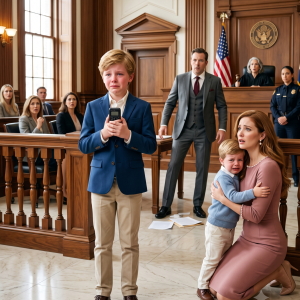
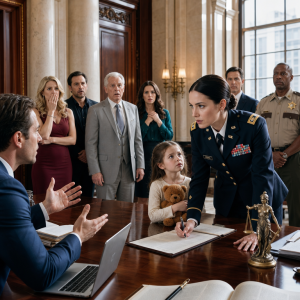
The Three Daughters They Tried to Hide
“You should be grateful I allowed you to stay here at all. Three daughters cannot carry on a family name.”
The words traveled across the elegant dining room, reaching every guest seated beneath the crystal chandelier.
I stood beside the long table holding a silver tray of coffee cups. Around me were nearly forty business owners, attorneys, physicians, and community leaders who had gathered for the annual fundraiser of the Bellamy Family Outreach Foundation.
The organization claimed to protect women facing hardship.
Yet no one moved when its chairwoman publicly humiliated me.
My name is Laurel Bennett. I was thirty-three years old, and for nearly six years, I had lived inside the Bellamy estate outside Nashville, Tennessee, as though I were an unwanted employee rather than the widowed mother of three Bellamy grandchildren.
My daughters were nine-year-old Maisie, seven-year-old Taryn, and five-year-old Hope.
Their grandmother, Lenora Bellamy, rarely called them by their names.
She called them “the three disappointments.”
My late husband, Everett, had been her only son. When he passed away in a highway accident, Lenora told me that he had left behind enormous financial obligations. She claimed our townhouse, his insurance policy, our savings, and even several pieces of jewelry my grandmother had given me.
According to Lenora, allowing my daughters and me to remain under her roof was an act of extraordinary generosity.
In reality, we slept in a converted storage room beside the laundry area.
I prepared meals, cleaned two floors, arranged events, answered household calls, and worked without pay. My daughters were expected to remain quiet whenever guests visited.
That morning, I had been awake since four thirty. I prepared breakfast for the staff, polished the serving pieces, arranged flowers, and placed brochures on every seat.
The brochures promised dignity, safety, and new beginnings for vulnerable women.
Each time I read those words, I felt something tighten inside my chest.
The Man at the End of the Table

At the far end of the dining room sat Grant Holloway.
He was the founder of a respected network of rehabilitation clinics and the largest financial supporter of the Bellamy Foundation. Business magazines described him as focused, private, and nearly impossible to impress.
He had never married.
According to local gossip, he had stopped allowing people close to him after losing his mother when he was a child.
Grant had said very little throughout the luncheon. He listened, reviewed the reports placed before him, and occasionally wrote notes in a leather-bound notebook.
Then Lenora accused me of serving the wrong coffee.
I quietly explained that I had followed the menu she approved the previous evening.
Her expression hardened.
“Do not correct me in front of my guests.”
“I was only explaining what happened.”
“You always have an excuse. That is why Everett spent his life fixing your mistakes.”
The tray trembled in my hands.
For years, I had learned to remain silent because every response brought another punishment, another night without dinner, or another warning that she could take my daughters away.
But something inside me had finally become too tired to hide.
“Everett never treated me this way.”
Lenora stepped closer and raised her hand.
Before she could touch me, Grant stood.
His chair moved sharply against the floor, and every conversation in the room ended.
“That is enough.”
Lenora stared at him.
“This is a family matter.”
Grant slowly removed his jacket.
“No. This is a matter of how one person is being treated while an entire room pretends not to notice.”
He placed the jacket around my shoulders, then looked toward the staircase.
“Where are her children?”
Lenora’s face changed.
“They are resting.”
“They have been locked in the upstairs sewing room since breakfast,” I said.
For the first time in years, I heard my own voice clearly.
Grant turned toward me.
“Bring them downstairs.”
Lenora ordered the household security staff to remove me for causing a scene.
Grant did not raise his voice.
“My company’s support for this foundation ends today.”
The room filled with shocked whispers.
“You cannot destroy years of work over a resentful housekeeper,” Lenora said.
Grant looked directly at her.
“She is not your housekeeper. She is your son’s widow, and those girls are your grandchildren.”
Then he faced me.
“You and your daughters are leaving with me.”
A House Without Locked Doors

We found my girls sitting together on the floor of the sewing room.
Maisie had her arms wrapped around Hope while Taryn stared toward the door, trying to appear brave.
When Hope saw me wearing Grant’s jacket, she ran forward.
“Mom, are we in trouble again?”
I knelt beside her.
“No, sweetheart. We are leaving.”
“For how long?”
I looked at Grant.
He crouched several feet away so he would not frighten them.
“For as long as your mother decides.”
Outside, rain covered the stone driveway. Grant held an umbrella over the girls while I carried the small bag containing the only clothes Lenora allowed us to keep.
Grant’s home was a quiet brick house in Franklin, not the enormous mansion I had expected.
There were no locked interior doors.
No one told the girls to whisper.
A housekeeper named Mrs. Dorsey prepared warm soup and showed each child a bedroom. Hope stood in the center of hers, staring at the bed.
“Is this really for me?”
“Yes,” Grant answered.
“Can I sleep under the blanket?”
He looked confused until he realized what she meant.
At Lenora’s estate, the girls were rarely allowed to use the guest bedding because she claimed children ruined expensive fabric.
Grant knelt beside the bed and pulled back the quilt.
“This blanket belongs to you while you are here. You may sleep under it, on it, or build a tent with it.”
Hope smiled for the first time that day.
I believed we were finally safe.
I was wrong.
The Accusation

At seven the next morning, two official vehicles and several reporters appeared outside Grant’s home.
Lenora had accused me of taking nearly two hundred thousand dollars from the foundation.
She also requested emergency guardianship of my daughters, claiming I had no income, no permanent address, and no ability to provide for them.
The news spread quickly.
A photograph of me leaving the estate in Grant’s jacket appeared online beside headlines calling me an opportunist.
Commenters claimed I had manipulated a wealthy man.
Others said Lenora had rescued me after Everett’s death and that I had repaid her kindness by taking her grandchildren.
Maisie found one of the reports on a tablet.
“Are they going to make us go back?”
I sat beside her and held her hands.
“I will do everything I can to keep us together.”
She lowered her voice.
“Grandmother always said nobody would believe us.”
Grant’s attorneys arrived within the hour. They requested that every interview be documented and arranged an independent family evaluation.
The girls spoke to a child advocate.
A physician examined the old injuries and signs of long-term neglect.
Mrs. Dorsey carefully recorded everything the girls said about sleeping beside the laundry room and hiding food because they never knew when Lenora would refuse them dinner.
That afternoon, a former Bellamy employee appeared at Grant’s gate.
Her name was Pauline Mercer.
She had worked at the estate for nineteen years before Lenora dismissed her.