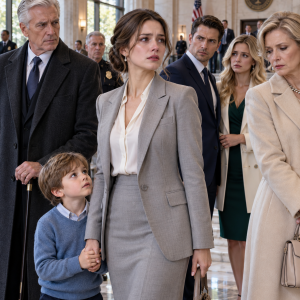
The Smile Across the Courtroom
Eleven minutes into my divorce hearing, my husband leaned back in his chair and smiled at me as though my entire life had already become his property.
It was not the nervous smile of a man facing the end of his marriage. It was calm, polished, and full of certainty. Blake Donnelly had spent fifteen years building a respected career as a corporate attorney, and he knew exactly how to control a room.
That morning, inside the Mecklenburg County Courthouse in Charlotte, North Carolina, he believed he had controlled everything.
His attorney stood and presented a thick folder to Judge Rebecca Sloan.
“Your Honor, these documents demonstrate that Mrs. Donnelly has struggled to make responsible financial decisions for several years,” the attorney said. “They also confirm that she voluntarily gave my client authority over her business and personal estate.”
My hands remained folded on the table.
The business they were discussing was Northstar Advisory Group, the company I had started from a rented office with two secondhand desks and an unreliable coffee machine. After eleven years of long nights, missed holidays, and difficult decisions, it had grown into a company valued at nearly thirteen million dollars.
Blake wanted half of it.
He also wanted access to the family trust my father had created long before Blake and I met.
But the most painful part was not sitting across from the man who had promised to protect me.
It was seeing the three people seated directly behind him.
My mother, Judith Keene.
My younger sister, Taryn.
And Taryn’s husband, Russell Dane.
They were not there to support me.
They were Blake’s witnesses.
My mother wore a pale gray suit and held her handbag neatly in her lap. Taryn looked almost cheerful. Russell kept checking his watch as if he expected to celebrate before lunch.
For nearly a year, they had eaten at my table, accepted my gifts, and smiled while asking about my company.
All that time, they had been helping Blake build a story designed to take everything from me.
The Document I Was Never Meant to Question

Blake’s attorney opened the folder and removed a signed agreement.
“This document gives Mr. Donnelly broad authority over his wife’s financial interests,” he explained. “It also includes an amendment to their prenuptial agreement.”
Judge Sloan examined the pages.
I recognized the signature immediately.
It looked like mine because it was mine.
Three years earlier, my father had passed away unexpectedly. In the days that followed, I barely slept. I moved through the house as though I were walking underwater, surrounded by flowers, phone calls, and paperwork I could not understand.
Two days after the memorial service, Blake placed several documents in front of me.
“These are routine tax forms connected to your father’s estate,” he had said gently. “You don’t need to worry about the details. I’ve reviewed everything.”
I trusted him.
I signed where he pointed.
Now those pages had returned as evidence that I had willingly handed him control over my company and inheritance.
Blake glanced at me from across the courtroom.
His smile widened.
He expected me to protest. He wanted me to become emotional so he could use my reaction as proof that his claims were true.
Instead, I turned toward my attorney, Gideon Price.
Gideon was in his early sixties, with silver hair, thoughtful eyes, and a voice that never needed to become loud.
He leaned closer.
“Let them speak,” he whispered. “They still believe they are winning.”
I gave him a small nod.
They did not know that the worn leather case beside my chair contained enough evidence to change the direction of the entire hearing.
The First Number That Did Not Belong

Three months earlier, I had not suspected a complicated conspiracy.
I had simply noticed a number.
Every Friday morning, I reviewed Northstar’s major transactions. Most of the work was handled by our finance team, but my father had taught me never to place complete responsibility for my future in someone else’s hands.
That morning, a payment of $184,000 caught my attention.
The money had been sent to an organization called Bright Harbor Outreach.
My mother had introduced me to the organization at a charity dinner. She described it as a nonprofit that supported families starting small businesses.
I remembered approving a modest donation.
I did not remember approving $184,000.
When I asked our financial director about it, she showed me an authorization carrying Blake’s digital approval.
The organization’s official address was a mailbox service in Wilmington, Delaware.
No public reports existed.
No staff members were listed.
No real programs could be found.
That evening, I asked Blake about the transfer.
He barely looked up from his phone.
“It was part of the asset-protection plan we discussed,” he said.
“I don’t remember discussing Bright Harbor.”
He sighed as though I were a child interrupting an important meeting.
“Marissa, this is why you asked me to help. You understand operations. I understand legal structures.”
His answer did not calm me.
It made me look closer.
Four Hours in the Dark

That night, Blake fell asleep shortly after midnight.
I waited until his breathing became slow and steady before leaving the bedroom.
His office was at the end of the upstairs hallway. I had rarely entered it without knocking because he always claimed his client files were confidential.
The door was unlocked.
I sat behind his desk and opened his laptop.
Blake had changed his password, but he had always been predictable when it came to important dates. I entered the date he had become a partner at his law firm.
The screen opened.
For the next four hours, I followed transfers through a network of companies that appeared legitimate until I examined them closely.
Bright Harbor Outreach had no employees.
Linden Ridge Management had no office.
Clearwater Consulting had never completed a real consulting project.
Money from my company and my father’s trust moved through those organizations before reaching private accounts.
Blake was listed as the primary beneficiary of one account.
Russell was listed on another.
A third account was linked to a property management company controlled by my mother.
My fingers became cold against the keyboard.
The people who had spent years telling me that family should always come first had quietly created a system to take money from me.
I photographed every account number, transfer record, email, and authorization.
Then I returned everything exactly as I had found it.
When I climbed back into bed, Blake rolled toward me.
“Couldn’t sleep?” he murmured.
I stared into the darkness.
“Just thinking about work.”
He reached for my hand as though he were still my loving husband.
“You think too much.”
That was the moment I understood his greatest mistake.
Blake believed my silence meant weakness.
Building a Case Without Making a Sound

The following morning, I contacted Gideon Price.
I chose him because he had once represented a business owner in a complicated financial dispute involving forged agreements and hidden companies.
After reviewing the photographs, he brought in a forensic accountant named Camille Ford.