The Laugh I Will Never Forget
The moment my son laughed inside that courtroom, I understood something painful: he had become so certain of my weakness that he had forgotten who raised him.
I was seventy-one years old, recently widowed, and standing alone beside the respondent’s table in a courthouse in Richmond, Virginia. My silver hair was pinned neatly behind my head, and I wore the same navy wool coat I had owned for almost twelve years.
My son, Everett Langley, sat beside his wife, Paige.
As I walked past them, Everett leaned toward her and said loudly enough for several people to hear:
“Look at her. By lunchtime, she won’t have anything left to control.”
Paige tried to hide her smile behind her hand.
I kept walking.
They believed I had come without an attorney because I was confused.
They believed the cane in my right hand meant I was helpless.
Most importantly, they believed I had no idea what they had been doing with my money.
They were wrong about all three.
The Widow They Thought They Knew
My name is Judith Langley.
My husband, Russell, and I had been married for forty-three years before I lost him.
We had built our home outside Richmond when Everett was still a child. It was a two-story brick house with white columns, a wide back porch, and an old maple tree Russell refused to cut down because Everett had once built a treehouse in it.
After Russell was gone, the house became painfully quiet.
For the first few months, Everett visited often.
He brought groceries. Paige helped organize paperwork. They called every evening.
At first, I was grateful.
Then Everett began asking questions.
How much remained in my retirement accounts?
Was the house completely paid off?
Had Russell left a trust?
Who was listed as beneficiary?
I noticed the pattern, but I said nothing.
Numbers had taught me something long ago: when something does not make sense, never interrupt too early.
Watch.
Record.
Wait.
The First Missing Money

One Tuesday morning, I reviewed my bank statement and found three transfers from an emergency account Russell and I had rarely touched.
Together, they totaled $38,600.
The destination was an account I did not recognize.
I called Everett.
“Did you move money from my emergency account?”
There was a pause.
Then he laughed.
“Mom, Paige and I are just helping you organize things.”
“Helping me does not require transferring my money.”
His voice changed.
“You’ve been forgetting things lately.”
That sentence stayed with me.
Not because I believed it.
Because I understood why he had said it.
A week later, I found something worse.
A loan application had been submitted using my financial information. The signature at the bottom looked almost like mine.
Almost.
Everett had watched me sign birthday cards, school forms, checks, and family documents his entire life.
He had learned the shape.
But he had never learned the rhythm.
I knew immediately that I had not signed it.
I printed everything.
Then I began keeping records.
When My Own House Stopped Feeling Like Mine
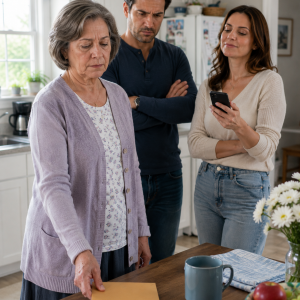
Paige’s brother, Nolan, arrived one afternoon with a pickup truck.
He began unloading boxes into my guesthouse.
I walked outside.
“What is happening?”
Paige smiled as if the answer should have been obvious.
“Nolan needs somewhere temporary. You have all this space.”
“No one asked me.”
Her smile disappeared.
Everett came around the truck.
“Mom, it’s family. Why are you making everything difficult?”
That phrase again.
Difficult.
Forgetful.
Emotional.
Confused.
The words were slowly building a picture of me that had nothing to do with reality.
I told Nolan he could not move in.
Two days later, Everett returned with paperwork and told me I needed to give him financial power of attorney.
I refused.
That was when his concern disappeared.
“You’re not thinking clearly anymore.”
I looked at the man I had once taught to ride a bicycle and asked quietly:
“Is that what you truly believe?”
He did not answer.
Three weeks later, I came home from a dental appointment and my key no longer opened my front door.
They had changed the locks.
One Night Away From Home
I stood on my own porch for nearly ten minutes.
My clothes were inside.
Russell’s photographs were inside.
The cedar box containing forty-three years of letters was inside.
Everything that made the house mine was on the other side of a door my son had decided I was no longer allowed to open.
I did not make a scene.
I checked into a small hotel.
That evening, Everett posted a family photograph online from my living room.
He and Paige were sitting beneath our wedding portrait.
At 11:48 p.m., my phone vibrated.
A message from Everett appeared.
“Stop making this harder than it needs to be.”
I stared at those words for a long time.
Then I opened my laptop.
For the first time since Russell passed away, I felt something stronger than grief.
Purpose.
The Petition
Three days later, I was served with papers.