Part 1 — The Seat Behind the Last Pillar
By the time my younger sister asked me to move my wheelchair behind the final stone pillar of St. Catherine’s Church in Richmond, Virginia, I had already spent nearly an hour trying to make myself as visually unobtrusive as possible.
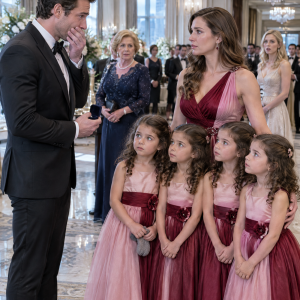
I was thirty-one years old, dressed in a soft navy gown with ivory gloves covering the worst scarring across my hands, while my wheelchair had been positioned carefully near the second row so nobody needed to squeeze past me. My sister, Olivia Bennett, was twenty-two and less than twenty minutes away from marrying Andrew Collins.
She had invited me personally three months earlier.
She had called twice to make sure I would attend.
That morning, however, she looked at my chair, my scarred hands, and the photographers gathering near the aisle before lowering her voice.
“Mara, could you move farther back before everyone comes in?”
At first, I assumed she meant there was an accessibility problem.
“Is my chair blocking something?”
Olivia glanced toward the photographer.
“Not exactly. I just need the front rows to look balanced in the pictures.”
My stomach tightened.
“Balanced how?”
She exhaled as though I were forcing her to explain something obvious.
“Please don’t make this difficult. Everything has been planned around a very specific look, and your chair is right beside the aisle.”
There were moments when cruelty announced itself loudly enough to fight.
This was not one of them.
Olivia spoke softly, politely, and with the strained smile of a bride asking someone to move a flower arrangement.
I looked toward our parents.
My mother, Susan, stared down at the wedding program.
My father, Robert, suddenly became fascinated by the stained-glass windows.
Neither defended me.
I placed both hands on my wheels.
“Where do you want me?”
Olivia pointed toward the rear corner.
“Behind that pillar would be best. You’ll still hear everything.”
I almost admired the efficiency of the sentence.
She was not asking me to leave.
She merely wanted me present somewhere photographs would not prove it.
I turned my chair.
Before I reached the back, Andrew’s mother stood from the first pew.
Her name was Eleanor Collins, and I had met her only four times.
“Why is Mara being moved behind the pillar?”
Olivia froze.
I wished Eleanor had remained silent.
Not because she was wrong, but because I had spent twelve years learning how to survive humiliation by shortening it.
Olivia forced a smile.
“It’s just a seating adjustment.”
Eleanor looked at me and then at the empty space I had left near the front.
“It looked perfectly accessible before.”
Then she turned toward her future daughter-in-law.
“Especially considering she once carried you out of a burning house.”
The church became very quiet.
Andrew slowly turned toward Olivia.
And that was the moment my sister’s wedding stopped being about where I was sitting.
Part 2 — The Story Andrew Had Never Heard
Andrew did not look angry at first.
He looked confused.
“What does my mother mean?”
Olivia tightened both hands around her bouquet.
“Andrew, this is not the time.”
His gaze shifted toward me.
“Did Mara save you from a fire?”
I stopped beside the pillar.
For years, I had assumed he knew.
Andrew knew I used a wheelchair. He knew the scarring across my arms and neck came from burns, but apparently Olivia had never explained the circumstances.
Our father finally spoke.
“There was a house fire when Olivia was ten.”
Olivia snapped toward him.
“Dad, please.”
Robert ignored her for once.
“Mara was nineteen.”
I remembered that night more through fragments than sequence.
Smoke gathering across the downstairs ceiling.
My mother screaming Olivia’s name from the yard.
The staircase burning along one side before firefighters had arrived.
Olivia trapped upstairs because part of the hallway had collapsed.
I remembered going back inside despite my father grabbing for my shirt.
I remembered finding Olivia beneath a fallen curtain beside her bedroom door.
Most clearly, I remembered wrapping my body over hers when burning debris came down near the stairs.
I woke three days later.
Olivia had minor smoke inhalation and burns that eventually healed almost completely.
My injuries were different.
Multiple surgeries followed.
Then skin grafts.
Then infection.
Then physical therapy that stretched across years rather than months.
Damage to my lower spine and legs eventually left me relying on a wheelchair for most mobility.
Andrew looked between us.
“You went into the house for her?”
I nodded.
“She was trapped.”
His face lost color.
“And Olivia never told me?”
I answered carefully.
“She wasn’t obligated to make it part of your relationship.”
That mattered.
I had never wanted Olivia to spend her life paying an emotional debt because I went into that house.
She had been ten years old.
I had been her older sister.
There had been no heroic calculation.
She was screaming, and I went toward her.
The debt existed only in other people’s imaginations.
What hurt was something else entirely.
I looked at Olivia.
“But she did tell me ten minutes ago that my wheelchair would damage the look of her photographs.”
Olivia’s cheeks reddened.
“That is not what I said.”
My father answered before I could.
“It was close enough.”
For the first time that morning, nobody softened the truth for her.
Part 3 — The Family Habit Nobody Had Named

My mother finally stood.
“Everyone is under tremendous pressure today, and perhaps we should all calm down before saying something permanent.”
I almost laughed.
That sentence had shaped our family for most of Olivia’s life.
Olivia was overwhelmed.
Olivia was younger.
Olivia had been through trauma.
Olivia did not mean things the way they sounded.
When she screamed at sixteen because my wheelchair made a restaurant table arrangement inconvenient, my mother reminded me that adolescence was difficult.
When Olivia refused to accompany us to one of my reconstructive surgeries because hospitals made her anxious, everyone protected her from feeling guilty.
When she complained at nineteen that relatives always asked about “the fire story” whenever we appeared together, I stopped discussing my medical history around extended family.
I believed accommodation was kindness.
Eventually, accommodation became infrastructure.
Andrew looked at Susan.
“Pressure made her ashamed of her sister?”
My mother immediately shook her head.
“Of course not.”
“Then why did neither of you stop her?”
Neither parent answered.
Olivia’s composure finally cracked.
“Because none of you understand what it is like being connected to that story forever.”
The words landed harder than anything she had said about the photographs.
I turned my chair back toward her.
“What does that mean?”
She looked at me, then at the guests pretending not to listen.
“Every family gathering eventually becomes about the fire. People look at you like you’re some saint and look at me like I’m the helpless little girl who needed rescuing.”
Her voice began shaking.
“I wanted one day where nobody looked at me through what happened when I was ten.”
For one moment, I understood.
Trauma does not distribute itself fairly simply because one person carries more visible damage.
Olivia had been a child trapped inside a burning house.
She had grown up hearing strangers describe the worst night of her life as evidence of my courage.
That could create resentment.
It could create shame.
It could even create a desperate need to become someone unconnected to that frightened child.
I might have sympathized completely if she had stopped there.
Instead, she looked toward my chair.
“I just wanted everything today to look beautiful and normal.”
Something inside me became very still.
“And I make it look abnormal?”