The Red Velvet Box

The Candle at Christmas
“I brought something special for my actual grandchildren. And for Lily—well, I didn’t want her to feel completely forgotten.”
Margaret Whitmore spoke with the gentle, polished voice she used whenever she wanted to say something cruel without appearing cruel herself. She did not raise her voice, and she did not look directly at me when she said it. Instead, she smiled toward the relatives seated around her long dining table as though she had merely made an innocent observation everyone else was too sensitive to understand.
My seven-year-old daughter sat beside me in a pale green dress, her small hands folded in her lap. Nathan, my husband, had ironed that dress twice before we left our home in Raleigh because Lily had told him she wanted to look especially pretty for Christmas. He had even driven back around the block after we left because she had forgotten the two pearl clips she planned to wear in her dark blond hair.
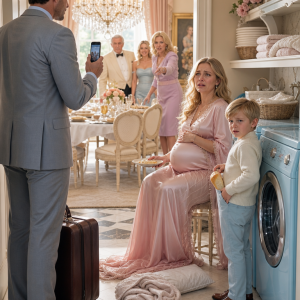
Now, in Margaret’s beautifully decorated home outside Asheville, Lily watched the other children open their gifts.
Margaret’s oldest grandson received a new tablet. His younger sister received one as well. Two teenage cousins opened envelopes containing several hundred dollars, while another child unwrapped a set of expensive wireless headphones.
The room was filled with the bright, restless sounds of children comparing gifts, adults taking photographs, and wrapping paper being pushed beneath chairs.
Then Margaret reached for a wrinkled paper bag beside her feet and handed it to Lily.
“Here you are, sweetheart.”
Lily accepted it with both hands.
“Thank you, Grandma.”
She was not a child who measured affection by price. At home, she could spend an entire afternoon turning a cardboard box into a castle, and one of her favorite possessions was a smooth blue stone Nathan had found beside a hiking trail. If Margaret had given every child a simple gift chosen with equal care, Lily would have been perfectly happy.
She pulled aside the tissue paper and found a small vanilla candle inside.
For one hopeful second, she smiled.
Then I noticed the tag tied around the glass jar with a thin piece of twine.
In Margaret’s neat handwriting were the words:
For Nathan’s wife’s daughter.
The conversation around the table gradually faded. Nathan’s brother lowered his coffee cup. One of the cousins stopped taking pictures. Across from me, Nathan’s younger sister, Rebecca, stared at the label and then quickly looked toward the window.
Lily read the words silently. I watched her lips move as she worked through the longer ones.
My first instinct was to tear off the tag before its meaning settled inside her, but it was already too late. She looked at the other children and then back at the candle, trying to understand why everyone else had been identified by name while she had been described as someone attached to the family only through me.
Margaret gave a small laugh.
“Please don’t make those faces. It’s only a label.”
I turned toward Nathan, waiting for him to respond. His coffee cup was bent beneath his fingers, and several drops had spilled onto the sleeve of his white shirt.
He did not confront his mother immediately. Instead, he leaned toward me and spoke so quietly that only I could hear.
“If she does something like this again, there’s a red velvet box in Lily’s suitcase.”
I frowned. “What box?”
“It’s in the inside pocket.”
“What’s in it?”
Nathan looked past me at his mother.
“Something I prepared four months ago.”
A cold uneasiness moved through me.
“Did you expect this to happen?”
“I hoped it wouldn’t. But hoping hasn’t protected Lily before.”
His answer stayed with me throughout the afternoon.
I had known for years that Margaret did not regard Lily as a grandchild, but until that Christmas, I had kept persuading myself that patience might soften her. I wanted to believe that if Lily remained sweet, respectful, and affectionate, Margaret would eventually recognize what Nathan already knew—that a child did not need to share a person’s ancestry to become part of that person’s life.
Nathan had met us when Lily was three. At the time, I was working as a pediatric dental hygienist and living in a small apartment outside Durham. My first marriage had ended quietly but painfully, and Lily’s biological father had chosen to relinquish his parental rights after deciding he did not want the responsibilities of parenthood.
Nathan entered our lives without making promises he could not keep. He never announced that he intended to become a father to Lily. He simply began doing the work.
He learned how she liked the crust removed from her sandwiches. He kept extra hair ties in the glove compartment of his truck. He attended school programs, helped build a solar-system model, and once spent an entire Saturday searching three stores for the exact stuffed rabbit she had accidentally left behind during a family trip.
When she woke from a bad dream, she called for him as often as she called for me.
To Lily, Nathan was not the man her mother had married.
He was Dad.
Margaret, however, seemed to view his devotion as a challenge to the natural order of her family. She never openly demanded that Nathan reject Lily. Her methods were quieter.
At Lily’s fifth birthday party, Margaret brought small presents for every cousin who attended but gave Lily a blank notebook, explaining that she did not know what children she “wasn’t close to” enjoyed.
During a summer picnic, she asked for a photograph of her grandchildren. When Nathan guided Lily into the group, Margaret smiled and said, “Let’s take one with the grandchildren first, and then we can include everyone else.”
The following Christmas, she ordered pajamas embroidered with every child’s name. Lily’s pair never arrived.
Margaret blamed the store.
Every incident came wrapped in a reasonable explanation, and because none of them seemed serious when considered alone, I kept telling myself that confronting her would create more pain than remaining quiet.
That was how I failed my daughter.
I had confused comforting Lily afterward with protecting her beforehand.
The Question in the Guest Room
That evening, after dinner and several strained hours of forced holiday cheer, I found Lily sitting on the edge of the guest-room bed. The vanilla candle rested on her knees, and the handwritten tag was still tied to the jar.
She ran one finger over the words.
“Mom?”
I sat beside her. “What is it, honey?”
She looked up at me, and the uncertainty in her face made every excuse I had ever accepted from Margaret seem shameful.
“Am I ever going to be real family here?”
My throat tightened. I wanted to tell her that Margaret did not matter, but children know when adults are avoiding the truth. Margaret did matter because we had continued bringing Lily into her home, sitting her at her table, and asking her to endure small humiliations for the sake of family peace.
Before I could answer, Nathan appeared in the doorway.
He had changed out of his stained shirt and rolled the sleeves of a gray sweater to his elbows. For a moment, he remained still, absorbing the sight of Lily holding the candle. Then he crossed the room and knelt in front of her.
“Look at me, kiddo.”
Lily raised her eyes.
“You are my daughter because I choose to be your father every single day. I choose it when I pack your lunch, when I sit through your school concerts, when you’re cheerful, and when you’re tired and grumpy. Nobody else gets to undo that choice.”
“But Grandma doesn’t think I belong.”
Nathan breathed slowly before answering.
“Grandma is wrong.”
He went to the closet, opened his suitcase, and removed a small red velvet box. It was no larger than the palm of his hand, with a brass clasp on the front.
He placed it in Lily’s hands.
“I want you to keep this in your bag tomorrow. If my mother makes you feel unwelcome again, you may give it to her.”
Lily examined the box but did not open it.
“What’s inside?”
“Something she’ll understand.”
“Will she get mad at me?”
“She may become angry, but none of that anger will belong to you.”
Lily’s fingers tightened around the box.
“Will you still be my dad if everybody gets mad?”
Nathan looked down for a second, gathering himself.
“I will be your dad even if every person in this house disagrees with me.”
“Promise?”
“I promise.”
After Lily fell asleep, I followed Nathan into the hallway and closed the door behind us.
“You need to tell me what’s in that box.”
He studied my face, and I could see that whatever he had planned had not been done impulsively.
“There’s a key and a letter.”
“A key to what?”
“This house.”
I stared at him.
For years, Margaret had told relatives that the stone house had been the final gift her husband arranged for her before he passed away. Nathan had never contradicted her in public, and I had assumed the story was true.
It was not.
Four years earlier, Margaret had placed most of her savings into a business investment recommended by a family friend. When the investment failed, she faced the possibility of selling both her home and the furniture store that had supported the Whitmore family for decades.
Nathan, who had recently sold his interest in an engineering consultancy, quietly purchased the property. He allowed Margaret to remain there under a formal occupancy agreement, paid the property taxes and insurance, and covered every major repair.
The house legally belonged to him.
“Why didn’t you tell me?” I asked.
“Because helping my mother wasn’t something I wanted to advertise. And because she was embarrassed. I let her tell people whatever made her comfortable.”
“What does the letter say?”
“It says that if Lily gives her the box, our visits end and my attorney will begin terminating the occupancy agreement.”
I stepped back.
“Nathan, that is enormous.”
“So is allowing a child to grow up believing she deserves less.”
“People will say you’re taking away your mother’s home over a Christmas gift.”
“Then they can say it. This isn’t about a candle.”
He lowered his voice and glanced toward Lily’s door.
“Four months ago, Mom excluded her from another family photograph and said Lily had no rightful place beside the other children. That night, Lily asked me whether she should stop calling me Dad when Grandma was around. I contacted an attorney the next morning.”
Only then did I understand that the red box was not a threat created for Christmas. It was the final step in a decision Nathan had been carrying alone for months.
The Card Marked Guest

Margaret’s traditional holiday brunch began at ten the next morning.
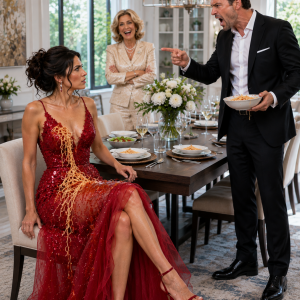
She had covered the dining table with white linen and arranged winter greenery around silver candlesticks. Every plate had a handwritten place card above it, and the entire room smelled of cinnamon, coffee, and baked apples.
The cards displayed the names of every relative.
Nathan.
Caroline.
Rebecca.