Part 1 — Twenty-Two Days After the Crash
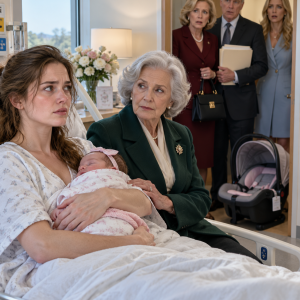
Twenty-two days after a highway collision shattered both of my legs and fractured three ribs, my husband entered my hospital room carrying no flowers, no clean clothes, and no expression of relief that I had survived.
Instead, Eric Lawson closed the door behind him and stared at the casts extending from my thighs to my ankles as though they were evidence of some expensive mistake I had deliberately made.
Outside my window, a pale December morning covered Columbus, Ohio, in low gray clouds, while nurses moved quietly between rooms at Riverside Medical Center. Inside, the cardiac monitor beside my bed continued its steady rhythm, and a plastic water cup trembled slightly when Eric dropped his car keys onto the bedside table.
“How much longer are you planning to stay here, Natalie?”
The question sounded almost reasonable until I looked at his face.
I had been married to Eric for eleven years, which meant I knew the particular tension around his mouth whenever anger was already present and merely waiting for an excuse.
“The orthopedic team said at least another week before they can transfer me to rehabilitation.”
Eric rubbed both hands over his face.
“Another week here, followed by rehabilitation, physical therapy, equipment at home, and probably some nurse coming into the house every day. Do you understand what all of that costs?”
I stared at him, momentarily unable to answer.
Three weeks earlier, I had been driving home after buying groceries when another vehicle crossed the center line during freezing rain. I remembered the violent rotation of the car, the windshield breaking, and a paramedic asking repeatedly whether I knew my own name.
I remembered asking about my nine-year-old daughter, Lily.
I remembered being told she was safe at school.
Then came surgery, metal hardware, broken ribs, bruising, stitches hidden beneath my hairline, and doctors explaining that walking normally again would require patience measured in months rather than days.
Eric seemed to remember only the invoices.
“I nearly died.”
He shrugged.
“You didn’t die, Natalie, so at some point everybody has to stop treating you like you did.”
The sentence settled between us with startling clarity.
For years, I had excused Eric’s coldness as stress, ambition, exhaustion, or the unfortunate personality of a man who believed practicality was more useful than tenderness.
That morning, none of those explanations worked anymore.
Part 2 — The Life I Had Organized Around Him
Before Lily was born, I worked as an accountant for a regional manufacturing company in downtown Columbus. I liked the precision of the work, the independence of earning my own money, and the strange satisfaction of finding an error that had survived several layers of review.
When I became pregnant, Eric began suggesting that one of us should stay home.
By the time Lily arrived, his suggestion had become an expectation.
“Childcare will consume half your salary anyway, and I’m earning enough for both of us.”
At first, staying home seemed temporary.
I imagined returning when Lily started preschool, then when she entered kindergarten, then when she became more independent. Each time I raised the possibility, Eric found another reason why returning to accounting would be inconvenient.
He reminded me that school ended before the workday did, that Lily needed stability, and that companies would probably consider my résumé outdated after such a long absence.
Meanwhile, everything invisible in our household became my responsibility.
I paid utility bills, tracked insurance renewals, scheduled dental appointments, prepared taxes, organized school paperwork, kept grocery spending within the budget Eric demanded, and remembered every birthday that he later received credit for acknowledging.
When Lily had pneumonia at six, I slept beside her for four nights.
Eric slept downstairs because he had meetings.
When his mother needed help organizing medical bills, I spent an entire weekend creating spreadsheets for her.
Eric thanked me by saying I had finally found a productive use for my old accounting skills.
Over time, his salary became “his money,” while the hundreds of unpaid tasks that allowed him to work late and travel whenever necessary somehow became evidence that I contributed nothing financially.
The crash exposed how fragile that arrangement had always been.
For the first time in eleven years, I could not cook dinner, clean the house, drive Lily to school, organize his schedule, or make his life easier.
Within three weeks, Eric had stopped seeing me as his wife.
He saw a bill.
Part 3 — The Word He Used

Eric walked to the foot of the bed and lifted the discharge folder lying beside my medication chart.
“The hospital financial office called yesterday, and the estimate has already changed twice.”
“Insurance is covering most of it.”
“Most is not all.”
He tossed the folder onto the blanket.
“I cannot keep paying for a wife who contributes nothing and now needs everybody else to do everything for her.”
The monitor beside me continued beeping.
I remembered every lunch I packed, every tax form I organized, every evening I rearranged because his meetings mattered more than mine, and every conversation in which he promised that staying home with Lily was something we were choosing together.
“I gave up my career because you wanted me home with our daughter.”
Eric leaned forward.
“You keep saying that like somebody held a gun to your head. You stayed home because it suited you.”
A strange calm moved through me.
“You told me our family needed me there.”
“Our family needed you to be useful.”
He paused before delivering the sentence that ended something inside me.
“Right now, you are nothing except a burden.”
I looked toward Lily’s drawing taped to the wall.
She had drawn three people holding hands beneath an enormous yellow sun, with our dog appearing almost as large as the house. Above the crooked roof she had written, MOM PLEASE COME HOME SOON.
For days, I had imagined returning to that house.
Suddenly, I understood that going home might be the most dangerous thing I could do.
Part 4 — When I Said No
Eric moved toward the side of the bed and pulled the blanket away from my legs.
Both casts were fully visible, along with the support wedges keeping them aligned.
“What are you doing?”
“Getting you out of here.”
I thought I had misunderstood him.
Then he gripped my upper arm.
“Eric, the doctors have not cleared me to stand.”
“I don’t care what they cleared. You can sit in a wheelchair at home just as easily as you can sit in a hospital bed.”
He pulled.
Pain shot through my ribs, pelvis, and legs with such intensity that I cried out before I could stop myself. My right cast shifted several inches, and the monitor beside me changed from its ordinary rhythm into a rapid alarm.
I clutched the metal rail with both hands.
“Stop pulling me.”
Eric tightened his grip.
“You are coming home today.”
For eleven years, I had learned to manage his anger by surrendering before it became worse.
I apologized when I was not responsible. I abandoned arguments when my facts were better than his. I allowed him to make financial decisions alone because challenging him created hours of tension afterward.
Something about lying helpless in that hospital bed destroyed my ability to keep doing it.
I looked directly at him.
“No. I am staying until my doctors discharge me safely.”
His expression changed.
The refusal itself seemed to offend him more than anything I had ever said.
“You do not get to tell me no after everything I pay for.”