Part 1: Seventeen Calls During the Celebration
The seventeenth call from Massachusetts General Hospital illuminated Nathan Langston’s telephone while a server carried a birthday cake into the private dining room of a Miami Beach hotel. Beyond the glass walls, evening lights shimmered across Biscayne Bay, while investors surrounding the table waited to celebrate another successful expansion for Langston Learning.
Thomas Bell, Nathan’s personal assistant, picked up the vibrating telephone and studied the emergency notification. Across the table, Camille Rhodes, the company’s twenty-nine-year-old director of development and Nathan’s former girlfriend, leaned toward the candles as guests raised champagne glasses.
Thomas approached his employer with an urgency that ignored professional caution. “Your wife is hemorrhaging in Boston, and the hospital says your son must be delivered immediately. Are you truly refusing this call?”
Nathan remained seated and adjusted his cuff link without examining the screen. “The finest surgeons in Boston already have authorization to provide whatever treatment she requires.”
“Rebecca could lose her life tonight, and your child is arriving six weeks early.”
Nathan glanced toward the investors before lowering his voice. “I am closing an acquisition worth hundreds of millions, Thomas. Stop creating panic and handle the interruption professionally.”
Five hours earlier, Rebecca Langston had been resting alone inside their Beacon Hill townhouse. At thirty-four weeks pregnant with their first son, she had developed placenta previa, and her obstetrician had warned that sudden bleeding could become catastrophic. Nathan had promised to return from Miami two days before her next examination, but another delay produced only a bank transfer and a brief message.
He had deposited thirty thousand dollars into her account and instructed her to purchase anything necessary. Their longtime housekeeper, Maribel, could manage everything else, he wrote, as though fear, medical danger, and companionship belonged among the services money could arrange.
Rebecca almost told him how frightened she had become, but Camille’s social-media story appeared first. It showed champagne, a birthday cake, and a man’s hand guiding the knife beside hers. Rebecca recognized the engraved watch she had given Nathan for their fifth anniversary and the narrow scar crossing his wrist.
The first contraction struck before she could close the image. Moments later, Maribel found her gripping the bedroom dresser while blood spread across the floor. Paramedics arrived quickly, and hospital physicians prepared an emergency cesarean delivery before Nathan returned a single call.
The attending surgeon held Rebecca’s gaze while staff moved around them. “We must deliver your son immediately, and the bleeding may become severe, but waiting would place both of you in greater danger.”
Rebecca called Nathan one final time, only to watch the connection disappear after he declined it. As anesthesia entered the intravenous line, she wondered whether her son would grow up believing that presence could always be replaced by a generous transfer.
She lost more than two liters of blood during surgery, while her premature son entered the neonatal intensive care unit. Rebecca survived narrowly and awakened the following afternoon beneath warm blankets, surrounded by machines Nathan had assumed could substitute for him.
Two days later, peonies arrived beside nutritional hampers and a message announcing his return flight. Nathan had deposited another five hundred thousand dollars and instructed her to concentrate upon recovering.
Rebecca read the message without crying, then telephoned Naomi Brooks, her closest friend from Columbia University and one of Boston’s leading family-property attorneys. “Come to the hospital with a secure computer, because I am ending my marriage and exposing everything Nathan concealed inside it.”
Part 2: The Documents He Never Read
Naomi arrived before sunrise and found Rebecca watching her newborn through the NICU window. For six months, Rebecca had quietly collected bank statements, corporate invoices, licensing agreements, and emails connecting Nathan’s marital assets with shell companies associated with Camille.
Her investigation had begun during the fifth month of pregnancy, after a jewelry receipt appeared inside Nathan’s jacket. She expected evidence of an affair but uncovered millions transferred to Camille’s consulting company, a luxury Miami condominium funded partly through marital accounts, and disclosures that omitted several offshore structures.
Rebecca had waited because she needed proof stronger than suspicion. The emergency surgery ended any remaining belief that preserving appearances protected her child.
“File the divorce petition, request temporary control over the disputed assets, and prepare the intellectual-property notice,” Rebecca instructed. “Nathan believes he built Langston Learning alone because he never bothered reading the foundation beneath his name.”
Seven years earlier, while the couple lived in a small Brooklyn apartment, Rebecca had designed the teaching framework, interactive exercises, and adaptive-learning architecture that later became the company’s central product. She held a master’s degree in educational administration from Columbia, although Nathan routinely described her work as imaginative material created during spare afternoons.
Before the company expanded, Rebecca registered her authorship and granted Langston Learning a royalty-free license governed by specific contractual conditions. The agreement permitted immediate termination if the legal relationship between the parties ended under circumstances involving concealed marital assets or misuse of her intellectual property.
Nathan had signed the document without reading beyond the summary page. Success encouraged him to remember Rebecca as a supportive wife rather than the architect whose work made his platform valuable.
Four days after surgery, Rebecca left the hospital with medical support and moved into a protected rental near the NICU. She removed her personal belongings from Beacon Hill without damaging or concealing anything belonging to Nathan. On the bedside table, she left the divorce petition and formal notice that his access to several shared accounts would face judicial review.
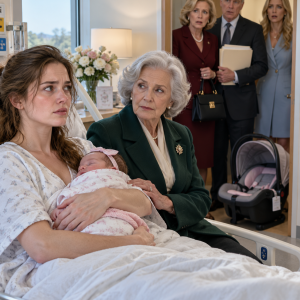
Nathan entered her empty hospital room the next morning carrying an expensive designer box. His mother, Helen Langston, was packing a thermos when he demanded to know where Rebecca had gone.
Helen placed the divorce envelope across his unopened gift. “While your wife nearly lost her life delivering your son, you chose champagne and Camille’s birthday celebration.”
Nathan defended the investor negotiations, but Helen refused the familiar explanation. “An obligation did not prevent you from answering seventeen calls. You made a choice, and Rebecca finally made hers.”
Later, Nathan discovered Rebecca’s clothing and work materials missing from their townhouse. He telephoned her while moving through silent rooms, offering to send a driver for her and the baby.
Rebecca’s reply remained composed. “Tomorrow you will receive a temporary preservation order covering the accounts connected to your undisclosed transfers.”
For the first time, Nathan’s confidence faltered. “You investigated my accounts while pretending everything between us was normal?”
“I investigated our assets after discovering that normality was another arrangement you expected me to maintain for you.”
Part 3: The Price of Bitter Coffee

The following Monday, Langston Learning’s legal counsel interrupted a board meeting with news that several investment accounts connected to marital property had been temporarily restricted. Rebecca had provided contracts, bank records, payment instructions, and correspondence involving Camille’s companies.
Nathan insisted the measures would disappear within days, but counsel warned that unexplained transfers worth millions required credible documentation. His private relationship with Camille transformed ordinary consulting payments into transactions inviting serious scrutiny.
Still convinced Rebecca could be persuaded, Nathan located her at a private maternal-health clinic near Back Bay. He arrived carrying a diamond bracelet and a certified check for one million dollars, then placed both items between them.
“I accept that I failed you, so keep the money, take the bracelet, and bring our son home. We can repair everything privately.”
Rebecca never touched either offering. “You keep confusing compensation with care because money allows you to avoid learning what another person actually needs.”
A nurse delivered coffee, and Nathan frowned after tasting his cup because it contained too much sugar. Rebecca watched him push it away before asking whether he knew how she preferred hers.
He could not answer. “For seven years, I prepared unsweetened coffee because that was your preference, and I drank the same bitter cup beside you. I prefer vanilla milk and cinnamon, but you never noticed.”
She returned the bracelet and check. “That coffee became our marriage: I memorized your smallest needs, while you never considered asking who I was becoming.”
Rebecca then opened the intellectual-property agreement. Nathan’s face tightened as he reached the termination clause and understood that the company’s core educational system did not belong to him.