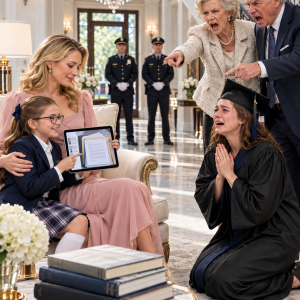
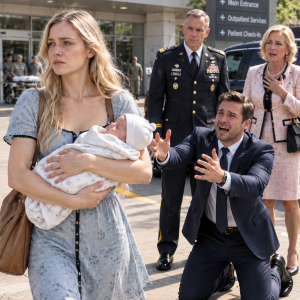
My mother-in-law threw my suitcase down the front steps less than twenty-four hours after we buried her son.
It hit the wet stone, popped open, and spilled half my life across the lawn.
My navy nursing scrubs landed in a puddle. A sweater Terrence had given me our first Christmas together slid into the mud. My shoes rolled beneath one of the hedges.
Eleanor Washington stood beneath the covered entrance of the house, perfectly dry in a cream-colored robe.
“You need to leave, Audrey.”
Behind her, my sister-in-law Chloe held up her phone.
She was recording.
I looked at her, then at the suitcase.
“Are you serious?”
Chloe gave a short laugh.
“Please don’t make this embarrassing.”
I almost asked her what part she thought was embarrassing—the widow standing in the rain or the woman filming her.
Instead, I bent down.
The rain had already soaked through the shoulders of the black dress I’d worn to Terrence’s funeral the day before. My knees sank into the wet grass as I picked up my clothes.
Then I saw our wedding album.
It had fallen facedown beside the driveway.
I opened the cover.
There was mud across the plastic sleeve protecting the first photograph. Terrence was looking at me in that picture instead of at the camera. He always did that.
I wiped the mud away with my sleeve.
Eleanor watched me.
“You can take your personal belongings. Nothing belonging to this family leaves the property.”
I stood slowly, holding the album against my chest.
“Terrence belonged to this family too.”
Her face tightened.
“Don’t do this.”
That was all she said.
Don’t do this.
As though I were the one creating the scene.
The House I Was No Longer Allowed to Enter
Terrence and I had been married for seven years.
I was a pediatric nurse when we met, and I was still a pediatric nurse when he died. His last name never changed what I did for a living, although it changed almost everything else about the way people looked at me.
Washington Shipping had been in his family for three generations.
His grandfather built it from two cargo vessels into a national shipping company. By the time I met Terrence, the Washington name was on office buildings, charity programs, scholarships, and enough gala invitations to fill a kitchen drawer.
I grew up outside Baltimore with a school secretary for a mother and an electrician for a father.
Eleanor never let herself forget that.
The first time Terrence brought me home, she asked which nursing school I’d attended before she asked anything else about me.
When I answered, she smiled.
“How practical.”
Terrence heard her.
Under the dinner table, he put his hand over mine.
That was how he handled his family most of the time. He didn’t make speeches. He just made it clear where he stood.
The morning after his funeral, he wasn’t there to do that anymore.
Howard Washington came outside while I was putting wet clothes back into my suitcase.
My father-in-law looked older than he had the day before. His tie was gone, and there were gray shadows beneath his eyes.
For one second, I thought he might stop Eleanor.
He didn’t.
He handed me an envelope.
“Your copy of the prenuptial agreement.”
I stared at him.
“Why would I need this today?”
“Because grief makes people confused about practical matters.”
He kept his voice low, almost gentle.
That somehow made it worse.
“Terrence’s personal effects will be reviewed by the family attorney. Anything you’re legally entitled to will be forwarded.”
Chloe lowered her phone just enough to speak.
“Which isn’t going to be much.”
“Chloe,” Howard said.
She shrugged.
“What? She should know.”
Eleanor crossed her arms.
“Terrence protected this family before he married you.”
I looked down at the envelope.
I knew about the prenup.
Terrence and I had signed it three weeks before our wedding. I’d had my own attorney review it, and I’d never objected. I hadn’t married him for Washington Shipping, the mansion, or the family’s money.
But Eleanor apparently thought the document meant something much simpler.
Terrence dies.
Audrey leaves with nothing.
I put the envelope into my suitcase.
Then I picked up our wedding album.
“Is my car still in the garage?”
Howard glanced toward Eleanor.
That glance told me enough.
“The Range Rover is titled through the company,” he said. “We’ll arrange transportation.”
“I meant my Honda.”
There was a pause.
The twelve-year-old Accord I’d owned before marrying Terrence was still parked in the back garage because I’d refused to sell it.
Terrence used to tease me about it.
That thing is going to outlive both of us.
Howard cleared his throat.
“Yes. Of course.”
I walked around the house to get it myself.
No one offered to help with the suitcase.
The Envelope Terrence Told Me Not to Open Yet
I spent the next three nights at a hotel near the hospital.
Going back to work was easier than sitting alone.
Children still needed medication at the right hour. Parents still needed someone to explain what the doctor had just said. Charts still had to be completed.
Nobody cared that my husband’s family owned ships.
At work, I was just Audrey.
On the fourth evening, I came back to my hotel room and found a voicemail from a man named Nathan Vance.
I knew the name.
Terrence had introduced us once at a Christmas party.
Mr. Vance was an estate attorney.
Not the Washington family’s attorney.
Terrence’s.
“Mrs. Washington, I’m sorry to contact you so soon. Your husband left instructions that I speak with you privately. Please call when you’re ready.”
I sat on the edge of the bed for nearly ten minutes before calling.
He answered himself.
“Audrey?”
“Yes.”
“I’m sorry about Terrence.”
I looked at my wedding ring.
“Thank you.”
There was a brief silence.
Then he said something that made me sit straighter.
“Did Terrence ever give you a sealed envelope?”
I looked toward the suitcase beside the dresser.
Two months before he died, Terrence had handed me an envelope while I was making coffee.
He’d written my name across the front.
I had laughed at him.
“What’s this?”
“Something boring.”
“Then why is it sealed?”
He’d taken my coffee mug from me and kissed my forehead.
“Put it somewhere safe. Vance will tell you when to open it.”
I had forgotten about it.
The envelope was still tucked inside the lining of my suitcase.
The same suitcase Eleanor had thrown into the rain.
I pulled it out.
One corner was wrinkled from the water, but the seal was intact.
“I have it.”
Mr. Vance exhaled.
“Good. Don’t open it over the phone. Come to my office tomorrow.”
The next morning, I sat across from him in a small conference room in Midtown Manhattan.
He pushed a letter opener toward me.
Inside the envelope was a handwritten note.
Terrence’s handwriting.
Audrey,
If Vance told you to open this, then I didn’t get the chance to explain it myself.
Trust him.
Don’t let my family rush you into signing, surrendering, transferring, or agreeing to anything until you understand what I left you.
I know you’ll hate that sentence.
Do it anyway.
T.
I read it twice.
Then I looked at Mr. Vance.
“What did he leave me?”
He opened a folder.
“Before I answer that, I need to ask whether you’ve signed anything since Terrence died.”
“No.”
“Transferred anything?”
“No.”
“Waived any estate rights?”
“No.”
He nodded.
“Good.”
Then he turned the first document toward me.
I recognized Terrence’s signature.
I did not understand the number beside it.
51%.
“What is this?”
Mr. Vance folded his hands on the table.
“Your husband owned fifty-one percent of Washington Shipping.”
I stared at him.
“No. Howard runs Washington Shipping.”
“Howard is CEO. That isn’t the same thing.”
He tapped the document.
“Terrence inherited his grandfather’s controlling shares. Those shares were his separate property. His final will transfers them to you.”
I looked at the number again.
“You’re telling me I own half the company?”
“More than half.”
“But the prenup—”
“Doesn’t change Terrence’s right to leave his separately owned shares to you.”
I stopped talking.
Mr. Vance waited.
Finally, I asked the only question I could think of.
“Did his family know?”
His expression changed slightly.
“They knew Terrence controlled the shares.”
“Did they know he left them to me?”
“No.”
I leaned back in the chair.