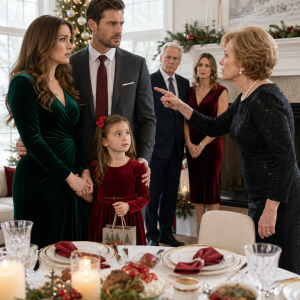
The Baby They Refused to Hold
When the nurse placed my newborn son in my arms, I expected my mother to come closer.
Instead, she stepped back.
Her expression changed the instant she looked at him.
My father, standing beside the window of my private hospital room in Columbus, Ohio, folded his arms across his chest.
My mother stared at the tiny bundle against me and finally said the words I had spent months preparing myself to hear.
“We are not going to pretend this is normal, Maren.”
I looked down at my son.
He was less than an hour old. His tiny fingers were curled beneath his chin, and he had no idea that two adults were already judging him for circumstances he could not possibly understand.
My father cleared his throat.
“Your mother and I agreed before we came here. We will not recognize a child whose father you refuse to name.”
Then my mother added quietly:
“And don’t expect either of us to hold him.”
Something strange happened inside me.
Nothing.
No shock.
No desperate need to defend myself.
I simply kissed my son’s forehead.
“That’s your decision.”
My mother’s eyebrows lifted.
She had expected tears.
For most of my thirty-three years, tears had been the easiest way for my parents to know they were still in control.
But this time, I wasn’t crying.
Because they didn’t know the truth.
They didn’t know who my son’s father was.
They didn’t know why I had kept his identity private.
Most importantly, they didn’t know that he was already inside the hospital.
At that very moment, he was walking toward my room.
The Family I Grew Up In

My parents, Lorraine and Franklin Dorsey, had built their lives around appearances.
My father owned a regional commercial development company. My mother chaired committees, hosted charity dinners, and treated family photographs like corporate advertisements.
Everything had to look perfect.
Their house.
Their marriage.
Their daughter.
Especially their daughter.
I had spent my childhood learning that affection was usually attached to achievement.
A good report card earned praise.
A scholarship earned pride.
A prestigious job earned bragging rights.
But disagreement brought silence.
Failure brought humiliation.
Independence was treated almost like betrayal.
By thirty, I understood something I should have learned much earlier: my parents didn’t necessarily want me to be happy.
They wanted me to be impressive.
Then I met Callum Voss.
Callum was forty, reserved, thoughtful, and nothing like the men my parents tried to introduce me to.
We met through a redevelopment project involving one of the nonprofit housing organizations I advised.
At first, I didn’t know much about him.
He dressed simply. He drove himself. He listened more than he spoke.
It took several weeks before I discovered that Callum controlled Voss Meridian Group, a private investment company with interests in logistics, real estate, and infrastructure across several states.
His money didn’t impress me.
His restraint did.
Callum never tried to manage me.
For the first time in my life, I was close to someone who could disagree with me without punishing me.
When our relationship became serious, we decided to keep it private.
That decision became even more important after I became pregnant.
Why I Never Told Them

My parents discovered my pregnancy when I was almost five months along.
My mother immediately asked one question.
“Who is the father?”
I told her I wasn’t discussing it yet.
She stared at me as though I had insulted her.
My father was more practical.
“Does he have money?”
That question told me everything.
Neither asked whether I was happy.
Neither asked whether the baby was wanted.
Neither asked whether the father treated me well.
They wanted to know what my pregnancy meant for them.
So I told Callum that I wanted to wait.
He understood.
“As long as you know I’m here, I don’t need your parents to know anything before you’re ready.”
There was another reason for my silence.
My father’s company had been struggling.
He hid it well, but years of working around commercial contracts had taught me how to recognize financial pressure.
Projects were being delayed.
Properties were quietly being sold.
Then my father began asking unusual questions about my savings, investments, and professional contacts.
When he learned that I was seeing someone, his interest became even stronger.
That was when I began documenting everything.
Three months before my son was born, I met with attorney Cecily Grant.
I gave her copies of messages, financial documents and correspondence involving my parents.
I wasn’t planning revenge.
I was building a boundary they could not simply talk their way around.
What They Really Wanted

Back in the hospital room, my mother pulled a chair toward my bed.
Her voice suddenly became softer.
That change interested me.
Lorraine Dorsey was never softer without a reason.
“Maren, despite everything, we’re willing to help you.”
“Help me how?”
She glanced at my father.
He stepped forward.
“You obviously can’t manage all of this alone.”
I almost smiled.
There it was.
Not concern.
Opportunity.
My father explained that they had prepared paperwork that would allow them to help manage certain financial matters while I recovered.