The Empty Place Cards

For six Christmases, my sister-in-law found a different reason my family couldn’t sit at the table.
The first year, she said she’d miscounted. The next, the dining room was too crowded. After that, there was a card table in the hallway, then a chair for me but not my wife, and finally a children’s table in an unheated sunroom. Every time, I tried to believe it was an accident. I work as a caterer; I count chairs and place settings for a living, but I still tried to give her the benefit of the doubt.
Then, at Christmas dinner last year, my seven-year-old son stood beside the table with a plate in his hands and asked where he should sit.
My sister-in-law glanced at him and said, “Oh, honey, I only set the table for people who actually belong here. Ask your dad where you’re sitting.”
I took the plate from my son and told him to get his coat.
That was the Christmas we stopped asking for a place at her table.
My name is Luke. I was thirty-four then, married to Hannah, and raising two children: Owen, who was seven, and Sophie, who had just turned four. I’d built a catering business after culinary school, beginning with office lunches out of a rented commercial kitchen. Over the years, it grew into a small company that handled weddings, fundraisers, and corporate events. I mention that because food and seating were part of my everyday work. I knew how many people could fit around a table, and I knew when somebody had been left out.
My older brother, Nathan, married Paige several years before this began. They bought a large colonial home in a New Jersey town not far from ours, and before long Paige offered to host Christmas. Our mother, Diane, was ready to retire from cooking for the whole family, so she gladly passed the holiday to her. Dad, Robert, didn’t have much to say about it. He was usually content to watch football and follow whichever plan the rest of us made.
Before Paige took over, Christmas at my parents’ house had been crowded and noisy. Mom cooked more food than we could eat, Dad nodded off in front of the television, and my uncle Frank argued about football with whoever happened to sit beside him. Nobody worried about matching dishes or carefully arranged napkins. It was a little chaotic, but people came, found a chair, and passed the gravy.
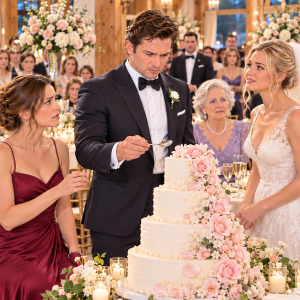
Paige’s first Christmas was lovely. She set the dining room table with matching china, pressed linen napkins, and handwritten place cards. The centerpiece looked like it had come from a magazine. I thought she’d done a beautiful job, and I told her so.
The following year, Hannah and I arrived to find twelve settings for fourteen people. Paige pressed her fingers to her chest and apologized as though the oversight had just occurred to her.
“Oh, goodness, I’m so sorry. I must have counted wrong. Let me get a couple of chairs.”
She brought folding chairs from the garage and wedged them near the kitchen doorway. We had paper napkins instead of linen and no place cards, but I told myself it was an honest mistake.
The next Christmas, our son Owen was two, and there were three of us without places. Paige said the dining room couldn’t fit everyone, so she set up a small table in the living room. I could see two empty chairs at the main table, each with a place card for someone who wasn’t coming. When I pointed that out, she said she had already arranged the seating and couldn’t change it at the last minute. Mom quietly told me not to make a fuss.
The year after that, we ate at a card table in the hallway. Owen asked why we couldn’t sit with everybody else, and Hannah, doing her best to keep the hurt out of her voice, told him it was a special adventure table. I watched her smile at him while her jaw tightened.
When our daughter Sophie was still an infant, Paige put one folding chair for me at the end of the main table. She said Hannah would probably be more comfortable in the den with the baby, where it was quieter. Hannah spent dinner alone in that room, with the television turned off, while I brought her a plate.
By the sixth year, Paige didn’t offer much of an explanation. She told us the children’s table was in the sunroom, which wasn’t heated. It was December in New Jersey. I brought in a space heater from the garage, set the children up, and sat with them. Hannah joined us. We ate lukewarm food in a chilly room while the rest of the family gathered in the warm dining room a few steps away.
That night, I tried to speak with Nathan.
“There were more settings than people at the main table,” I told him. “There was room for us.”
He stared down at the floor.
“She doesn’t mean anything by it, Luke. She gets stressed about the table.”
“Then talk to her.”
“I will.”
He didn’t. Nathan had always found it easier to avoid a difficult conversation and hope the problem would fade away. When we were children and our parents argued, he would retreat to his room and put on headphones. I’d sit on the stairs and listen to every word. As adults, our habits hadn’t changed as much as I wished they had.
The following November, Hannah told me she was done. We talked about it at our kitchen table after the children were asleep. She didn’t want to spend another holiday watching our kids wonder why they had been sent somewhere else.
I understood. I also knew my parents and uncle would be there, and I didn’t want Owen and Sophie to miss their grandparents and cousins. We agreed we’d go once more, but Hannah made me promise that if Paige did anything like before, we would leave immediately.
No arguing, no trying to smooth things over, no second chance that evening.
I promised.
We arrived around noon. Paige’s house looked beautiful. There were wreaths on the windows, garland along the banister, and a large inflatable snowman on the lawn that Owen loved. Inside, the house smelled of cinnamon and roasted vegetables. Paige greeted us warmly and sent the children downstairs to play with their cousins.
I walked into the dining room to look at the table. Six years of uncertainty had made me check, though I felt foolish doing it. There were fourteen chairs and fourteen place settings, all neatly arranged with handwritten cards.
I counted the people who were expected: my parents, my uncle, Nathan and Paige, their daughter, and several cousins. Even without Aunt Jo, who Paige had said wasn’t feeling up to coming, the numbers didn’t add up. There were more guests than chairs.
Before I could find Hannah, Owen came running upstairs with a plate he’d picked up in the kitchen. He was eager for dinner and proud that he’d remembered to get ready. He walked around the table, reading the place cards one by one. He was a good reader, and he expected to find his name.
He reached the last card and turned to Paige, who was carrying a basket of rolls.
“Where do I sit?”
She looked at the plate in his hands, then at him.
“Oh, honey, I only set the table for people who actually belong here. Ask your dad where you’re sitting.”
The conversation around the room stopped. My mother looked down at her napkin. Uncle Frank lowered his fork. Nathan closed his eyes for a moment.
Owen turned toward me with a puzzled expression. He wasn’t crying. He looked as if he were trying to work out what he had done wrong.
I walked over, took the plate gently from his hands, and placed it on the table, right beside Paige’s centerpiece.
“Go get your coat, buddy.”
Hannah had Sophie bundled up within minutes. No one came after us. No one said a word as we walked to the car.
I buckled Owen into his booster seat, and he asked, “Is Christmas over?”
“No,” I told him. “It’s just starting somewhere better.”
At home, I made grilled cheese and tomato soup. We watched a movie together, and it was the most peaceful Christmas dinner I could remember in years.
As we were leaving Paige’s house, Nathan stood in the front doorway with his phone in his hand. The screen was turned toward me, and though I don’t think he meant for me to read it, a message preview was visible. It was from Paige, sent that morning.
“If they complain about the seating, let me handle it. I have a plan.”
She hadn’t forgotten. She had planned it.
The Calls We Had Never Made
The week after Christmas, no one called. Not my parents, not Nathan, not any of the relatives who had been in the room when Paige told Owen he didn’t belong.
Hannah said the silence was an answer of its own. I knew she was right, but I still kept replaying the moment at the table. Owen walking around it, looking for his name. The confusion on his face. The text on Nathan’s phone.
A few days into January, Owen stopped mentioning Paige’s house. When Sophie asked if we’d go back to the big house with the snowman, he told her, “We don’t go there anymore.” He said it plainly, as if he were explaining that a store had closed. Hannah left the room after hearing him.
My mother called in the middle of the month.
“Luke, I think you overreacted.”
She didn’t ask how the children were. She went straight to the point.
“Mom, Paige told Owen he didn’t belong at the table.”
“She said it came out wrong. She was overwhelmed with dinner and misspoke.”
“She planned the seating. Nathan showed me the message she sent him that morning.”
There was a pause.
“I don’t know anything about that. What I know is that you made a scene in her home and ruined Christmas for everybody.”
I had plenty I wanted to say. Instead, I told her, “Okay, Mom,” and ended the call.
A few days later, Nathan called. He began with an apology.
“I know it was wrong, Luke. I’m sorry.”
“Did you know she was going to do that?”
He hesitated before answering.
“Not exactly. She said she was keeping the table small because of the new china. She told me you’d be in the sunroom again, and she thought you were fine with it. I told her to add chairs, but she said there wasn’t room. I didn’t push.”
“There was always room, Nathan. She just didn’t want us at the table.”
He sighed. I could hear him searching for an answer that wouldn’t require him to take a side.
“What do you want me to do?”
“Nothing. I’m done asking you to do something.”
After we hung up, I kept thinking about what he’d said. Paige had told everyone Aunt Jo was staying home because she wasn’t feeling up to Christmas. I remembered that Jo hadn’t come the year before, or the year before that. So I called her.
She was my mother’s younger sister, a kind woman who had lived alone since her husband, Ray, had passed on. She used to attend every family gathering. When she stopped coming, Mom had said Jo needed space.
We talked about the children and my business, and then I asked why she had missed Christmas.
There was a quiet moment.
“Honey, I wasn’t invited.”
I sat down at the kitchen table.
“What do you mean?”