The Seat by the Kitchen Doors

When I arrived at my parents’ anniversary reception with my six-week-old daughter tucked against my chest, my mother looked at the baby, looked at me, and said, “This family already has enough people living off everyone else.”
The room around her was bright with chandeliers and polished silver, but her words made the entrance feel cold. I adjusted the blanket around my daughter and gave my mother the small, careful smile I had learned to use whenever I wanted to keep a difficult moment from becoming a scene.
Then I walked past her and found the table nearest the kitchen doors.
I had no idea that, fifteen minutes later, my brother-in-law would cross the entire ballroom, stop beside that little table, and salute me in front of everyone. I only knew that my daughter, June, had finally fallen asleep, and I wanted to sit down before the ache in my back reminded me how little rest I had been getting.
My name is Nora Bennett. I was a lieutenant colonel in the United States Army, assigned to a joint cyber operations unit, and I had spent much of my adult life learning how to stay steady when other people were not. Still, there are moments when the people who know your childhood name can hurt you in ways no one else can. That evening, I was tired enough to feel every word.
My mother, Evelyn, stood in the entrance of the Willowbrook Country Club beneath a spray of white flowers. She wore a pale gold dress and the expression she used when she was hosting a fundraiser: gracious enough for photographs, sharp enough to keep the evening moving according to her plans. My younger brother, Owen, went by us in his county tactical-response uniform, with a few colleagues close behind him. He didn’t stop.
“Well, look who got away from her desk,” he said, giving his friends a crooked smile. “The taxpayer’s favorite.”
My father, Leonard, was close enough to hear. He had retired from the Marine Corps as a first sergeant, and even after retirement he carried himself as though every room had an invisible formation he could inspect. He raised his wineglass, turned toward the crowded bar, and left me standing beside my mother.
I had once hoped that his silence meant he was trying to avoid a quarrel. By then, I understood it as a choice.
I found a table tucked to the side, where the noise from the kitchen softened the sound of the reception. There was an empty place setting, a small vase of hydrangeas, and a view of my family gathered beneath the central chandelier. They were already posing for photographs with my older sister, Paige, who worked in public relations for an aerospace company. Paige’s husband, Nolan, was a Navy SEAL officer, and my parents had spent years treating his uniform as the finest thing anyone in the family had ever worn.
I settled June carefully in the bassinet Elias had brought from the car, then sat beside her with one hand resting on the edge. My husband was waiting outside with her. We had agreed that I would go in first, stay only as long as I wished, and leave whenever I felt ready. He knew the room might be hard for me. He had never asked me to prove that I could endure it.
Before I went in, he had held June against his chest in the back seat of our car while I smoothed the front of my charcoal blouse.
“You don’t owe them a performance,” he had said. “Go in as yourself. We’ll be right here.”
I had kissed his cheek, then my daughter’s soft hair. Now, seated beneath the muted glow of a wall sconce, I opened my phone and saw a message from a secure work account. The arrival I had been told to expect had reached the club’s front entrance.
I didn’t need to look up to know who it was.
The Family’s Measure
To understand why I chose the table by the kitchen, you would have to know how my family measured people.
My father had spent his career in the Marines, and he respected courage, discipline, and service. Those were good things. But over the years, he had narrowed his definition of service until it included only the kind he could recognize from across a room. A uniform, a story about a deployment, a visible scar, a handshake from someone important: those things counted. Work that happened behind screens, briefings, or locked doors did not.
At our house, you were either doing something real or hiding behind a desk. My father said it often enough that my brother began repeating it as if he had written the rule himself.
Owen liked attention, and the uniform suited him. He was quick to take offense and slow to consider what came after. When one bad decision threatened to complicate his career, I covered the cost of the attorney and the settlement. The amount was more than I could comfortably spare, but I had told myself that helping him was what a big sister did.
My mother was skilled at making family problems look like community events. She served on local committees and sat on the boards of two charities, where she wore a warm smile and spoke fondly of the family’s military tradition. When one of her fundraising accounts came up short, I transferred enough money to cover the difference before anyone else noticed. She thanked me by asking whether I could also make the next deposit early.
Paige was less loud than Owen and much better at reading a room. She knew how to find the people who mattered and make them feel noticed. When she married Nolan, who was a lieutenant commander in the Navy, my parents decided they had found the kind of son-in-law they could proudly introduce to anyone.
Nolan was courteous, capable, and careful with his words. I liked him, even when I wished he would see the difference between my family’s admiration and genuine respect.
My own work did not fit the picture my father wanted to display. I served in Army cyber operations, where much of what I did was confidential. I could not tell my family where I was going, who I was working with, or what had gone wrong during a long night at the office. At dinners, I usually said that the work was going well and asked about everyone else.
The less I could explain, the more they assumed there was nothing to explain.
When I was promoted to lieutenant colonel, I called home. My mother congratulated me, then asked if I would be able to take a few days off to help with an upcoming family event. My father said he was glad the Army had finally given me a title that sounded important.
I didn’t tell them how I felt about that. I had been trained to keep some things private. I had not yet learned that privacy and silence are not always the same as peace.
The Thanksgiving I Said Nothing

The moment I began to reconsider my place in the family came at Thanksgiving, when I was seven months pregnant with June.
My pregnancy had been difficult enough that I had kept it mostly to myself. The work schedule had been demanding, and I had worried about what I could safely share, so I wore loose sweaters and avoided questions. Elias knew, of course. He went with me to appointments when he could and took over every household chore I pretended I could still manage.
My family did not know. I had decided I would tell them when I felt ready.
That Thanksgiving, rain swept across the highway as I drove two hours to my parents’ house. By the time I arrived, my back ached and my ankles had begun to swell. The house was warm and crowded, filled with the smell of roasted vegetables, baked bread, and the cedar wreath my mother hung over the fireplace every year.
I was still taking off my coat when my father raised his glass.
“It’s good to have someone in the family who has done the real work,” he said, nodding toward Nolan. “We’re proud of you, son.”
Nolan offered a modest smile. Paige reached for his hand.
My father looked across the table at me. “Some people spend their whole careers in air-conditioned rooms, tapping on a keyboard and calling it service.”
Owen chuckled into his drink.
“At least you’ve got job security,” he said. “I bet they let you have coffee breaks, too.”
I had one hand beneath the table, resting against my stomach. I felt June shift and pressed my palm gently to my belly. For a moment, I thought I might tell them. I could have said that I was expecting a daughter, that I was tired, that their jokes had become hard to carry. I could have told them that the work I did was not small simply because I could not describe it.
Instead, I took a sip of water and let the conversation move on.
Three days earlier, my team had spent a long night responding to a cyber intrusion that had disrupted communications supporting a Navy operation overseas. I could not discuss the details, and I would not have used them to win an argument even if I could. But I knew what the work meant. I knew the people on the other end of the system were depending on us to keep a difficult situation from growing worse.
Nolan had been among the officers whose operation depended on that network.
He didn’t know my part in it then. He only knew that his team had been able to proceed after the disruption was contained. I did not tell him. The work was confidential, and I had no wish to turn it into family dinner conversation.
That night, driving home through the rain, I tried to convince myself that the remarks didn’t matter. I had said that for years. By the time June was born, I had begun to understand that a hurt does not become harmless simply because you refuse to name it.
The Man Everyone Was Waiting For
The reception hall quieted when the brass-handled doors opened.
Nolan entered in his Navy dress uniform, neat and polished, the gold trident on his chest catching the light. He looked tired from travel but composed, as always. His arrival set off a ripple of movement. A few guests stood. Someone by the bar called his name.
My mother’s face brightened immediately. She started toward him with both arms open, wearing the smile she saved for the best photographs.
“There he is,” she called. “Our real hero has arrived!”
My father straightened his jacket and lifted his chin. Paige rose beside the center table, smiling at her husband. Owen paused halfway through a sip.
Nolan took a few steps into the room. His eyes moved over the gathering, past the flowers, the raised glasses, and the people who had come to greet him. Then he saw me.
He stopped.
I watched his expression change—not into surprise, exactly, but into the focused attention of an officer who had recognized someone whose work he knew. He crossed the ballroom without going to the center table. The guests made room for him as he passed.
My mother’s arms slowly lowered. My father’s proud posture softened into uncertainty. Owen set his glass down.
Nolan reached the table by the kitchen doors and came to a stop in front of me. June was asleep beside my chair, her blanket rising and falling with each small breath.
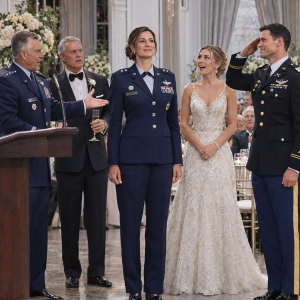
He brought his heels together and raised his right hand in a crisp salute.
“Ma’am,” he said.
The word carried through the hush.
I stood. There was no room for triumph in me, and no wish to punish anyone by enjoying the silence. I was simply aware of how many people were watching, and how little I owed the room in that moment.
I returned the salute.