Chapter 1: The Daughter Nobody Expected to See
I returned to my hometown of Fredericksburg, Virginia, on a Saturday afternoon, carrying an old canvas duffel bag and hoping to spend one peaceful evening with my father.
The town was hosting its annual veterans’ appreciation ceremony at a local church, and my father, Walter Whitcomb, was among the guests being honored.
I had planned to sit quietly near the back, listen to the speeches, and congratulate him afterward.
Unfortunately, my stepmother had other plans.
For months, Patricia Whitcomb had been telling people that I had left the Navy because I couldn’t handle the responsibilities of military life.
According to her, I had returned home embarrassed, unemployed, and unwilling to discuss my supposed failure.
None of it was true.
My name is Brooke Whitcomb. I was thirty-six years old, and I had spent fourteen years building a career in the United States Navy.
I hadn’t abandoned my career. I had recently completed a demanding six-month assignment overseas, and I was scheduled to report to Norfolk the following morning.
But the details of my assignment weren’t something I could freely discuss.
Patricia had used that silence to create her own story.
When I entered the church fellowship hall wearing jeans, a gray sweater, and comfortable walking shoes, I immediately noticed several familiar faces turning toward me.
Mrs. Fletcher, who had once brought homemade cookies to our house, offered an uncomfortable smile.
A retired veteran sitting near the aisle glanced at my duffel bag before looking away.
Then I heard Patricia’s voice.
“Well, look who finally decided to come home.”
She stood beside my father in an elegant navy-blue dress, smiling as though she were welcoming an unexpected guest.
“Brooke, sweetheart, you should have told us you were coming. We could have found something appropriate for you to wear.”
I looked down at my sweater.
“I’m comfortable, Patricia. Thanks.”
Her smile widened.
“Of course. After everything you’ve been through, I suppose comfort matters more than appearances.”
Several people nearby exchanged sympathetic glances.
My father stood beside her, looking older than I remembered.
He had served twenty years in the Army before retiring as a sergeant first class. His military service had always been a source of pride, although he rarely spoke about his accomplishments.
“Brooke?” he said quietly. “I didn’t know you were coming.”
“I wanted to surprise you, Dad.”
For a moment, his expression softened.
Then Patricia touched his arm.
“Walter, they’re waiting for you in the front row. Brooke can find a seat in the back.”
I could have corrected her.
Instead, I nodded and walked toward the last row.
I hadn’t come home to defend my reputation.
I had come to see my father.
Chapter 2: The Story My Stepmother Had Invented
My mother passed away when I was sixteen.
Her name was Rebecca, and she was the person who taught me that quiet strength mattered more than public approval.
She had always encouraged my interest in the military.
When I was younger, she would take me to my father’s ceremonies and remind me that service wasn’t about medals or recognition.
“The most important things you do in life may be the things nobody ever sees,” she once told me.
After she was gone, our house changed.
Dad married Patricia three years later.
At first, she seemed friendly enough. She organized family dinners, helped with community events, and made sure our home looked perfect whenever guests visited.
But she never seemed comfortable with the memories of my mother.
Photographs disappeared from the living room.
My mother’s favorite books were moved into storage.
Eventually, even mentioning her name seemed to make Patricia uncomfortable.
When I joined the Navy, Patricia described my decision as an attempt to escape the family.
When I earned promotions, she dismissed them as ordinary career progress.
And when my assignments required long periods away from home, she told my father that I was deliberately avoiding him.
Over time, our conversations became shorter.
Then, during my latest deployment, communication became especially difficult.
I had given Dad the appropriate contact information before leaving. I had also explained that I might be unreachable for extended periods.
But when I finally returned, I discovered that Patricia had been telling people I had resigned.
Apparently, she had also convinced Dad that I no longer wanted him involved in my life.
I didn’t know the full extent of her deception that evening.
All I knew was that the father who once proudly introduced me to every veteran he knew now seemed unsure whether he should approach me.
As I settled into the back row, I heard two women whispering.
“That’s Walter’s daughter, isn’t it?”
“Yes. Patricia said she couldn’t keep up with the Navy anymore.”
“Such a shame. Walter was always so proud of her.”
I stared at the folded program in my hands.
I could handle strangers misunderstanding me.
What hurt was knowing that my father might believe them.
Chapter 3: The Unexpected Visitor
The ceremony began with a prayer, followed by a presentation honoring local veterans.
Dad sat in the front row beside Patricia.
Every few minutes, I caught him looking over his shoulder.
I wanted to wave, but something about his expression stopped me.
He looked worried rather than disappointed.
Halfway through the program, the side doors opened.
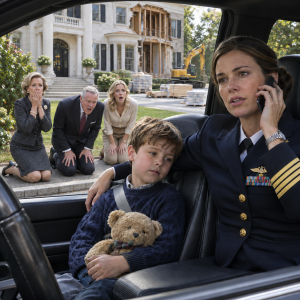
A young naval officer entered wearing a perfectly pressed dress uniform.
He paused near the entrance, scanned the room, and immediately spotted me.
I recognized him.
Lieutenant Owen Kessler.
Several years earlier, Owen had served under my supervision aboard a Navy destroyer. He had been enthusiastic, intelligent, and occasionally a little too confident for his own good.
I had once spent an entire afternoon teaching him why small procedural details mattered.
Now he was standing in the church hall, looking as though he had been sent on official business.
He walked directly toward the back row.
The sound of his polished shoes against the floor attracted attention.
When he reached me, he stopped, straightened his posture, and raised his hand in a formal salute.
“Commander Whitcomb, ma’am. Lieutenant Kessler reporting as directed.”
The room went silent.
I stood instinctively.
For a moment, I forgot that I was wearing jeans instead of a uniform.
Then I returned his salute.
“At ease, Lieutenant.”
He lowered his hand.
“Admiral Prescott asked me to locate you, ma’am. Your transportation is waiting outside, and your dress uniform has been prepared for tomorrow’s ceremony.”
I glanced toward the front row.
My father had turned completely around.
Patricia was staring at us.
“Commander?” she said loudly.
Owen remained focused on me.
“Ma’am, the Admiral also asked me to deliver a personal letter to your father. He believed your family should hear the news before the official announcement.”
He held a sealed envelope.
Across the front, in clear black lettering, were the words:
COMMANDER BROOKE R. WHITCOMB — OFFICIAL RECOGNITION
I could feel every eye in the room following the envelope.
Patricia stood abruptly.
“There must be some misunderstanding. Brooke told us she left the Navy.”
Owen looked genuinely confused.
“I’m sorry, ma’am, but Commander Whitcomb is currently on active duty.”
Then he added something that changed the entire atmosphere.
“She completed a six-month operational assignment overseas and is scheduled to receive formal recognition for her leadership.”
Chapter 4: The Truth Nobody Had Expected
The councilman at the podium tried to continue the program, but the audience was no longer paying attention.
People began whispering.
A veteran in the second row slowly stood.
Another turned toward me with an expression I couldn’t quite read.
Patricia recovered first.
“Well, isn’t this wonderful!” she announced, forcing a laugh. “Brooke never mentioned anything about a promotion. Walter, did you know?”
Dad didn’t answer.
He was staring at me.
Not at my duffel bag.
Not at my clothes.
At me.
Owen leaned closer.
“Commander, Admiral Prescott said you would probably prefer to keep the attention on your father tonight. He asked me to give you the choice.”
I appreciated that.
The Admiral knew how much I disliked public recognition.
He also knew that I had spent years trying to maintain a relationship with my father despite the distance between us.
“Thank you, Lieutenant. Give me a moment.”
I walked toward the entrance with Owen.
Outside, a government vehicle waited near the curb.
My dress-white uniform hung neatly inside.
Beside it was a presentation case containing a formal citation.
I touched the sleeve of my uniform.