PART 1 — THE CAR IN MY DRIVEWAY
“Your husband lost this SUV to me in a poker game last night. He signed it over, so you’d better get your things out.”
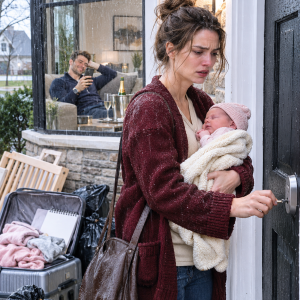
The stranger said that from behind my steering wheel at seven o’clock on a Saturday morning. My eight-month-old daughter was asleep in her car seat behind him, and he was holding a folded document with my husband’s signature on it.
“My baby is in that car,” I said. “Turn off the engine. Right now.”
He glanced over his shoulder, then looked back at me with an expression that made my stomach turn.
“Then get her out, lady. I’ve got somewhere to be.”
I had paid for that SUV myself. My husband, Trace, wasn’t even listed as an owner. But as I reached for the back door, I understood that arguing about paperwork could wait. Getting my daughter out couldn’t.
My name is Jessie Holcomb. I’m thirty-two, and I work as a medical billing specialist in Biloxi, Mississippi. Until that morning, I thought the worst thing my husband had done was lie about how much money he’d lost playing poker.
I was wrong.
The man in my driver’s seat was in his fifties, with a weathered face, a leather jacket, and a heavy gold ring. He introduced himself as Sal Brodeur, as though we were meeting at a neighborhood cookout instead of in my driveway.
I kept my eyes on him while I opened the rear passenger door. Eloise stirred when I unfastened her harness, then started crying as I lifted her against my chest. I carried her several steps away before turning around.
“You have no right to take that vehicle,” I told him.
Sal held up the document again.
“Take it up with your husband.”
“I’m calling the police.”
“Suit yourself. But Trace knew what he was doing when he signed.”
He started backing out before I’d reached the porch. I stood there holding Eloise, watching my SUV disappear around the corner, unable to believe that something I’d worked so hard to buy could be taken in less than a minute.
Then I went inside, locked the door, and called my husband.
Trace answered on the fifth ring, sounding as though I’d dragged him out of a deep sleep.
“What is it, Jess?”
“A man named Sal Brodeur just drove away in my SUV. He says you lost it playing poker.”
There was silence long enough for me to hear Eloise fussing against my shoulder.
“Trace, tell me he’s lying.”
“Jess, I was going to tell you.”
I sat down at the kitchen table because my knees suddenly felt unsteady.
“You bet my car?”
“I had a full house. I thought I had him.”
“You thought you had him?”
“Don’t start. I already know I made a mistake.”
I looked at the empty driveway through the window.
“Our daughter was in the back seat when he took it.”
Trace exhaled sharply.
“Well, she’s with you now, isn’t she?”
For a moment, I thought I’d misheard him.
“That’s what you have to say?”
“What do you want me to say, Jessie? I can’t undo last night.”
“You can tell me how much you owe this man.”
“I’ll handle it.”
“You couldn’t even keep him out of our driveway.”
His voice hardened.
“Listen carefully. Don’t call the cops. Sal isn’t somebody you want to make angry, and you’re going to make things a whole lot worse for me.”
I stared at the phone.
“Worse for you?”
“Yes, for me. I’m the one who owes him money. You’ll get another car. Your mother can drive you around for a while.”
He hung up before I could answer.
I stayed at the table, holding Eloise until she settled. Then I laid her safely in her crib and opened the folder where I kept our vehicle documents.
The SUV was titled in my name alone.
I knew that because I’d been the one who bought it, financed it, and made every payment. Trace had been with me at the dealership, but his credit was so poor that he hadn’t qualified for the loan. He was listed on our insurance as a permitted driver, not as an owner.
That distinction mattered.
So did the fact that I’d never signed anything transferring the vehicle.
I called 911 and reported what had happened, including Sal’s name, the SUV’s license plate number, and the fact that he’d taken it while my daughter was inside. The dispatcher asked whether Eloise was safe, then told me not to confront or follow the man.
I assured her I wouldn’t.
After the call, I remembered the vehicle app on my phone. I’d activated its location feature when I bought the SUV, mostly because I was forever forgetting where I’d parked at the grocery store.
I opened it.
A small vehicle icon appeared on the screen, moving west along Highway 90.
I called the dispatcher back and gave her the information.
“Keep the app open, ma’am,” she said. “An officer will contact you. Please don’t try to follow the vehicle.”
My mother arrived twenty minutes later. She took one look at me standing in the kitchen with my phone and immediately reached for Eloise.
“Honey, what’s happened?”
I told her everything.
She sank into a chair.
“Trace gave away your car?”
“He tried to.”
Mom looked toward the driveway.
“Jessie, you need to call your father.”
“I will. First, I need to know where the car is.”
I kept watching the icon while Mom fed Eloise a bottle. Eventually, the vehicle stopped behind a motel near the highway. I passed the location to the dispatcher and waited.
A deputy called about fifteen minutes later.
“Ms. Holcomb, we’ve located your SUV. The driver is here, and we’re reviewing the paperwork he presented.”
“Is he going to leave with it?”
“Not while we’re sorting this out. Can you come to the station with your ownership documents?”
I told him I could.
Then he paused.
“There’s something else. Mr. Brodeur claims the vehicle was partial payment on a gambling debt.”
I looked at my mother.
“How much?”
“He’s claiming forty-two thousand dollars.”
I felt the blood drain from my face.
“Forty-two thousand?”
“And he says your husband offered him an interest in your house as additional security.”
For several seconds, I couldn’t speak.
The house had belonged to my grandmother. She’d left it to me two years before I married Trace, and the recorded deed was in my name alone.
My husband knew that. He also knew what that house meant to me.
I looked toward the framed photograph of Grandma hanging beside the kitchen doorway. She was standing on her porch, wearing gardening gloves and smiling beneath the fern she’d kept alive for nearly twenty years.
I’d spent my childhood summers in that house. When Grandma died, she left it to me because she wanted me to have a home I could always count on.
Now a stranger was claiming my husband had offered it to settle a poker debt.
I thanked the deputy and ended the call.
Mom was watching me.
“What did he say?”
“Trace owes that man forty-two thousand dollars.”
She covered her mouth.
“Oh, Jessie.”
“And apparently, he tried to give him Grandma’s house.”
Mom looked toward the photograph.
“He wouldn’t.”
I shook my head.
“This morning, I would’ve said the same thing about my car.”
I went to the hall closet and pulled down the fireproof document box. Inside were our birth certificates, insurance papers, and the recorded deed to the house.
I laid everything on the kitchen table.
Then I called my father and asked him to come stay with Mom and Eloise while I went to the police station.
I didn’t know how far Trace’s gambling had gone, but I was finished accepting his word that everything was under control.
The trouble hadn’t started that Saturday. Looking back, I could see the signs I’d spent months trying to explain away.
Trace worked on fishing boats along the Gulf Coast. During a good season, he could bring home more money in a few weeks than I earned in a month. When storms kept the boats in port, though, his income could disappear for weeks.
I’d always been the cautious one. I worked full-time, paid the household bills, and kept an emergency savings account. Trace used to tease me about planning for disasters that hadn’t happened.
“Jessie, you worry too much,” he’d say.
“Somebody has to remember the insurance bill,” I’d answer.
We’d been married five years. Before the gambling started, Trace was the sort of husband who fixed a broken cabinet without being asked and brought me coffee when I worked late. He cried when Eloise was born and insisted on learning how to swaddle her properly.
I remembered those things because they were real.
So were the lies that came afterward.
At first, poker was a Friday-night game with friends. Then Trace started going out on Saturdays. By September, he was spending evenings in a back room at a bar off the highway.
“I’m up two grand this month,” he bragged one evening.
I was rinsing Eloise’s bottles at the sink.
“Good. Put some toward the bills.”
“I will. I’m keeping a little in the game for now.”
I never saw the two thousand dollars.
Instead, cash began disappearing from our joint checking account. Trace blamed gas, meals, and supplies for the boat. When I found a receipt for a twelve-hundred-dollar withdrawal, he claimed he’d loaned the money to a friend.
I didn’t believe him, but every conversation ended the same way.
“You’re treating me like a child,” he’d complain.
“I’m asking where our money went.”
“I had a bad week. It happens.”
“Then stop playing.”
“You don’t understand. If I quit now, I lose everything I’ve put in.”
I’d heard that sentence so many times that it had almost stopped sounding alarming.
Now I understood how dangerous it was.
By the time I arrived at the police station, I had a folder full of documents and a headache that wouldn’t go away.
A detective named Laura Benton met me in a small interview room. She listened while I described Sal’s arrival, the conversation with Trace, and the vehicle’s location.