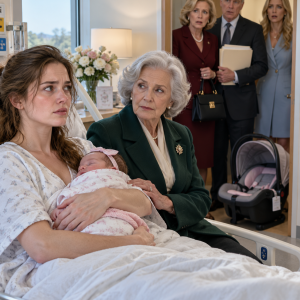
“Tell anyone what?”
He looked at me then, and I understood before he spoke that whatever he said next would make every word I had spoken at the door return to me with teeth.
“She has pancreatic cancer,” he said. “It has spread. The doctors told her she has a few months, maybe less.”
I sat down hard in the chair.
“No.”
“She checked herself out of the palliative care unit. She packed before dawn and took a bus here because she did not want my brother’s family watching her die in their guest room. She said she wanted one last chance to be useful while she could still stand up.”
My hands went cold.
“Why here?”
Mark’s face broke again.
“Because Lily is the only grandchild she barely knows. Mom said she wanted Lily to remember the warmth of her grandmother before it was too late.”
I covered my mouth.
The camphor blanket. The kitchen. The detergent. The clothes in my closet. The sentence at the door. All of it rearranged itself, not into innocence, because Ruth had crossed lines she should not have crossed, but into something infinitely more painful.
She had not come to take over my life.
She had come to leave pieces of herself in it before she disappeared.
“Where is she now?” I asked.
Mark’s voice was almost gone.
“County Hospital. She collapsed at the station last night. A janitor called 911.”
I stood so quickly the chair scraped the floor.
“Get your coat.”
Part 3 — The Apology At County Hospital

County Hospital at midnight was all bright lights, tired nurses, vending machine coffee, and people trying not to look afraid in plastic chairs. We found Ruth in a curtained corner of the emergency observation unit, small beneath a white blanket, oxygen tubing under her nose, her old blue suitcase tucked carefully beneath the bed.
The sight of that suitcase nearly split me open.
Ruth opened her eyes when we entered. The first thing she did was lift one thin hand to smooth her hair. Even then, embarrassed and ill and exhausted beyond pride, she tried to look presentable for me.
“Anna, sweetheart,” she whispered. “I am sorry.”
The woman I had sent away in a car was apologizing to me.
I moved to the bed, but I could not touch her yet. Shame can make your hands feel borrowed.
“Please do not apologize,” I said.
She shook her head.
“No. I should not have moved your things. It was your home. Your rules. Your little girl. You were right to protect it.”
My throat closed.
“I did not know.”
“Of course you did not. I did not tell you.”
Mark stood at the foot of the bed, crying silently.
Ruth turned her tired eyes back to me.
“The detergent was because Mark had awful eczema when he was small. His skin would crack behind his knees until he cried. When I saw Lily scratching, I thought I could help before it got worse.”
I remembered my anger when she said older people learned these things. I had heard condescension. Perhaps it had been condescension, a little. But beneath it, there had been memory.
“The kitchen?” I asked, because I needed to know, and because punishment had already become confession.
A faint smile touched her mouth.
“That was foolish. I arranged it like my old kitchen. I thought if everything was in reach when you came home tired, you would not have to search for anything. I wanted to leave something useful, even if it was only where the mugs should go.”
I pressed both hands against the metal bed rail.
“And the blanket?”
Ruth looked toward the suitcase.
“I knitted it when Mark told me you were pregnant. Cream and yellow, because nobody would tell me the nursery colors. I kept it in my cedar chest with camphor so moths would not ruin it. I always meant to bring it when Lily was born, but then life moved quickly and I kept waiting for the right invitation.”
Tears slid down her temples into her gray hair.
“There is not much time for invitations now.”
The sentence broke me. I reached for her hand. It was lighter than I expected, as if illness had already stolen the weight from her body.
“I sent you away.”
She squeezed weakly.
“You defended your child. That is not a small thing.”
“You slept at a bus station because of me.”
“I slept there because I was stubborn and proud, and because my son was too frightened to tell the truth.”
Mark flinched.
Ruth looked at him with tenderness and disappointment braided together.
“You should have told her, Mark.”
“I know.”
“No, honey. You were scared. Knowing is what you do after fear has made a mess.”
I almost laughed through tears because even dying, she sounded like a mother reorganizing the emotional kitchen.
The doctor arrived and explained discharge risks, pain management, home hospice options, and the fact that Ruth should not be moved unless we understood what we were accepting. I signed every form with a hand that shook.
At dawn, we brought her home.
Not to a hotel. Not to a terminal. Not to the place where people waited for buses through the night.
Home.
The first thing I did was open her suitcase. I took out the knitted blanket I had shoved away in rage three nights earlier. It smelled just as strong as before. Camphor, cedar, wool, and time. I carried it to Lily’s room, where Ruth would sleep because it was the only room bright enough for morning sun. I spread it over Ruth’s lap as she sat propped against the pillows.
She touched it with both hands.
“There,” she whispered. “That looks right.”
Lily appeared in the doorway, clutching her stuffed fox.
She studied Ruth, then me.
“Is Grandma sick?”
I knelt beside her.
“Yes, baby. Grandma is very sick, and she is going to stay with us so we can love her.”
Lily frowned in the serious way only three-year-olds can.
“Can she use my blanket?”
Ruth covered her mouth.
I pulled Lily close.
“Yes,” I said. “I think she would like that very much.”
Part 4 — Five Weeks Of Borrowed Time

Ruth lived with us for five weeks.