I looked across the yard, at the grill, the paper plates, the family I had helped keep afloat while letting them believe I was small enough to use.
“Because every time I tried to be more than useful, this family became uncomfortable.”
My mother’s eyes filled.
“That is not fair.”
“No,” I said. “It is not.”
Part 3 — The Drive Home

I did not stay for fireworks. I put Caleb and Emma into my truck while Derek sat on the grass rubbing his shoulder, suddenly smaller than the stories he had built around himself. Mallory followed me down the driveway, but Derek called her name like an order. She stopped.
That told me everything I needed to know.
The road home was dark except for porch lights, firework flashes, and the soft glow of the dashboard. Emma fell asleep with my folded jacket under her cheek. Caleb stayed awake, staring through the windshield as if the night had become a question.
After nearly twenty minutes, he spoke.
“Mom, why did you let him talk to you like that?”
I gripped the steering wheel.
The old answer was simple: because I was tired, because family was complicated, because my mother needed help, because Mallory was trapped in a marriage she defended in public and complained about in private. None of those answers were good enough for my son.
“Because I thought enduring disrespect quietly made me strong.”
He turned toward me.
“Did it?”
Children can be merciless when they are honest.
“No,” I said. “It made me forget I deserved better.”
He looked down at his hands.
“I do not want to learn that.”
The words landed with more force than Derek ever could have.
“Then I will stop teaching it.”
The next morning, I called Tasha Reed, the woman who had pulled me through the hardest year after my retirement and never allowed me to romanticize self-erasure. She answered with no greeting.
“Silas called me.”
I closed my eyes.
“Of course he did.”
“How bad?”
“I put Derek on the mat in front of the family.”
“Good.”
“Tasha.”
“Do not Tasha me. That man has been using your patience as a public punching bag for years.”
I sat at my kitchen table with coffee cooling between my hands.
“My mother cried.”
“Let her,” Tasha said. “People cry when the appliance they have depended on suddenly reminds them it is human.”
That was harsh. It was also accurate.
After the call, I opened my banking app and canceled the automatic transfers: part of my mother’s utilities, Mallory’s mortgage support, the emergency savings fund that was supposed to be temporary three years earlier. Then I requested a public summary of my military record and wrote one email to my mother and sister.
I love you. I have spent most of my adult life helping this family, and I do not regret generosity freely given. What I will not continue is financial support in a family system where I am mocked, diminished, or treated as useful but not respected. If you want me present, that presence will now require honesty, boundaries, and basic dignity.
I attached the record.
I stared at the screen for a long time before pressing send.
For twenty-two years, I had been terrified that revealing myself would sound like bragging. But there is a difference between humility and burial. Humility does not ask your children to watch you disappear.
Mallory called first.
She was crying so hard I barely understood her.
“I knew Derek went too far sometimes, but I told myself you did not mind because you always smiled.”
“That was easier for you.”
She inhaled shakily.
“Yes. It was. I let him make you the joke because it kept the peace in my house.”
It was the first honest sentence anyone in my family had given me in years.
“I cannot fix your house for you anymore,” I said.
“I know.”
“Do you?”
She did not answer immediately.
“I am trying to.”
That was not enough to repair anything, but it was enough to keep the line open.
My mother called three days later. She did not begin with an apology. She began with a question.
“The year you sent money for my roof, were you recovering from the injury in that record?”
I closed my eyes.
“Yes.”
“You told me you fell down concrete steps.”
“I did not want you to worry.”
Her voice broke.
“I let you carry everything.”
“Yes,” I said. “You did.”
It was the first time I had agreed with her pain instead of rescuing her from it.
Part 4 — The Ceremony
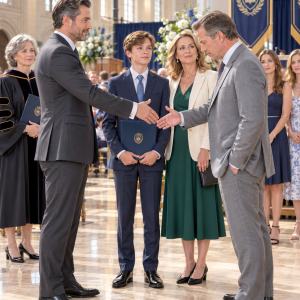
Two months later, my old unit held a small recognition event at Quantico for several retired service members involved in a mentorship program. I had avoided those ceremonies for years because they made me feel exposed in ways combat never had. This time, I invited my family because secrecy had already cost too much.
Mallory asked whether Derek could come.
“Only if he understands this is not about his pride.”
He came in a dark suit, silent for once, hands folded in front of him instead of spread wide across other people’s space. He did not look humble exactly. He looked like a man trying to imitate humility until he could understand what it required.
My mother sat between Caleb and Emma. She clutched a program so tightly that the paper wrinkled beneath her fingers.
When Colonel Hayes read my record, the room seemed to tilt backward through time.
Bronze Star with valor. Purple Heart. Special operations deployments. Humanitarian evacuation command. Advisory work with wounded service members. Twenty-two years of things my family had turned into vague office jokes because I had let them.
Emma leaned against my mother and whispered loudly enough for me to hear.
“Grandma, Mom is really brave.”
My mother covered her mouth.
“Yes, sweetheart. She is.”
After the ceremony, Derek approached me near the hallway windows. He stopped at a respectful distance, which was already an improvement.
“I was wrong,” he said.
I waited.
He swallowed.