Part 1 – The Child in the Cardiology Hallway
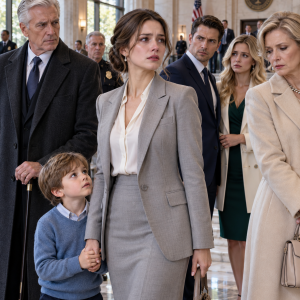
Fourteen months after her divorce became final, Dr. Allison Grant encountered her former husband outside the pediatric cardiology department of Riverbend Children’s Hospital in Columbus, Ohio.
She was carrying a tablet loaded with surgical schedules and quality-review reports, while the identification badge clipped to her white coat displayed the title Director of Pediatric Anesthesiology. A staffing meeting would begin in ten minutes, and Allison might have continued walking if Blake Mercer had not positioned himself directly across the hallway as though the encounter were something he had been rehearsing.
He stood beside an expensive stroller, wearing a navy overcoat and polished shoes that reflected the ceiling lights. One hand rested on a leather diaper bag, while the other adjusted the blanket covering a small boy with pale brown hair and wide gray eyes.
Beside him stood Tessa Vaughn, Allison’s closest friend throughout medical school, residency, and the first decade of her marriage. Tessa held a bottle against her chest and looked considerably less confident than Blake.
Allison had once trusted Tessa with details she had not shared with her own sisters. Tessa attended fertility consultations, brought food after failed treatment cycles, and sat beside Allison while she cried over another negative test. During those same years, she was quietly becoming the person Blake called after leaving their home.
Blake saw Allison and immediately smiled.
“Well, this is unexpected,” he said loudly enough for the nurses at the reception desk to hear.
Allison stopped several feet away.
“Hello, Blake.”
His expression tightened because her voice remained calm. During their marriage, Blake collected emotional reactions and later rearranged them into evidence that Allison was difficult. Tears proved she was unstable, anger proved she was hostile, and silence proved she was incapable of intimacy.
He had never known what to do with composure.
Blake glanced at her badge.
“Still building your entire identity around the hospital?”
Tessa lowered her eyes toward the stroller.
“I enjoy my work, and my patients benefit from that commitment,” Allison replied.
“You always had a polished explanation for choosing work over a family.”
Several people nearby became still. A nurse stopped typing, while a father beside the vending machines lowered his coffee. Blake moved closer to the stroller, ensuring Allison could see the child clearly.
The little boy reached for a stuffed elephant attached to the safety bar. None of the bitterness above him belonged to him, and Allison refused to let her gaze become another instrument used against an innocent child.
Blake placed one hand on the stroller handle.
“Leaving you was the first honest decision I made in years,” he said. “Some men eventually accept that a marriage cannot become a family when the woman involved is incapable of giving them children.”
Tessa whispered his name, but Blake continued because the audience had grown.
“Fortunately, life corrected itself. Tessa and I have a healthy fourteen-month-old son, and he has given me everything our marriage never could.”
Allison remembered eight years of consultations, blood tests, injections, surgical procedures, and silent drives home from fertility clinics. She remembered apologizing to Blake for the failure of a body she believed had betrayed them. He accepted every apology without once suggesting the problem might not belong to her.
Now he stood in a children’s hospital using those years as entertainment.
Allison looked at the child again. He had Tessa’s narrow chin and dark lashes, although neither feature matched Blake. More importantly, Tessa’s hand around the bottle was trembling.
Fear appeared in her posture rather than pride.
Allison returned her attention to Blake and offered a small, controlled smile.
“Really?”
His confidence faltered.
“What is that supposed to mean?”
“It means I heard what you said.”
Her phone vibrated inside her coat pocket. The message came from attorney Evelyn Price, who had represented Allison during the divorce.
URGENT. FINANCIAL DISCOVERY COMPLETE. I AM IN THE MAIN LOBBY WITH THE COURT FILING.
Blake stepped closer.
“You always did enjoy pretending you knew more than everyone else.”
“Our marriage taught me that appearances and facts are frequently unrelated.”
Tessa’s face became pale.
Allison excused herself and continued toward the elevators without looking back. Behind her, Blake laughed as though he had won the exchange, although his voice lacked its earlier certainty.
Part 2 – The Diagnosis He Allowed Her to Carry
Evelyn waited near the hospital’s central atrium with two folders and a laptop. She had requested post-divorce financial discovery after Blake applied for a commercial development loan and declared assets inconsistent with the disclosures he submitted during their settlement.
They entered a private consultation room normally used for families awaiting surgical updates.
“The lender contacted the title company about several properties transferred through Mercer Development Holdings,” Evelyn explained. “Those transfers revealed accounts Blake omitted during the divorce.”
The hidden assets included two rental properties, investment shares, and nearly eight hundred thousand dollars routed through a management company controlled by Blake’s cousin. Some funds had been accumulated during the marriage, which meant Allison had been entitled to disclosure regardless of whose name appeared on the accounts.
“We can reopen the property judgment because he signed sworn statements declaring those assets did not exist,” Evelyn continued. “However, the financial discovery uncovered something else.”
She opened the second folder.
During the original divorce, Blake resisted producing records from a private reproductive health clinic. He claimed the files contained unrelated personal information. The new court order compelled complete disclosure because several payments to that clinic came from a concealed account.
The earliest report was dated eighteen months before Allison and Blake began fertility treatment together.
It stated that Blake had a genetic condition causing permanent infertility. Multiple specialists confirmed that natural conception was medically impossible, and the report recommended donor conception or adoption.
Allison read the conclusion several times.
“He knew before our first appointment.”
“Yes,” Evelyn said. “He also signed a document refusing permission for the clinic to share the diagnosis with a spouse or future treatment provider.”
The room seemed to lose its dimensions.
Allison remembered physicians focusing every consultation on her hormone levels, uterine structure, age, weight, and work schedule. Blake provided limited samples at a separate clinic and later claimed his results were normal. Whenever Allison suggested obtaining another opinion, he accused her of refusing to accept responsibility.
His mother called her defective during a Thanksgiving dinner. Blake remained silent, then later asked Allison not to embarrass him by creating family conflict.
He had watched her undergo years of invasive treatment while carrying the truth in a locked file.
“Why did the fertility clinic proceed without his complete records?” Allison asked.
“He used different facilities and presented altered summaries. We found payments to a records consultant who later lost his license for falsifying medical documentation.”
Allison placed the report on the table.
Her first response was not rage. It was a strange physical emptiness, as though years of grief had been lifted from her body before she knew where to place them.
“He did not merely lie about being infertile,” she said. “He constructed a medical history that made me responsible.”
Evelyn nodded.
“There is another complication. Blake used these concealed records when applying for life insurance six months ago, so the verified diagnosis appeared in the underwriting file. That recent disclosure establishes that he still knows the condition is permanent.”
Allison thought about the child in the stroller.
“Then he cannot be the biological father.”
“Not through natural conception,” Evelyn replied. “The records show no surgical retrieval, donor arrangement, or assisted reproductive procedure involving Blake.”
Tessa had once worked as a research coordinator at the same private clinic. If she knew Blake’s condition, the deception extended far beyond infidelity.