Part 1 – The Morning the World Returned
For twenty-six months, Lauren Whitaker understood the world through texture, sound, and the voices of people she trusted enough to guide her.
Her vision disappeared after a highway collision damaged both optic nerves and left scar tissue pressing against the structures behind her eyes. The first surgery prevented permanent deterioration, while a long sequence of treatments preserved the possibility that sight might return. Every specialist warned that progress would be uncertain, gradual, and painfully sensitive to light.
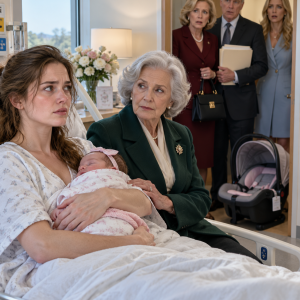
Therefore, when Dr. Samuel Keller removed the final protective bandages at a university hospital outside Portland, Lauren did not immediately celebrate. She stared at the pale ceiling until its edges separated from the walls, then followed the movement of the physician’s hand as he raised several fingers.
“How many fingers can you distinguish?”
Lauren blinked through the burning brightness.
“Four, although the last one is blurred.”
Her mother, Caroline Whitaker, began crying from the chair beside the examination table. Dr. Keller smiled and adjusted the lights before testing Lauren’s ability to identify shapes, colors, and printed letters.
The results were considerably better than expected. Her vision remained fragile, but she could recognize faces, navigate familiar spaces, and read large text without assistance.
“You should not travel alone today,” Dr. Keller warned. “Your depth perception will remain unreliable, and emotional stress can intensify the headaches.”
Lauren promised to be careful, although she did not promise to obey.
Her husband, Daniel Mercer, was absent. He claimed an urgent meeting at his estate-planning firm prevented him from attending the appointment, but he promised to collect her at six with white roses and dinner from the restaurant where they celebrated their engagement.
During the previous two years, Daniel had become the architecture of Lauren’s daily life. He selected her clothes, managed transportation, organized medication, filtered phone calls, reviewed documents, and explained which relatives had visited or stopped caring.
Whenever Lauren asked why her younger half sister, Paige, no longer called, Daniel answered with patient sorrow.
“Paige could never accept what happened to you. Some people disappear when another person’s suffering makes them uncomfortable.”
Lauren believed him because trust had become a practical necessity rather than an emotional luxury.
Her mother offered to drive her home, but Lauren wanted one private hour inside the townhouse she had known first through vision and later through memory. She wanted to see whether the living room still carried the blue curtains she selected before the accident, whether Daniel had preserved the photographs along the staircase, and whether the maple tree outside the kitchen had survived another winter.
She arranged a car and returned to the quiet neighborhood where she and Daniel had lived for nine years.
The city appeared almost offensively vivid through the passenger window. Traffic lights, storefronts, wet pavement, bicycles, and strangers’ faces arrived too quickly for her recovering eyes. Lauren kept her sunglasses on and rested one hand against the door.
When the car stopped, she declined the driver’s offer to accompany her inside. She climbed the front steps slowly, unlocked the door, and entered without calling Daniel.
The first thing she noticed was that the curtains were no longer blue. They had been replaced with cream-colored linen that allowed harsh daylight to flood every room.
The second thing she noticed was a red leather handbag resting beside the sofa.
Paige had always carried red handbags.
Lauren stood motionless while recognition arranged itself around her.
Daniel claimed Paige had moved to Arizona almost two years earlier after a family argument. He said she changed her number, abandoned her design work, and wanted no connection to the life she had left behind.
Yet Paige’s handbag rested inside Lauren’s house, beside shoes Lauren had never owned.
A woman laughed in the kitchen.
Lauren followed the sound without making herself known. Her steps remained careful because vision had returned faster than balance, but she knew every uneven floorboard from navigating the house in darkness.
Through the half-open kitchen door, she saw Daniel standing beside the island with his hands around Paige’s waist.
Paige wore Lauren’s pale gray robe. One bare foot rested against a stool, while Daniel leaned close enough that no explanation could transform the scene into innocence.
Lauren stopped in the doorway and watched them kiss.
The betrayal was not hurried or ashamed. It carried the relaxed familiarity of two people who believed the room belonged to them.
Lauren did not speak.
Her recovering eyes collected details with brutal precision: Paige’s silver earrings, Daniel’s loosened tie, two coffee cups, an overnight bag near the pantry, and several envelopes marked with the name of Lauren’s family trust.
Daniel’s phone lay beside the sink with its screen illuminated.
A message from Paige appeared across the display.
Once she signs the capacity petition, the coastal property can finally be sold.
Lauren felt the returning world tilt beneath her.
Part 2 – The Conversation They Believed She Could Not Witness
Paige separated from Daniel and reached for one of the coffee cups.
“Are you certain she will stay at the hospital until evening?”
Daniel laughed quietly.
“Lauren cannot cross a parking lot without holding someone’s arm. Even if Keller releases her early, Caroline will take her somewhere for lunch.”
“What happens if the surgery actually worked?”
“Keller said improvement would be gradual. She may recognize light and large shapes, but she will remain dependent for months.”
Lauren understood that Daniel had been receiving more information from Dr. Keller’s office than the physician intended. Either he had manipulated updates through Lauren’s medical authorization, or someone inside the clinic had communicated with him improperly.
Paige opened one of the envelopes.
“The assisted-living facility called again. They need confirmation before reserving the private wing.”
Daniel lowered his voice.
“The evaluation is scheduled for next week. Once the psychologist confirms she cannot manage finances independently, the court will approve temporary conservatorship.”
“Temporary?”
“Long enough to transfer the townhouse, refinance the coastal property, and sell her interest in the restoration company. After that, her condition can improve as much as it wants.”
Lauren pressed one hand against the wall.
Before the accident, she had operated Whitaker Heritage Design, a profitable architectural restoration firm inherited from her father and expanded through fifteen years of work. She also owned the townhouse, a small coastal property, and shares in a family investment partnership.
After losing her vision, she temporarily delegated operational authority to Daniel because she believed her husband would protect everything until she recovered.
He had apparently interpreted dependence as an acquisition opportunity.
Paige turned another document toward him.
“She still has to sign the durable power of attorney.”
“I will tell her it renews the homeowners’ insurance and medical transportation agreement. She signs wherever I guide her hand.”
Paige hesitated.
“Sometimes I think you enjoy how much she trusts you.”
Daniel smiled.
“Trust is useful when someone cannot verify what you place in front of them.”
The sentence reached Lauren more deeply than the kiss.
The affair was a betrayal of love, but the documents revealed a colder contempt. Daniel had not merely stopped seeing her as a wife. He saw her as a signature attached to inaccessible property.
Lauren reached for her phone, intending to record the conversation, when she noticed a small amber bottle beside the espresso machine.
The label was handwritten rather than professionally printed.
NIGHT FORMULA – RIGHT EYE / LEFT EYE.
Daniel administered those drops every evening, claiming they prevented inflammation after surgery. He never allowed Lauren to hold the bottle because he said the dosage required careful measurement.
During the appointment that morning, Dr. Keller mentioned an unexplained compound detected in recent tissue testing.
“Something appears to be causing recurring irritation,” he had said. “I need to compare your home medications with our pharmacy records.”
Lauren moved closer to the counter.
The floorboard beneath her foot creaked.
Daniel turned.
For several seconds, he simply stared at her. Paige gasped and pulled the robe closed across her chest.
Lauren met her husband’s eyes clearly for the first time since the accident.
His face had changed during the years she could not see him. There were deeper lines near his mouth, silver near his temples, and a hardness that his voice had successfully concealed.
“Lauren?” he whispered.
She lifted the amber bottle from the counter and brought it close enough to read the label.
“What have you been putting in my eyes?”
Daniel recovered quickly.
“You should not be here alone. Your doctor specifically warned that visual confusion can create frightening misunderstandings.”
Lauren looked from him to Paige.