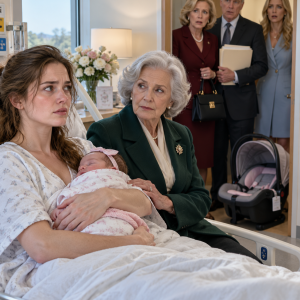
“Julia, families survive mistakes by showing mercy.”
“Did you consider mercy when you encouraged your son to send me downstairs?”
She looked away.
“We believed Serena was more useful to the business.”
“That sentence explains everything.”
Constance reached for my hand, but I moved it beyond her reach.
“I misjudged you.”
“You did not misjudge my bank account. You judged my humanity and decided it required evidence.”
The elevator doors opened.
My father waited inside without interfering.
Preston ran toward us before the doors closed.
“Julia, please come home. We can discuss the affair, the financing, and everything else privately.”
I removed my wedding ring.
“There is nothing private about how you treated me. The affair happened in hotel records, the financial misconduct happened in company accounts, and the humiliation happened before hundreds of witnesses.”
I placed the ring in his palm.
“My attorney will contact yours tomorrow.”
Part 5 – The Cost of Losing Protection

The forensic investigation lasted five months.
Serena had copied municipal proposals, client lists, development models, and confidential environmental reports. Her brother’s consulting company sold portions of that information to a competitor bidding against Bennett Urban.
She accepted a plea agreement and cooperated with prosecutors.
Preston was not charged with economic espionage, but investigators found that he approved false consulting invoices, used company funds for personal travel, and concealed material financial information from the board.
He was removed as chief executive and required to repay substantial compensation.
Bennett Urban did not collapse.
My father’s firm could have acquired the company at a distressed price, but I refused to support that strategy. Employees should not become prizes awarded to whoever possessed the greatest leverage during a scandal.
Instead, North Harbor converted part of its debt into noncontrolling equity while an independent infrastructure fund supplied new capital. The company retained its engineers, project managers, and public contracts under new leadership.
Preston accused me of taking his company.
The legal record showed that I protected it from him.
Our divorce proceeded under the prenuptial agreement. I recovered the marital funds used for Serena, retained my separate property, and waived any claim to Preston’s remaining personal assets beyond what restitution required.
Constance sent letters describing her declining health and the emotional damage caused by public embarrassment. Richard sent one shorter note accepting responsibility for his silence.
I responded to neither.
My marriage had trained me to treat every request for access as an emergency. Healing required discovering that another person’s discomfort did not automatically create an obligation.
Preston appeared outside my father’s residence once, standing in the rain beside the security gate. He requested five minutes.
I agreed to speak through the intercom because I no longer needed a dramatic confrontation.
“Serena lied to me,” he said. “She used me to reach the company.”
“She exploited what already existed.”
“I made mistakes, but I loved you.”
“You loved being cared for by someone you believed had no power to leave.”
His silence confirmed that the sentence reached somewhere he had avoided examining.
“Could we begin again?”
“Beginning again would require pretending the previous marriage lacked sufficient evidence. It did not.”
“What am I supposed to do now?”
“Become someone who respects people before learning what they can offer you.”
I ended the call.
Part 6 – The Table I Built Differently

One year after the gala, Waverly Global opened the Harbor Commons Initiative, a development program combining affordable housing, neighborhood healthcare, public transportation, and small-business financing.
I accepted the role of executive director after negotiating an independent board, transparent compensation, and authority separate from my father’s office.
I no longer wanted wealth hidden, displayed, or used as a test of affection. I wanted it governed responsibly.
At the program’s opening reception, the room contained city planners, community advocates, construction workers, health professionals, tenants, investors, and local business owners. There was no separate basement buffet and no family table protected from the people doing the work.
Every guest received the same meal.
My father noticed the seating plan and smiled.
“You redesigned the entire event around one terrible chair.”
“Around the belief behind it.”
Near the stage, a large circular table had no assigned head position. Community representatives sat beside institutional investors, while executives shared space with apprenticeship graduates and neighborhood organizers.
The arrangement irritated several donors.
That confirmed it was necessary.
Before my speech, Adrian handed me the final divorce judgment.
Preston had signed without requesting another meeting.
Bennett Urban continued operating under its new leadership. Richard resigned from the board. Constance sold the family’s oversized estate after financial guarantees connected to Preston’s management reduced their savings.
I did not celebrate those outcomes.
Consequences were not trophies.
When my name was announced, I approached the stage wearing the same navy dress from the previous gala. I had repaired a loosened seam but changed nothing else.
The dress had never been the source of humiliation.
I addressed the room.
“Development is often described through capital, land, engineering, and scale. However, every institution also reveals itself through something simpler: who receives a place at the table, who is expected to serve quietly, and whose dignity becomes negotiable when money enters the room.”
I looked toward my father.
“For several years, I believed hiding my family name would help me discover whether love could remain separate from wealth. I learned that secrecy cannot create character. It only delays the moment character becomes visible.”
After the ceremony, my father and I stood near the windows overlooking San Francisco Bay.
“Do you regret leaving?” he asked.
“I regret believing endurance was proof of sincerity.”
He nodded.
“Do you regret coming back?”
“Coming back was not surrender. Remaining dependent upon your decisions would have been.”
My father accepted that distinction. Our relationship had improved because he learned to offer support without directing the life it protected.
As guests began leaving, a young community organizer approached me.
“Mrs. Bennett, thank you for the speech.”
I smiled.
“It is Ms. Waverly now.”
The name no longer functioned as a secret weapon or a certificate of worth. It was simply mine, attached to decisions I made openly.
Later that evening, I walked through the empty reception space while staff cleared plates and folded linens. I stopped beside the circular table.
One year earlier, Preston believed removing my chair would establish my insignificance. He expected me to accept humiliation because he thought I had nowhere more important to go.
He misunderstood both the room and the woman standing inside it.
My father’s fortune did not make me worthy of respect. Preston’s betrayal did not make me powerful. The divorce did not create the person who eventually led Harbor Commons.
Those events merely removed the structures that encouraged me to ignore what had always been true.
Love without respect becomes dependency. Generosity without boundaries becomes exploitation. A seat offered only after someone discovers your status is not belonging.
I turned off the final table light and walked toward the exit.
Behind me remained a room designed without servants’ entrances, disposable guests, or chairs reserved according to social value.
It was not a perfect model for the world.
However, it was a table I had chosen to build differently.
THE END