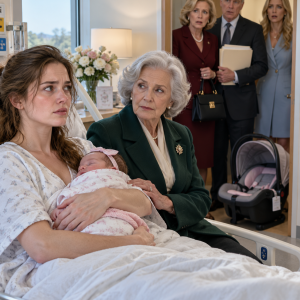
“How convenient,” she said. “She becomes critically ill on the exact day you planned to leave.”
Natalie’s face lost what little color remained.
“Mother, stop,” Owen said.
Margaret ignored him.
“Perhaps she discovered the papers and created this performance to keep control of the company.”
Paige picked up one of the insurance letters.
“These forms could belong to anyone. People manipulate medical documents constantly during divorces.”
Diane rose from her chair.
“My daughter may die, and both of you are discussing strategy.”
Natalie attempted to stand, perhaps intending to escape the argument, but pain suddenly twisted across her face. She pressed one hand against her abdomen and struggled for breath.
Owen reached her before she collapsed.
“Natalie, look at me.”
Her forehead rested against his shoulder.
“Please stop fighting,” she whispered. “I cannot listen to everyone tearing each other apart.”
Diane’s phone rang.
The call came from Natalie’s surgeon. New laboratory results and worsening symptoms suggested active internal bleeding. The operation could no longer wait until Monday.
Natalie needed emergency admission that evening.
Part 3 – The People Who Arrived Without Being Asked

Owen carried Natalie toward his truck while Diane gathered the medical folders. Margaret stepped forward, but Owen blocked her path.
“You will not speak about my wife as though illness makes her manipulative.”
Margaret looked stunned.
“I was trying to protect you.”
“You protected your assumptions. You never protected me from becoming cruel.”
The drive to Portland felt impossibly long. Diane sat in the back with Natalie’s head resting against her shoulder while Owen gripped the steering wheel. Rain began striking the windshield as traffic slowed near downtown.
At Cascadia Medical Center, a nurse recognized Natalie and covered her mouth.
“You told everyone you were visiting family.”
Natalie offered a weak smile.
“I was ashamed that I could help other families with their coverage but could not solve my own case.”
Owen leaned close.
“Needing help is not a professional failure.”
The surgical team confirmed that the operation had to begin before morning. However, because the specialist group was technically outside the preferred insurance network, the hospital’s finance department still needed a substantial guarantee while the emergency authorization was reviewed.
Owen stepped into the corridor and called Marcus Reed, his business partner.
“I need to sell the excavator tonight.”
Marcus did not ask whether Owen was serious.
“What happened?”
“Natalie needs emergency surgery, and I cannot cover the advance payment.”
“Do not sell anything until I arrive.”
Forty minutes later, Marcus appeared with two site supervisors. Behind them came electricians, carpenters, laborers, and several subcontractors from Marshall Construction. Someone had posted a message in the company group chat, and workers began arriving from across the city.
Some brought checks. Others transferred money through banking applications. A concrete finisher named Luis offered the savings he had set aside for a family vacation.
Owen tried refusing.
“You have children. Keep your money.”
Luis folded his arms.
“When my daughter needed physical therapy, you kept me on payroll while I missed three weeks. Do not insult me by pretending help only moves in one direction.”
A longtime foreman named Bernard placed an envelope containing several thousand dollars on the counter.
“This was supposed to cover my son’s winter tuition payment,” Bernard said. “The college will accept a payment plan. Your wife cannot place surgery on a payment plan with time.”
Owen’s rigid pride finally broke. He covered his face as Marcus held his shoulder.
A hospital administrator named Dr. Allison Greene arrived next. Natalie had spent years helping the hospital’s uninsured and underinsured patients complete financial-assistance applications.
“I have approved a temporary institutional guarantee,” Allison explained. “The remaining advance is covered, and our legal office will challenge the insurer after surgery. Natalie has spent years preventing families from being abandoned by paperwork. We will not abandon her now.”
Diane cried openly.
Margaret stood near the elevator, watching strangers offer money, time, and compassion without questioning whether Natalie deserved them. Paige remained beside her with her arms folded, although embarrassment had replaced hostility.
Before the medical team transported Natalie upstairs, she asked for a moment alone with Owen.
He approached the bed and took her hand.
“I am terrified,” she said.
“So am I.”
“You are supposed to tell me everything will be fine.”
Owen kissed her forehead.
“I will not promise what neither of us can control. I will promise that you will never face fear alone again.”
Natalie glanced toward his jacket pocket.
“Did you sign the divorce petition?”
Owen removed the torn envelope.
“I signed one page before I knew the truth.”
Pain moved through her expression.
He tore the remaining pages into smaller pieces and dropped them into the wastebasket.
“Those papers described the ending created by our silence. I am not signing that ending tonight.”
Natalie squeezed his fingers.
“We have damaged each other, even if neither of us intended to.”
“Then come back after surgery, and we will repair what can be repaired without pretending nothing happened.”
The orderlies began moving the bed.
Natalie kept looking at him until the operating-room doors closed.
Part 4 – Eight Hours Beneath Fluorescent Lights
The surgery lasted through the night.
Owen walked the corridor until his legs ached, then sat for several minutes before standing again. Diane prayed quietly. Marcus remained despite repeated suggestions that he return home. Bernard brought coffee and left sandwiches nobody touched.
Margaret eventually approached her son.
“Your father kept secrets from me for years,” she said. “When Natalie became distant, I believed I recognized the same pattern.”
Owen looked at her with exhausted anger.
“You recognized your own history and forced it over ours.”
“I thought warning you would prevent the humiliation I experienced.”
“Your warning almost convinced me to leave my wife while she was preparing to risk her life.”
Margaret began crying.
“I do not know how to repair what I said.”
“Start by apologizing to Natalie without explaining yourself first.”
Neither of them said the thought that followed.
Natalie had to survive before anyone could apologize.
Shortly after sunrise, the surgeon entered the waiting area. His scrubs were wrinkled, and fatigue darkened the skin beneath his eyes.
“The procedure was extremely complicated,” he said. “The tumor had attached to tissue near a major artery, and she lost a significant amount of blood.”
Owen felt the floor tilt.
“Is she alive?”
“She is currently stable. We removed most of the mass, although she will require additional treatment. Her heart rhythm became dangerously unstable for several moments, but the team restored it.”
Diane covered her mouth.
“Can we see her?”
“One person may enter briefly after the intensive-care team finishes.”
Owen entered the ICU twenty minutes later. Natalie seemed impossibly small beneath blankets, monitoring wires, and ventilation equipment. He sat beside her and held the hand that was not connected to an intravenous line.
“I do not know whether you can hear me,” he said, “but I need to confess something beyond the divorce papers.”
He explained how jealousy had grown because he felt powerless. He admitted allowing Margaret and Paige to define Natalie’s silence before he demanded a real conversation. He acknowledged that work had become a convenient reason to stop noticing the person beside him.
“You hid your pain and called it protection,” he continued. “I hid my insecurity and called it patience. We were both deciding what the other person could survive without asking.”
Owen found a hospital notepad and wrote slowly: