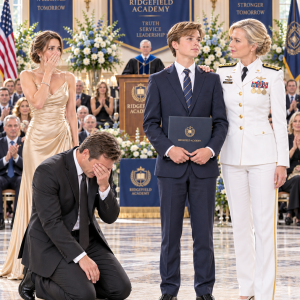
He lowered his face.
“Why did you never tell me?”
“Because your mother convinced me that love meant carrying the truth until you were strong enough to hear it. Eventually, I realized you had no reason to become stronger while everyone protected you from reality.”
Margaret began crying again.
“Caroline, I am sorry for what I asked you to do.”
I believed she regretted it. Regret, however, could not restore surgeries, years, or dignity.
“You asked a young wife to preserve your son’s pride by sacrificing her own body. I forgive myself for agreeing, but forgiveness does not require me to pretend the damage was harmless.”
Grant looked toward Natalie.
“Did you ever love me?”
She folded her arms.
“I loved the life you promised. You said Caroline would sign everything because she was too ashamed to fight.”
His expression collapsed.
“What about Derek?”
“Derek was useful before you became useful.”
The cruelty of her answer shocked even Derek.
He finally looked toward the closed office where the twins waited with the nanny.
“Whatever happens to us, the children should not be punished.”
That was the first responsible statement anyone among them had made.
“They will not be,” I replied. “Their legal interests will be handled separately from the fraud investigation.”
Grant asked whether I had ever intended to become a mother with him if the treatments succeeded.
“I intended to build a family with the man I believed you were. That man disappeared gradually because I kept protecting him from the choices that revealed his character.”
He whispered my name, but I gathered the remaining documents and left.
For the first time in eight years, I did not turn back to reassure him.
Part 6 – Consequences Without A Shield
The investigation lasted fourteen months.
Additional DNA testing confirmed Derek as the biological father of both twins. Natalie filed for child support, while Derek’s wife initiated divorce proceedings and provided investigators with financial records he had hidden inside a family investment account.
Federal prosecutors charged Natalie and Derek with wire fraud, conspiracy, money laundering, and theft from an employee benefit fund. Grant avoided the most serious criminal charges by cooperating, although he pleaded guilty to falsifying certifications and failing his fiduciary duties.
Natalie received a prison sentence after prosecutors proved she had created the shell companies and coordinated the invoices. Derek received a longer sentence because he designed the payment structure and attempted to destroy evidence after the board meeting.
Recovered assets reimbursed Aurora and restored the employee health reserve.
Grant lost his executive career, professional credentials, and every benefit linked to my trust. He moved into a rented apartment above an automotive repair shop in Waukegan and found temporary work selling medical equipment for a regional supplier.
He wrote to me repeatedly.
Some letters blamed Natalie, some blamed Margaret, and others blamed the physicians who had concealed his diagnosis. The final letters contained apologies, but I returned every envelope unopened because his understanding no longer required my participation.
Margaret testified fully, surrendering medical correspondence and admitting that she had pressured me into secrecy. She entered therapy and began volunteering with cancer survivors navigating fertility loss.
I did not restore our former relationship. I allowed one supervised lunch every few months because accountability had changed her behavior, although trust remained something she would have to rebuild without demanding a deadline.
My mother also apologized.
She admitted that she had discovered Natalie’s affair several months before the anniversary dinner but remained silent because she feared losing both daughters.
“I thought keeping the family together was better than exposing the truth,” she said.
“Silence did not keep us together. It only ensured that I stood alone inside the family.”
We began repairing our relationship slowly, without pretending motherhood made her decisions harmless.
Aurora survived the scandal and expanded its compliance division. Every executive approval above a modest threshold required independent review, while employees gained direct access to anonymous reporting channels protected from retaliation.
I named Helen chief ethics counsel and gave her authority equal to the financial office.
The company became stronger because we stopped treating reputation as more valuable than truth.
Part 7 – A Different Path To Motherhood

Six months after the divorce became final, I returned to the reproductive endocrinologist who had treated me during the marriage.
For years, I had associated the clinic with failure, anesthesia, bruised hope, and Grant’s disappointed silence. This time, I entered alone and asked a different question.
“What choices remain if I want motherhood without building my life around another person’s permission?”
The physician reviewed my preserved eggs and explained donor options, embryo screening, and the emotional realities of becoming a single parent.
I did not decide immediately. Freedom had taught me that urgency and courage were not the same thing.
After counseling and months of planning, I created embryos using donor sperm. One successful transfer led to the birth of my daughter, Lily Bennett, nearly two years after the anniversary dinner that ended my marriage.
When the nurse placed Lily against my chest, I felt no victory over Grant, Natalie, or Margaret. Revenge had nothing to do with the warmth of her breathing or the weight of her tiny hand against my skin.
Motherhood was not proof that I had been worthy all along. I had never needed a child to prove that.
It was simply a life I chose after I stopped allowing other people’s lies to define my possibilities.
Natalie had initially treated the twins as evidence of power. During the criminal proceedings, she gradually understood that the children were not bargaining tools, financial shields, or symbols of victory.
Their custody arrangement placed them primarily with Derek’s parents, who passed extensive background reviews and committed to maintaining stable contact with both incarcerated parents where appropriate.
I contributed nothing financially beyond ensuring that Aurora’s legal actions did not interfere with the twins’ court-ordered support accounts. The children deserved security, but I would not become responsible for repairing every life damaged by choices I had never made.
Part 8 – The Eleanor Bennett Center
One year after Lily’s birth, Aurora opened a reproductive health and advocacy center on Chicago’s South Side.
I named it the Eleanor Bennett Center for Reproductive Truth and Care after my grandmother, who had taught me that financial power carried obligations beyond inheritance. The center provided independent fertility testing, counseling after cancer treatment, legal support for medical coercion, and affordable reproductive care for patients who had been blamed, misled, or excluded.
At the opening ceremony, I stood in the courtyard holding Lily while physicians, nurses, advocates, and former patients gathered beneath a clear autumn sky.
Margaret remained near the back, respecting the boundaries we had established. She had testified, disclosed the secret she once protected, and spent two years learning that remorse did not entitle her to immediate closeness.
Grant stood outside the gate.
He looked thinner, older, and surprisingly ordinary without the tailored authority Aurora had once provided. When our eyes met, he mouthed two words.
“I am sorry.”
I adjusted Lily’s blanket and turned toward the stage.
His apology might have been sincere, but sincerity did not require a reunion, conversation, or reward.
During my remarks, I described the center’s purpose without mentioning Grant by name.
“People are often told that silence preserves dignity, protects families, or prevents unnecessary pain. In reality, silence usually protects the person with greater power while forcing everyone else to carry the cost.”
I looked toward women sitting beside partners, parents, friends, and children.
“Truth can be painful, but informed choices are impossible without it. No patient should undergo treatment because another person’s pride is considered more valuable than her body.”
After the ribbon was cut, my mother approached and touched Lily’s small shoe.
“Your grandmother would have been proud of this.”
“She would have asked whether the budget was sustainable before admitting it.”
My mother laughed through tears, and for once the sound did not carry shame.
Grant left before the reception ended. I saw him walking toward the parking lot alone, but I felt no urge to follow.
For eight years, he believed my silence meant emptiness, weakness, and surrender. He never understood that silence can also become the space where someone studies the records, measures the damage, and prepares to leave without losing herself.
I had signed the divorce papers before dessert because the marriage had already ended long before the ink dried. What began afterward was not revenge, although those who benefited from my silence preferred to call it that.
It was accountability, recovery, and the first life I built without asking anyone else to confirm that I deserved it.
THE END