Part 1 – The Gift Placed Beside Her Cradle
The silver rattle made a bright, delicate sound when Vivian Carrington lifted it from the velvet box and held it above my six-week-old daughter.
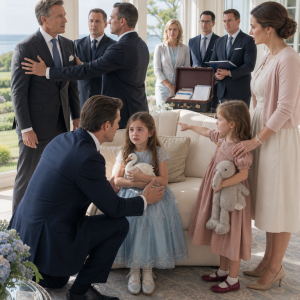
At first glance, the object appeared expensive enough for the conservatory gathering surrounding us. Its handle was engraved with curling vines, while a tiny crown decorated the top. White peonies filled tall glass arrangements along the windows, waiters carried champagne between clusters of relatives, and polished automobiles lined the circular drive outside the Carrington family estate near Richmond.
Then Vivian turned the rattle around, revealing the words engraved across the back.
PROPERTY OF THE CARRINGTON HOUSEHOLD.
Several people laughed.
My daughter, Emma, slept against my chest in a pale blue wrap, unaware that her grandmother had commissioned an heirloom declaring ownership over her before she could hold up her own head.
Vivian smiled at the audience before looking directly at me.
“Since my son has been generous enough to bring you into this family, I thought the baby should receive something explaining where her opportunities come from.”
Another wave of laughter traveled through the room.
My husband, Andrew, stood beside the fireplace holding a drink he had barely touched. His discomfort appeared in the way he adjusted his collar, but he did not interrupt his mother.
The Carringtons believed I came from an ordinary family in western Pennsylvania and worked as an administrative analyst for a federal agency. They knew my father had served in the military, although nobody had ever asked what he did or why senior officials occasionally called me directly.
Vivian preferred the simpler story.
I was the practical daughter-in-law without society connections, inherited property, or a recognizable surname. She gave me kitchen appliances for birthdays, corrected my pronunciation at charity dinners, and once introduced me to a state senator as the woman who helped Andrew remain organized.
In reality, I was Lieutenant Colonel Mara Sullivan, an intelligence officer assigned to a joint national-security command. Most of my work could not be discussed outside secure facilities, so allowing Vivian to dismiss it had once seemed easier than explaining why silence sometimes protected more than pride.
Motherhood changed that calculation.
Every humiliation I accepted now threatened to become a lesson Emma might someday inherit.
I looked at the rattle again.
“Please return it to the box,” I said.
Vivian’s smile narrowed.
“Do not be oversensitive. It is a family joke.”
“A joke requires more than one person finding it amusing.”
The relatives nearest us stopped laughing.
Vivian stepped closer and shook the rattle gently above Emma’s head. The sound awakened her, and she began to cry.
“Give her to me,” Vivian said. “You are making her anxious.”
I moved backward.
“No.”
The single word quieted the conservatory more effectively than shouting could have done.
Vivian looked toward Andrew.
“Are you going to allow your wife to insult me in my own home?”
Andrew placed his glass on the mantel.
“Mother, perhaps we should put the gift away.”
His answer arrived too late and too softly. Vivian heard it as negotiation rather than refusal.
“This gathering celebrates my granddaughter, and I will not be lectured by someone who has spent three years resenting every tradition she cannot understand.”
I removed my phone from the diaper bag and activated the camera.
Vivian noticed.
“What exactly are you doing?”
“Preserving the context you will later claim everyone misunderstood.”
Her cheeks darkened.
I recorded the rattle, the engraving, the guests who had laughed, and Andrew standing several feet away with the expression of a man waiting for someone else to rescue his marriage.
Then I lifted the diaper bag.
“I am taking Emma home.”
Andrew followed me into the hallway.
“Mara, do not leave like this. Mother was trying to provoke you, and you are giving her exactly what she wanted.”
I turned toward him.
“Your mother placed an ownership label beside our daughter and waited to see whether you would defend us.”
“It was a cruel joke, but leaving will turn it into a permanent conflict.”
“No, Andrew. Your silence already made it permanent.”
I drove away without raising my voice.
Inside the car, my hands began trembling only after the estate disappeared behind the trees. I sent the unedited recording to my father, General Daniel Sullivan, who had recently retired after four decades in military intelligence.
He called immediately.
“Are you and Emma safe?”
“Yes.”
“Send me the full guest list, every prior message from Vivian, and anything involving financial or custody arrangements.”
His tone changed slightly before he added, “Do not return to the estate alone.”
The next morning, Andrew arrived at our townhouse looking exhausted.
“My father has ordered everyone from yesterday’s gathering back to the estate at noon,” he said. “He says attendance is mandatory.”
I waited.
Andrew swallowed.
“Your father will be there, along with an attorney and someone from his former command.”
Part 2 – The Family Meeting Without Champagne
At noon, the Carrington estate looked almost identical to the previous afternoon, although nobody had opened the champagne.
The flowers remained in place, their edges beginning to curl beneath the conservatory heat. Uneaten pastries sat beneath glass domes, while relatives occupied sofas in rigid silence.
I arrived in my own car with Emma sleeping against me.
My father stepped from a dark sedan behind us. He wore a simple charcoal suit rather than a uniform, but age had not diminished the quiet command in his posture. Beside him walked attorney Rebecca Holt and retired Major Isaac Bennett, who now worked in corporate and personal-security investigations.
Dad looked at my face first, then at Emma.
“How long has she been asleep?”
“Almost half an hour.”
He touched one finger lightly against her covered foot.
“Excellent judgment. She is avoiding the meeting.”
Despite everything, I smiled.
Before we entered, Dad studied me carefully.
“This conversation belongs to you. I am here to support your decisions, not replace them.”
That sentence mattered more than he probably realized.
Inside, Andrew stood near the doorway. His eyes moved from Emma to my father and then to the attorney’s document case.
“Mara,” he said quietly.
I acknowledged him with a nod.
Andrew’s father, Henry Carrington, waited near the fireplace. He was a reserved man whose habit of avoiding conflict had allowed Vivian to define the family’s emotional weather for thirty years.
Vivian stood at the center of the room wearing pearls and a dark green dress. The velvet box containing the rattle sat on the table before her.
Henry spoke first.
“Colonel Sullivan, General Sullivan, thank you for coming. Yesterday’s event became more serious than anyone intended.”
Dad looked toward the box.
“It became serious when your wife used an infant as an instrument of public humiliation.”
Vivian released a sharp breath.
“General, private family humor often sounds severe to outsiders.”
“Patterns reveal intention more accurately than labels do,” Dad replied. “My daughter has received degrading gifts and remarks for years. Yesterday, the pattern reached her child.”
Vivian looked at me.
“So this is what you wanted, Mara. You wanted to arrive with important people and make me appear cruel.”
Emma stirred against my shoulder. I placed one hand across her back.
“Yesterday, you already had an audience. Today, I want accountability.”
“For an engraved rattle?”
“For teaching everyone in this room that disrespecting me earns approval. For treating Andrew’s silence as permission. For attempting to pass the same message to my daughter.”
Andrew stepped forward.
“Mara is right.”
Vivian turned toward him so quickly that her pearls shifted.
“You are exhausted and embarrassed.”
“I am embarrassed by myself,” Andrew said. “I kept calling your behavior complicated because admitting it was cruel would have required me to confront you.”
The admission hurt because I had needed it before leaving the party, not after lawyers and parents entered the room. Still, late honesty remained more useful than continued denial.
Henry closed his eyes briefly.
“Vivian, apologize.”
She laughed in disbelief.
“You cannot be serious.”
“I am completely serious.”
Rebecca opened her case and placed one document on the table.
The agreement established boundaries rather than demanding money. Vivian would have no unsupervised contact with Emma until trust was rebuilt. There would be no derogatory gifts, remarks about my family, attempts to control photographs or medical information, or gatherings where phones were collected to restrict documentation.
Vivian stared at the page.
“You expect me to sign rules governing conduct inside my own family?”
“No,” I said. “I expect you to decide whether access to my daughter matters more than maintaining authority over everyone around you.”
Her expression shifted.
Emma was not a bargaining object, but protecting her required conditions Vivian could understand.
Vivian looked toward Andrew.
“You would choose this woman over your mother?”
His shoulders lowered as though he had carried that question since childhood.
“I am choosing my wife and daughter. That should never have been described as choosing against you.”