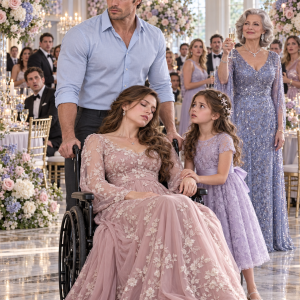
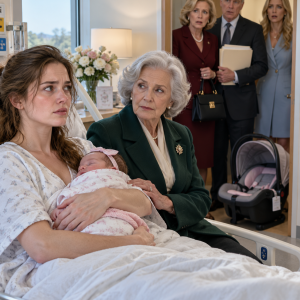
“I know exactly who your father is.”
Two Louisville police officers entered. Grant recognized the older one and appeared relieved.
“Officer Brennan, explain that this is a private misunderstanding.”
Brennan did not move toward him. His attention shifted repeatedly toward Samuel.
Samuel asked:
“Does Deputy Chief Elena Morales still supervise professional standards?”
The officer’s expression tightened.
Richard whispered:
“Samuel, please.”
That single word revealed more than panic. It revealed an older power arrangement collapsing.
Samuel looked toward me.
“Your mother left you more than a house and several family photographs. She inherited voting shares through her aunt, and those shares were never legally transferred to the Caldwell family.”
Grant frowned.
“What shares?”
I finally understood why Richard had always reacted angrily whenever I mentioned returning to compliance work.
“Shares in Caldwell Freight Systems,” I said. “The company your father claims his family built alone.”
Richard reached toward the wall for support.
Samuel’s late wife, my great-aunt Margaret Monroe, had helped establish the original freight business with Richard’s father. She owned thirty-four percent of the company when she died unexpectedly. Richard later produced documents showing she had sold her interest shortly before death.
Samuel had spent decades proving those documents were fraudulent.
“The shares passed into Margaret’s trust,” Samuel said. “Allison became the controlling beneficiary after her mother died.”
For the first time, Grant looked frightened.
Not because an old man might strike him.
Because records, ownership documents, and a woman inside a hospital bed had already begun moving against him.
Part 3: The Evidence My Family Had Preserved

Grant was escorted from the maternity floor while demanding an attorney. Richard attempted to leave with him, but investigators asked him to remain after Samuel mentioned possible bribery involving local officials and transportation permits.
I gave my statement while Lily slept beside me.
Samuel held a paper cup of water near my mouth because my hands still trembled.
“You completed the most difficult part,” he said.
“I survived it. That is not the same as finishing.”
“What do you want next?”
I looked at my daughter.
“I want Grant prevented from using money, reputation, or his father’s name to take her from me.”
Samuel nodded.
“Then we proceed carefully.”
Carefully meant no threats, no public revenge, and no emotional action that Grant’s attorneys could present as instability. It meant protective orders, authenticated evidence, independent experts, and consequences delivered through institutions the Caldwell family had spent years believing they controlled.
Within forty-eight hours, the court issued an emergency protection order prohibiting Grant from contacting me, entering my home, or approaching the maternity floor. I received temporary sole custody of Lily after the hospital photographs, social-worker report, recordings, and witness statements were submitted.
The second legal action targeted Caldwell Freight Systems.
Samuel’s attorney filed a civil complaint supported by original partnership agreements, bank records, notarized trust documents, and forensic comparisons of signatures. The complaint alleged that Richard created a false stock-transfer agreement after Margaret Monroe died, then moved her ownership interest through several holding companies until the shares appeared to belong entirely to the Caldwell family.
The original business had not been founded solely by Richard’s father. Margaret provided capital inherited from her parents, designed early payroll systems, and negotiated several contracts that allowed the company to survive its first decade.
After her death, Richard treated her contribution as a temporary inconvenience that could be erased from corporate history.
Samuel had preserved everything.
He kept carbon copies, meeting minutes, tax filings, letters from early investors, and one original certificate showing Margaret’s ownership. He also obtained evidence that a notary’s signature on the supposed sale agreement was created eighteen months after that notary died.
The lawsuit did not merely threaten Richard’s wealth.
It challenged the story upon which the entire Caldwell dynasty depended.
At the emergency custody hearing, Grant arrived wearing a navy suit and a calm expression carefully prepared for the courtroom.
His attorney described him as a concerned father responding to a postpartum crisis.
“Mrs. Caldwell has experienced anxiety throughout pregnancy,” the attorney said. “My client and his father attempted to stabilize an emotionally charged situation.”
Judge Helena Brooks opened the evidence folder.
“Mr. Caldwell, are you referring to the situation in which your wife sustained visible bruising around her throat?”
Grant remained composed.
“She became physically agitated during an argument.”
My attorney played an audio recording.
Grant’s voice filled the courtroom.
“Nobody will believe bruises on a hysterical woman after childbirth. My father owns enough people in this county to make the story disappear.”
The room became silent.
Richard closed his eyes.
Judge Brooks did not.
“It appears,” she said, “that your confidence in disappearing evidence was misplaced.”
The court continued my sole temporary custody, restricted Grant to supervised contact after psychological evaluation, and prohibited Richard from contacting me or the baby.
Outside the courtroom, Grant’s attorney attempted to negotiate.
“Mr. Caldwell will agree to anger-management treatment if Mrs. Caldwell withdraws the corporate action.”
Samuel answered before I could.
“Child safety and stolen ownership are separate matters. Neither will be traded for the other.”
Part 4: The Company Richard Built With Stolen History
The civil case triggered an independent board investigation at Caldwell Freight Systems. Three directors initially defended Richard, insisting the lawsuit concerned ancient family disagreements.
Then auditors discovered current misconduct.
Payments had been routed to consulting companies owned by relatives of county officials. Safety violations were removed from internal reports before regulators received them. Former employees described retaliation after questioning maintenance records, driver hours, and political donations.
The company’s respectable public image rested upon intimidation reinforced across decades.
Richard had not simply stolen Margaret’s shares.
He had built a culture where ownership, influence, and fear became interchangeable.
The board placed him on administrative leave. Several lenders froze expansion financing, and federal investigators requested records involving transportation contracts across Kentucky and Indiana.
Grant called Samuel from an unknown number.
“You are destroying hundreds of jobs to settle an old grievance.”
Samuel placed the call on speaker while I listened from his living room.
“The employees did not create fraudulent stock transfers or bribe inspectors.”
“My father protected that company.”
“Your father protected control.”
Grant changed tactics.
“Allison will never manage a logistics company while raising a newborn.”
I answered for myself.
“I worked in financial compliance before you pressured me to resign. I understand the company more clearly than you understand my life.”
His voice became cold.
“Lily belongs with the Caldwell family.”