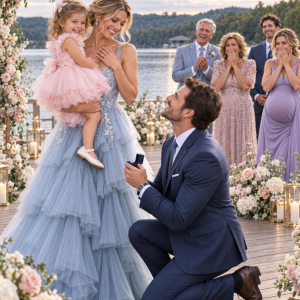
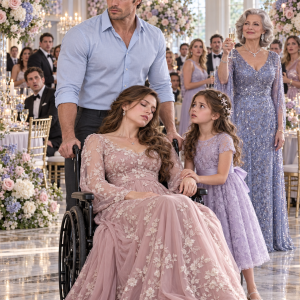
I stepped away before his fingers reached me.
“Did you instruct your office to withhold Marian’s letters?”
“I authorized enhanced screening because you were overwhelmed by wedding arrangements.”
“That was not my question.”
His eyes shifted toward the guests.
“I made a reasonable decision for our future, and I will not apologize for protecting you from emotional disruption.”
Marian gave me room to decide what happened next.
“A car is waiting if you wish to leave, although I will respect whatever choice you make.”
Warren finally recovered his voice.
“Nobody is leaving until you explain why a state investigator accompanied you.”
Marian turned toward him.
“That matter concerns the preservation contracts your company obtained through the Appalachian Renewal Program.”
Hollis Heritage Development converted historic buildings into luxury hotels, while Colton supervised a federal restoration program operating across three states.
The investigator removed a sealed evidence envelope from her briefcase.
Warren’s confidence cracked before anyone explained its contents.
Part 3: The Buildings That Existed Only on Paper

Marian asked whether I wanted the discussion moved away from the guests. I considered how frequently the Hollis family demanded privacy only after their own conduct became visible.
“The orchestra can take a break,” I said. “Everything else may continue exactly where Colton started it.”
The investigator introduced herself as Special Agent Lena Ortiz, who had spent eleven months examining grant reimbursements submitted by Hollis Heritage.
Marian’s involvement began through the Vale Center for Architectural Conservation, which reviewed endangered landmarks and maintained original plans for public buildings. Her staff noticed reimbursement requests for restoration work that contradicted photographs, permits, and archive records.
One project claimed six million dollars for stabilizing a textile mill demolished eighteen months earlier, while another charged taxpayers for slate roofing never installed. The most dangerous discrepancy involved the Red Hollow Children’s Library, where Hollis Heritage reported replacing fire barriers, electrical systems, and structural beams that remained untouched.
“The library opened three months ago,” I said.
Agent Ortiz nodded.
“It was closed this morning after an independent engineer identified overloaded wiring, unsupported flooring, and fraudulent inspection certificates.”
Warren pointed toward the investigator.
“Any discrepancies were created by subcontractors, and discussing an active inquiry at a social gathering is professionally irresponsible.”
“We did not come to announce charges,” Ortiz replied. “We came to preserve records scheduled for destruction tonight.”
Colton’s face turned rigid.
Marian opened a leather portfolio containing internal emails, demolition schedules, payment approvals, and mirrored copies of accounting ledgers. A whistleblower within Hollis Heritage had provided evidence that servers storing original invoices would be erased during a planned cybersecurity migration at midnight.
The authorization carried Colton’s electronic signature.
“Routine migration requests are approved in batches,” he said. “My signature proves nothing about individual files.”
Agent Ortiz removed a printed message.
“This instruction asks the technology director to ensure that legacy materials connected to Appalachian Renewal become permanently unrecoverable before Monday’s audit.”
Colton looked at Warren, and that single glance revealed an alliance neither man could explain away.
Warren lowered his voice.
“How did your organization obtain privileged corporate communications?”
Marian indicated the delivery truck near the gate.
“We did not obtain them from your company. Your executives donated forty-seven archival boxes to my conservation center after claiming the contents possessed no continuing business value.”
Hollis Heritage had discarded its own evidence through a charitable donation, and archive employees discovered carbon copies of invoices that no longer matched the digital records.
Shell contractors controlled by Colton’s former fraternity partner received nearly fourteen million dollars, then transferred money into ventures benefiting Colton and Warren. One transfer paid for the orchard wedding.
“Did public restoration money pay for this reception?”
Colton stepped toward me.
“The wedding was paid through a family events account, and you should not repeat accusations you do not understand.”
Marian placed another ledger on the table.
“The family events account received three transfers from Blue Ridge Materials Consulting, which billed the Red Hollow library for fireproofing that was never installed.”
For the first time that afternoon, Diane stopped defending her son.
“Colton, tell me that is not true.”
He did not answer her.
Instead, he turned his anger toward me.
“None of this would be happening here if you had respected my request to stop digging into those returned letters.”
I had not known about the investigation, but Colton’s accusation told Agent Ortiz that he believed I had.
Marian studied him carefully.
“What did you think Evelyn discovered?”
Colton realized his mistake too late.
Part 4: What He Hid Inside My Work
Three months earlier, Colton asked me to restore nineteenth-century municipal ledgers for an exhibition. I noticed modern pages sewn into old bindings, but he dismissed them as scrap paper reused during cataloging.
Agent Ortiz now showed me photographs of those pages.
The codes matched shell-company transfers, false certificates, and private property purchases. Colton had hidden transaction schedules inside artifacts delivered to my studio, intending to claim I inserted them if investigators discovered the evidence.
“You placed evidence in my studio,” I said.
His silence confirmed everything.