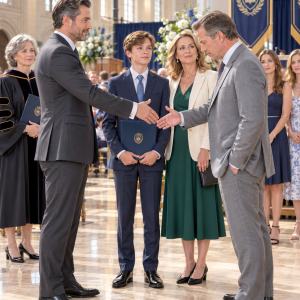
Part One: The License Filed Before Our Vows
Seventeen hours before my wedding in Seattle, I learned that my fiancé had legally married the woman he described as his most regrettable mistake.
I was standing inside the bridal suite of the Fairmont Olympic Hotel while two seamstresses adjusted the sleeves of my silk gown. Beyond the windows, rain softened the downtown towers, and the ballroom below was being transformed with cedar branches, white orchids, and suspended glass lights.
My closest friend, Lauren Brooks, sent the photograph without explanation. Graham Mercer stood outside the King County courthouse wearing the charcoal coat I bought for his birthday. Beside him, Celeste Ward held a marriage license against her ivory dress while his hand rested around her waist.
The courthouse clock showed 3:18 Friday afternoon.
At 3:24, Lauren called.
“Claire, I verified the license through the county filing system and spoke with the clerk’s office,” she said. “They completed a civil ceremony this afternoon, and the record is valid.”
I asked the seamstresses to leave, then locked the suite door. My wedding dress remained fastened around me while the future it represented disappeared with astonishing efficiency.
Graham and I had been together for eight years. He was the public face of Mercer Maritime Holdings, a family company operating ports, ferries, and coastal freight terminals throughout the Pacific Northwest. I was Dr. Claire Bennett, a cerebrovascular surgeon specializing in complex aneurysms at Cascadia University Medical Center.
Our wedding had become an event long before it remained a promise. More than three hundred guests were traveling from five states, the governor was expected at dinner, and Mercer Maritime had arranged a charitable announcement during the reception.
Graham’s grandmother, Margaret Mercer, had selected the date. She was seventy-eight, formidable, and recovering from a warning leak caused by an intracranial aneurysm that my team had monitored for eleven months.
I loved Margaret independently of the grandson who introduced us. She challenged hospital trustees, remembered nurses’ names, and never treated my medical authority as a charming accessory to Graham’s success.
My phone displayed a message from him before I could call.
Celeste’s mother is dying, and Celeste needed legal security before making decisions about the family property. The courthouse arrangement is temporary and private. Tomorrow remains unchanged, so please do not create a crisis that could endanger Grandmother.
I read the final sentence twice.
Graham had married another woman, yet he described my reaction as the dangerous event.
I removed the gown carefully and changed into black trousers, a cream sweater, and the raincoat hanging beside my luggage. Then I photographed every wedding contract, payment authorization, vendor invoice, and message connected to his explanation.
My attorney, Miriam Sloan, answered immediately.
“Do not sign anything, do not authorize additional payments, and preserve the original messages,” she said. “A public ceremony tomorrow could expose you to allegations that you knowingly participated in a fraudulent representation.”
“Can I recover the money paid from my account?”
“Some deposits are lost, although anything not yet earned can be frozen. More importantly, Graham cannot use your professional reputation to legitimize a ceremony after marrying somebody else.”
I called the hotel’s event director and revoked every outstanding authorization attached to my name. The Mercer family could continue paying for flowers, champagne, security, and the ballroom if they wished, but they would do so without access to my accounts.
Graham called seven times before I answered.
“Claire, tell me you are not canceling vendors over a legal technicality.”
“Marriage is generally more than a technicality on the evening before a wedding.”
“Celeste required protection because her mother’s estate is being challenged, and this arrangement gives her standing. We will dissolve it quietly after the situation stabilizes.”
“You cannot marry me tomorrow while remaining married to her.”
His silence lasted several seconds.
“The ceremony can proceed symbolically, and the formal license can be completed later.”
I sat beside two engraved champagne glasses bearing our initials.
“You want Celeste to receive the legal marriage while I perform the public one.”
“I want the people who depend upon us to avoid unnecessary humiliation.”
“You mean your family, your company, and yourself.”
His voice hardened.
“Grandmother’s blood pressure has been unstable, and you know emotional shock could trigger another hemorrhage. If you disappear tomorrow, whatever happens to her will follow you professionally and personally.”
That threat removed the final uncertainty from my decision.
“Margaret is my patient, Graham, which means her health will never become leverage in this conversation.”
I ended the call, placed my engagement ring inside its velvet box, and asked Lauren to book the earliest flight to Denver, where my sister lived.
Before leaving, I uploaded one file to the wedding video system. It contained no accusations, only the county record, Graham’s message calling his marriage temporary, and a written statement scheduled to appear if anyone publicly misrepresented my absence.
The ballroom could have its enormous screen.
It simply would not show a bride.
Part Two: The Ceremony Built Around an Empty Door
I reached Denver shortly after midnight and turned off every notification except calls from my hospital. Graham contacted me through unfamiliar numbers, his mother left pleading messages, and the Mercer family attorney demanded confirmation that I would honor contractual obligations.
I responded only through Miriam.
The following morning, Lauren entered the Seattle ballroom wearing the dark green dress selected for my maid of honor. She sat near the rear with her phone hidden beside the program and described events through an encrypted call.
At ten o’clock, guests filled the ballroom beneath thousands of white orchids. Graham waited beside the officiant, although his boutonniere disappeared after Margaret learned about the courthouse record.
At 10:14, Graham’s mother announced that a medical delay had affected the bride. At 10:27, the quartet repeated the processional. At 10:35, the hotel closed the entrance doors.
Then Graham stepped onto the stage alone.
“Claire has experienced an episode of severe professional exhaustion,” he told the guests. “Our family is supporting her through a private health crisis, and we ask everyone to respect her recovery.”
Lauren whispered, “He is telling them you had a breakdown.”
I watched snow move beyond my sister’s apartment window while anger settled into something colder than panic.
Graham understood exactly how an accusation of instability could damage a female surgeon. Exhaustion made male physicians dedicated, while the same condition could make women appear unreliable, emotional, or unsafe around patients.
He had married Celeste and was now attempting to turn my refusal into medical evidence against me.
“Activate the ballroom file,” I said.
Lauren sent the remote command provided by the hotel’s audiovisual manager. The enormous screen behind Graham changed from our engagement portrait to the official county record.
Three hundred phones rose almost simultaneously.
The next slide showed Graham and Celeste outside the courthouse. The final slide displayed his message explaining that their marriage was temporary and tomorrow should continue unchanged.
Beneath it appeared my statement: