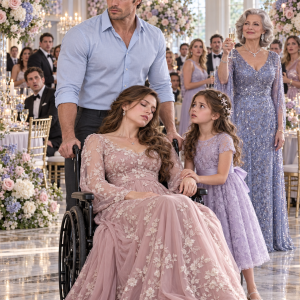
“Your personal relationships are no longer my concern,” I replied. “I hope you both enjoy the event.”
His expression revealed that indifference wounded him more deeply than anger would have. He had expected me to remain emotionally attached, whether through love or resentment, and he finally understood that I no longer organized my life around him.
That night, Daniel sent several messages claiming that he had changed, moved into a separate apartment, and confronted Lorraine. He asked whether we could rebuild our family.
I did not respond.
A man who recognizes a woman’s value only after strangers celebrate her is not necessarily grieving the pain he caused. Sometimes he is only grieving the loss of something he believed would remain available forever.
Part 5: The Witness Who Finally Spoke

Several weeks later, Daniel’s father, Charles Whitmore, visited my apartment. Charles had always been quiet, preferring newspapers and long walks to arguments with Lorraine. During my marriage, I had considered him harmless, but I had begun to understand that silence can protect harmful people as effectively as active support.
He sat on the edge of the sofa and placed an old phone on the coffee table.
“I recorded an argument with Lorraine after the temporary hearing,” he said. “I should have challenged her years ago, but I kept telling myself that avoiding conflict preserved the family.”
The recording captured Lorraine insulting my mother, describing Emma as difficult, and admitting that she had intended to control the custody arrangement because a public divorce would damage the Whitmore family’s reputation.
Charles’s voice could be heard confronting her and acknowledging that her treatment of Emma had crossed every acceptable boundary.
“I spoke once when I should have spoken repeatedly,” he told me. “My silence allowed her to believe nobody would ever stop her.”
He also offered a check for twenty-five thousand dollars.
“This is not payment for forgiveness. Place it in an education account for Emma, where Daniel and Lorraine cannot access it.”
After consulting Maya, I deposited the money into a protected college savings account. We also provided the recording to the court and CPS investigators.
The evidence supported a broader pattern of emotional abuse and confirmed that Lorraine viewed Emma less as a grandchild than as an extension of family authority.
During supervised visits, Daniel began attending parenting classes and individual therapy. He learned Emma’s allergies, favorite books, fears, and school routines. Although he was finally making an effort, I refused to confuse delayed responsibility with redemption.
A father should not require a judge, a therapist, and the threat of losing custody before learning how to comfort his own child.
Part 6: The Final Hearing
The final custody hearing occurred nearly eight months after I left the townhouse. Daniel requested joint custody and submitted evidence that he had moved away from Lorraine, completed parenting courses, and maintained consistent supervised visits.
The judge asked what he had learned about Emma.
This time, Daniel answered correctly. He knew she feared thunderstorms, disliked cooked tomatoes, loved drawing animals wearing human clothes, and needed quiet reassurance when overwhelmed.
I felt neither anger nor tenderness while listening. Memorizing details could not erase years of emotional absence, but it suggested that Daniel had finally begun seeing Emma as an individual rather than a responsibility managed by women around him.
The judge awarded me sole physical custody and primary legal decision-making authority. Daniel received structured visitation that could gradually expand if he continued therapy and complied with every recommendation.
He was expressly prohibited from bringing Emma into contact with Lorraine unless a child therapist and the court approved the arrangement. Child support was calculated according to his actual income, not the amount Lorraine considered socially acceptable.
Lorraine’s protective restriction was extended, and she was ordered to complete anger-management and family-boundary counseling before requesting any future modification.
On the courthouse steps, Daniel followed me while my mother walked ahead with Emma.
“I lost everything because I was afraid to stand against my mother,” he said.
I turned toward him.
“You did not lose us because you feared Lorraine. You lost us because you repeatedly chose her comfort over your daughter’s safety.”
He lowered his head.
“Do you think you will ever forgive me?”
“Forgiveness does not mean returning. It means I will no longer carry the weight of your choices.”
Daniel nodded slowly, and for once, he did not ask me to make his regret easier.
Part 7: The Home We Built Ourselves

Several months later, Emma and I moved into a bright two-bedroom apartment near her elementary school. It was not luxurious, but the windows faced a row of oak trees, the kitchen had enough space for two people to bake together, and Emma finally had a bedroom she could decorate herself.
I placed my grandmother’s gardenia beside the balcony door. It had lost leaves during every move, yet small green buds appeared after several weeks in the sunlight.
My mother visited whenever her schedule allowed, bringing casseroles, fruit, and more affection than the Whitmore townhouse had contained during all my years there. Rebecca arrived with coffee when deadlines became demanding, while Simone challenged my work without ever asking me to become smaller.
For the first time, the people surrounding me respected ambition rather than treating it as betrayal.
One winter evening, we celebrated the bonus I received after “Room to Grow” exceeded its national sales target. My mother baked an apple pie, and Emma set three plates on the table before noticing the gardenia near the balcony.
“Mommy, another flower opened!”
We gathered beside the plant while city lights flickered beyond the windows. Emma touched one white petal carefully.
“Do plants become scared when people move them?”
“Perhaps they do,” I answered. “But when they receive sunlight, water, and patience, they begin growing again.”
Emma considered my words before wrapping her arms around my waist.
“That sounds like us.”
Our apartment lacked marble floors, designer furniture, and rooms nobody used. We did not have the Whitmore family’s wealth or reputation. What we possessed was something I had once believed required permission from other people: peace.
Leaving Daniel had never been an act of revenge. It was the strongest expression of love I could offer my daughter and myself. Financial hardship could be addressed through work, planning, and support. A childhood shaped by fear could leave wounds that no bank account could repair.
I also learned that family is not defined by surnames or inherited blood. Family is revealed by the people who defend your dignity when doing so costs them something.
My mother offered the savings created through years of exhausting labor. Rebecca opened her home before asking for explanations. Mr. Price gave us a safe apartment when our finances looked uncertain. Simone restored a professional opportunity I had abandoned. Maya ensured that wealth did not silence evidence.
Most importantly, I finally became the person Emma needed to see: a mother who did not confuse submission with kindness.
Before bedtime, Emma switched on her rabbit-shaped lamp and climbed beneath the blankets. She no longer needed me to hold her hand through the night, although she still enjoyed asking questions after the lights dimmed.
“Mommy, are we a complete family now?”
I sat beside her and kissed her forehead.
“We were always a complete family. We simply escaped the place that taught us to believe otherwise.”
After Emma fell asleep, I left her door slightly open and stood beside the balcony window. The gardenia moved gently in the cool air without losing a single petal.
For years, I had waited for Daniel to protect us, Lorraine to respect us, and circumstances to become easier. I had believed that change would arrive when other people finally recognized the damage they caused.
I understood now that the miracle had never been their transformation.
The miracle was the moment I opened the door, reached for my daughter’s hand, and decided that we would build a life where love never required fear.
THE END