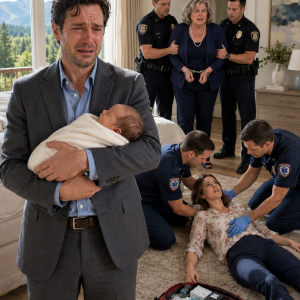
1. The Cup That Ended Everything
The first thing my husband said after throwing a mug of hot coffee across my face was not an apology.
He looked at the dark liquid dripping from my chin onto the pale limestone floor of my kitchen and said, “If you had stopped arguing, that would not have happened.”
For several seconds, I could not answer because the heat spreading across my cheek and neck had temporarily erased every thought except pain.
My name is Caroline Parker, and before that evening I had spent nearly six years convincing myself that my marriage was difficult rather than dangerous.
There is an important difference between those words.
I simply had not been ready to admit it.
My husband, Grant Parker, stood across the kitchen in our condominium overlooking downtown Boston, breathing hard as though I had attacked him rather than the other way around. His younger sister, Madison, was expected to arrive within the hour carrying two empty suitcases.
That was what started the argument.
Grant had announced over dinner that Madison would be taking several pieces of jewelry that had belonged to my grandmother, including a sapphire bracelet and an antique diamond brooch stored in my bedroom safe.
He did not ask.
He informed me.
“Madison is family,” he said. “Those pieces have been sitting there for years, and she has events where she can actually wear them.”
I stared at him across the kitchen island.
“They belonged to my grandmother.”
“And you are my wife.”
“Those two facts do not make them Madison’s property.”
Grant rolled his eyes.
“You always turn everything into a technical argument.”
That criticism had become one of his favorites.
I was a certified public accountant and had spent almost a decade working in audit before we married. I liked records, definitions, timelines, and the reassuring certainty of documentation.
Grant considered those habits charming when we were dating.
Once we were married, he called them controlling.
When I refused to open the safe, he raised his voice.
When I still refused, he stepped closer.
Then he picked up the mug.
I remember seeing his hand move.
I remember the coffee leaving the ceramic rim.
I remember the shocking heat.
Most clearly, I remember the silence afterward.
Grant stared at me with an expression that was almost annoyed.
“Look what you made me do.”
Something inside me changed.
Not loudly.
Not dramatically.
It simply stopped making excuses.
I walked into the bathroom, locked the door, and called emergency services.
Grant pounded on the door twice.
“Caroline, do not make this into something ridiculous.”
I looked at my reflection.
The left side of my face was already reddening.
Coffee had soaked the collar of my blouse.
“Grant, step away from the door.”
“Open it.”
“The police are coming.”
He became silent.
That silence frightened me more than his shouting.
Twenty minutes later, two Boston police officers stood in my kitchen while a third paramedic examined my skin. The burns were eventually documented as first-degree with several superficial partial-thickness areas along my jaw and upper neck.
Grant immediately changed his story.
He claimed he had accidentally knocked the mug during an argument.
The officers listened.
Then one of them asked why the mug was lying nearly twelve feet from the kitchen island.
Grant did not have a good answer.
Neither did he have an answer when Madison arrived carrying two empty rolling suitcases.
She stepped out of the elevator wearing expensive boots and a confused smile.
“What happened?”
One officer looked at the luggage.
“What are those for?”
Madison hesitated.
“I was picking up some things.”
I pressed a cold medical dressing against my cheek.
“My jewelry.”
Her eyes snapped toward me.
“Grant said you agreed.”
“I did not.”
Grant interrupted immediately.
“Nobody is stealing anything.”
The officer turned toward him.
“Then why did your sister arrive with empty suitcases after your wife says you demanded property from her?”
Madison looked at Grant.
Grant looked at me.
For the first time that evening, neither sibling seemed certain of the story they wanted to tell.
2. The Name on the Deed
The argument shifted from jewelry to the apartment because Grant believed property ownership gave him a stronger position.
He was wrong about that too.
“This is my home,” he told the officers. “She cannot call the police and throw me out of my own residence because we had a marital disagreement.”
One of the officers asked whether both our names appeared on the property deed.
Grant laughed.
“We are married.”
The officer repeated the question.
Grant looked at me.
I walked slowly toward the small office beside the kitchen and removed a document folder from the locked filing cabinet.
The condo had been mine for nine years.
I purchased it before meeting Grant using savings from my audit career and money left to me by my grandmother. The mortgage was paid off nearly two years before our wedding.
My father, a retired attorney, had once given me simple advice while reviewing my closing documents.
“Never transfer an asset you built yourself merely because someone believes marriage entitles them to a name on the paperwork.”
I never added Grant to the deed.
Not because I expected divorce.
Because ownership records should reflect ownership.
The officer unfolded the certified copy.
“Mr. Parker, I want you to read the owner listed here.”
Grant stared down.
His face slowly changed.
Madison moved closer.
“What does it say?”
The officer answered.
“Caroline Hayes. Sole owner.”
Hayes was my maiden name.
Grant looked at me.
“You told me we bought this place together.”
“No. I told you we were building a life together here.”
“That is the same thing.”
“Not legally.”
The officer folded the document carefully.
“The property predates the marriage and appears to be titled solely to Mrs. Parker.”
Madison crossed her arms.
“That does not mean she can just remove him.”
The second officer finally spoke.
“She is requesting emergency protective relief following a documented domestic incident. Exclusive possession can be addressed through that process.”
Grant turned toward me.