Part One: Seven Candles and a Stranger
The first time my seven-year-old daughter changed the direction of our lives, she did it with thirteen dollars, a crooked birthday cake, and a stranger crying outside a bakery in downtown Burlington, Vermont.
Lucy Parker had spent almost four months saving every coin she could find. She folded napkins for my employer, Mrs. Dawson, carried groceries upstairs for our elderly neighbor, and surrendered most of her weekly allowance to a glass jar labeled BIRTHDAY CAKE in purple marker. She wanted vanilla cake with strawberry frosting, white sugar flowers, and seven candles arranged in a perfect circle.
Instead, on the afternoon before her birthday, Lucy stood behind the counter of Dawson’s Bakery and pointed through the front window.
A man sat alone on a stone bench across Church Street while fresh snow collected on the shoulders of his expensive charcoal coat. He looked about forty, perhaps a little older, with carefully cut dark hair, polished leather shoes, and the posture of someone accustomed to entering rooms where everyone else immediately paid attention.
None of that impressed Lucy.
What she noticed was that he was crying.
“Mom, can I use my cake money for him?”
I stopped wrapping a box of cinnamon rolls.
“Use your birthday money for a stranger?”
“He looks like he needs the cake more than I do.”
“You have been saving for months, sweetheart.”
“I can save again.”
I looked toward the man. A pale blue envelope rested between his hands, and although he was doing everything possible to remain composed, his shoulders occasionally shook beneath the wool coat.
“You do not know him,” I reminded her.
Lucy considered that carefully before answering.
“I do not have to know somebody to see they are sad.”
Mrs. Dawson had been listening from the kitchen. Without saying anything, she placed a six-inch vanilla cake on the counter, covered it with strawberry frosting, and added several white flowers that were slightly uneven.
“Employee family discount,” she announced.
“I am not an employee,” Lucy protested.
Mrs. Dawson raised an eyebrow.
“You organize my napkins whenever your mother turns around, so I believe the Department of Labor might disagree.”
Lucy counted thirteen dollars and eight cents onto the counter. Mrs. Dawson returned most of it and slipped a single candle into the bakery box.
Ten minutes later, Lucy and I crossed the snowy street together.
The stranger noticed us only when Lucy stopped several feet from the bench.
“Excuse me, sir?”
He looked up immediately, and for one unguarded second the grief on his face was almost difficult to witness. Then something practiced returned to his expression, as though he had spent years learning how to conceal private pain before important meetings.
“Yes?”
Lucy held out the cake.
“I bought this for you.”
The man stared at the box.
“Why would you do that?”
“Because you were crying.”
His eyes moved toward me.
I gave a cautious shrug. “It was entirely her decision.”
He looked back at Lucy.
“It is not my birthday.”
Lucy sat on the far end of the bench while keeping a respectful distance.
“Maybe it belongs to whoever you are missing.”
His fingers tightened around the blue envelope.
“My daughter,” he said quietly.
“What is her name?”
“Emma.”
Lucy smiled faintly.
“That sounds like a birthday name.”
The man lowered his gaze.
“She would have turned fifteen today.”
Lucy’s expression changed.
“Would have?”
I touched her shoulder gently, but the stranger raised one hand.
“It is all right. She passed away six years ago.”
Lucy looked at him for several long seconds.
“Did she like strawberry cake?”
Something unexpected moved across his face.
“She loved it.”
Lucy immediately brightened.
“Then we accidentally bought the right one.”
The stranger laughed once, but the sound collapsed into a breath. Lucy opened the box, placed the single candle in the center, and asked whether he had a lighter.
He did.
Under falling snow, my daughter sang happy birthday to a child she had never met.
When she reached Emma’s name, the man closed his eyes.
Afterward, Lucy said, “You should make a wish for her.”
“It is not my birthday.”
“The candle does not know that.”
He leaned toward the flame.
Before blowing it out, Lucy whispered, “Maybe wishes can keep going when people cannot.”
The man covered his face immediately after the candle went dark.
Lucy panicked.
“Mom, did I make him worse?”
I sat beside her.
“Sometimes crying means something painful finally found a way outside.”
The stranger eventually lowered his hands.
“My name is Nathaniel Reed.”
I froze.
Almost everyone in Vermont knew that name.
Reed Medical Center. Reed Hotels. Reed Renewable Energy. Reed Foundation. The glass headquarters overlooking Lake Champlain carried his family name across twenty floors.
Nathaniel Reed was not simply wealthy. He chaired one of the largest private holding companies in New England.
Lucy, completely unimpressed, offered him a plastic fork.
“I am Lucy, and this is my mom, Hannah.”
He accepted the fork.
“Thank you, Lucy.”
A black SUV pulled to the curb moments later. A man in a navy overcoat hurried toward us.
“Mr. Reed, the board has delayed the development vote twice already.”
Nathaniel’s expression changed instantly.
“Then delay it again, Peter.”
“The governor’s office is participating.”
“The governor has survived disappointment before.”
Peter looked at Lucy, the cake, and then at me as though none of this belonged in the known universe.
Lucy noticed something beneath Nathaniel’s shirt collar.
“You have one too.”
Nathaniel looked down.
Around Lucy’s neck hung a silver pendant she had worn since infancy: one half of a small sunburst.
Nathaniel slowly pulled a chain from beneath his shirt.
The pendant hanging from it was the missing half.
When the pieces were brought together, their broken edges matched perfectly.
Nathaniel went completely still.
“Where did she get that?”
Every protective instinct inside me awakened.
“It came with her adoption records.”
His face changed.
“Lucy is adopted?”
“Not exactly.”
I took my daughter’s hand.
“She was conceived through an anonymous embryo donation program.”
Nathaniel looked at the completed sunburst in disbelief.
Then his eyes rose to mine.
“Which clinic?”
I hesitated.
“St. Margaret Family Institute.”
The blood seemed to leave his face.
Part Two: The File I Had Buried
Lucy and I lived above an old bookstore on Pearl Street, in an apartment whose radiator had stopped working eleven days earlier. I spent that night heating water on the stove and pretending Nathaniel Reed had not somehow carried the missing half of my daughter’s necklace.
Lucy sat wrapped in two blankets at the kitchen table.
“Is Mr. Reed my father?”
“We do not know anything like that.”
“But the necklace fits.”
“Jewelry is not evidence.”
She considered this.
“You say that like a detective.”
“I say that like a tired mother.”
What I did not tell her was that the necklace had arrived with her embryo-transfer documents seven years earlier. The small package contained no sender information, only a handwritten card.
For the child who was protected twice.
My late husband, Michael, and I had assumed it was a sentimental message from the anonymous donors.
After two miscarriages and several failed treatments, we had enrolled in St. Margaret’s embryo donation program. I carried Lucy myself, delivered her in Burlington, and became her mother before she opened her eyes.
The donors’ identities remained legally sealed.
Michael died in a highway accident four years later, and I had raised Lucy alone ever since while working full-time at Dawson’s Bakery.
That should have been the entire story.
Except St. Margaret’s was connected to another part of my life.
When I was nineteen, I gave birth at the same hospital complex.
My first daughter, Grace, was born after thirty-eight weeks of pregnancy. Doctors told me she had suffered catastrophic complications during delivery and had not survived. I was heavily sedated, devastated, and alone except for my mother, who insisted for years that something about the hospital’s explanation had never made sense.
I never held Grace.
I received no photograph.
I was told everything had already been handled.
The next morning, Nathaniel sent a single message.
I will not contact Lucy or investigate her without your permission. However, the sunburst belonged to my late wife, Caroline. She broke it into two pieces shortly before she died.
A photograph followed.
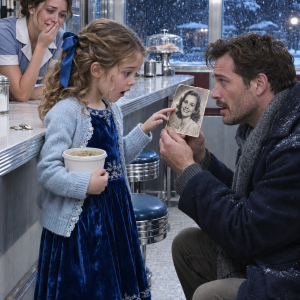
Nathaniel stood beside a red-haired woman and a smiling nine-year-old girl.
Emma.
Caroline wore Lucy’s half of the sunburst.
I stared at the photograph until my hands went numb.
Another message appeared.