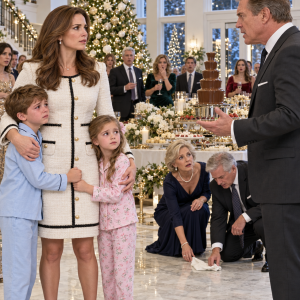
Part 1: The Child He Dismissed
At forty-one, Rebecca Lawson finally delivered the son she had wanted through years of fertility treatments, disappointing test results, and silent drives home from specialists. When nurses placed Caleb against her chest, his fingers curled beneath her collarbone, and she believed every painful year had led toward that single moment.
Her husband, Marcus Lawson, approached the hospital bed and studied their newborn without touching him. After nearly twenty years together, Rebecca understood his emotional restraint, but the emptiness in his expression felt unfamiliar.
“He looks considerably smaller than I expected,” Marcus said before returning to his telephone.
Within several weeks, late work meetings became overnight absences, while business dinners expanded into weekends away. Rebecca remained home in Columbus, Ohio, feeding Caleb at impossible hours and inventing explanations whenever headlights failed to enter their driveway.
The truth arrived through a message illuminating Marcus’s telephone beside the nursery chair. Someone thanked him for the previous night and wrote that she missed him already. Marcus entered before Rebecca could convince herself she had misunderstood.
“Who sent this message while I was nursing our newborn son?”
Marcus showed no embarrassment. “Her name is Kayla, and she is eighteen years old.”
Rebecca stared at the man she had trusted through nearly two decades of disappointment. “You are abandoning your wife and infant for an eighteen-year-old girl?”
He sighed as though her grief created an inconvenience. Looking toward the nursery, Marcus delivered the sentence that remained inside Rebecca for fifteen years.
“A baby born to an old woman will probably become slow and ordinary anyway.”
Two days later, Marcus carried his suitcases toward the front door. Caleb slept near the window beneath a blue blanket knitted by Rebecca’s sister, Melissa.
“Someday you will understand that leaving gives you the life you wanted more than I ever did,” Marcus said.
“Someday you may become capable of recognizing what you abandoned.”
He promised he would never return begging and closed the door almost gently. Rebecca expected dramatic endings to sound louder, but the quiet click followed her through every exhausted night afterward.
Part 2: The Years Built From Ordinary Courage
Single motherhood arrived through overdue bills, fragmented sleep, frozen casseroles, and grocery lists written across envelopes. Marcus paid only what their divorce agreement required, then moved away before Caleb’s third birthday.
Kayla disappeared before Caleb learned to walk, although Rebecca experienced no satisfaction when Melissa reported the news. Measuring Marcus’s unhappiness would still allow him to determine whether she felt victorious.
“I refuse to spend my future calculating whether consequences have made him miserable enough,” Rebecca said.
Caleb developed quietly. At twelve months, he spoke fewer sounds than several playmates, while at two he preferred studying toy wheels. Marcus’s prediction returned whenever the house became silent, so Rebecca consulted pediatricians without making Caleb feel examined.
At two years and four months, Caleb observed Rebecca and Melissa struggling to assemble a secondhand bookcase without instructions. He eventually approached, selected a short wooden brace, and positioned it correctly against the side panel.
“This part belongs there because the holes match the picture,” he explained.
Following his directions, they completed the entire structure within minutes. Rebecca cried after putting him to bed, not because extraordinary intelligence had suddenly become certain, but because she recognized how much time she had spent searching for evidence that Marcus was right.
That evening, she promised Caleb would never believe his value depended upon disproving his father.
During preschool, Caleb’s teacher, Mrs. Alvarez, showed Rebecca drawings containing bridges, road intersections, building corridors, and arrows tracking movement through their local library.
“Caleb recognizes relationships between systems unusually quickly, but we should challenge him without turning difference into isolation,” Mrs. Alvarez advised.
Rebecca followed that principle through advanced mathematics, science programs, blueberry pancakes, and ordinary friendships. Caleb remained gentle and funny, loving numbers without becoming nothing except numbers.
Part 3: The Family That Chose to Remain

Rebecca retrained as an administrative coordinator for the Franklin County education office and worked three mornings each week at the neighborhood library. There she met Gabriel Torres, an architectural engineer volunteering with a design program for middle-school students.
Gabriel spilled coffee across forty permission forms, then stayed late to recreate them. He had been widowed for five years, while his nineteen-year-old daughter, Elena, studied nursing.
Gabriel never treated Caleb’s intelligence as entertainment. He taught him how structures carried weight and why beautiful buildings failed. Caleb corrected Gabriel’s spreadsheets and mocked his outdated drafting pencils.
Two years after meeting Rebecca, Gabriel proposed inside the library after closing. Caleb helped arrange battery-powered candles while Elena guarded the entrance from confused patrons.
“I cannot promise that our family will avoid every fracture,” Gabriel told Rebecca, “but I promise nobody inside it will face the repair alone.”
By fourteen, Caleb had grown reserved without becoming withdrawn. He maintained friendships, played soccer enthusiastically, volunteered at the library, and repaired discarded computers.
During a statewide engineering competition, his transportation model attracted Professor Helen Ward from prestigious Stanton University in western Pennsylvania. She invited him into a six-week summer research program normally reserved for older students.
“They cannot possibly understand that I still lose my house key three times weekly,” Caleb said after opening the invitation.
Stanton provided a full scholarship, and Caleb spent the summer working alongside graduate researchers on traffic systems serving isolated rural communities. Faculty members praised his analytical ability, but they emphasized his willingness to explain difficult concepts without humiliating younger participants.
That autumn, Stanton offered Caleb admission through a selective early-college initiative beginning when he turned fifteen. Rebecca feared he would lose adolescence inside an institution built for adults, while Gabriel asked whether refusing might teach him that comfort mattered more than growth.