Gabriel never competed for Caleb’s loyalty. When Rebecca asked whether Marcus’s return threatened him, Gabriel answered calmly.
“Love is not a chair where one person must stand whenever another person sits down.”
At sixteen, Caleb began taking most classes at Stanton while returning home each weekend. He earned a disappointing grade in university physics, sought help from his professors, and learned that belonging did not require constant brilliance.
The scholarship helped him, but it did not define him. Margaret’s additional trust remained supervised until he turned eighteen, giving him time to consider how inherited money could serve something beyond personal achievement.
Part 7: The Ceremony He Had Waited Fifteen Years to See

When Caleb turned eighteen and gained control of the educational trust, he created a transportation-access program connecting rural teenagers with advanced academic opportunities. Stanton provided matching funds, Gabriel’s engineering firm donated technical help, and Marcus contributed quietly without requesting naming rights.
The program launched in the same hall where Caleb had attended his early-admission ceremony. Mrs. Alvarez, Melissa, Elena, Rebecca, Gabriel, and Marcus sat in the front row.
At the microphone, Caleb held Adrian Blackwell’s university pin and spoke about the people who had shaped him.
“My biological great-grandfather created a scholarship for someone he would never meet. My grandmother turned secrecy into anonymous service. My mother built a life where achievement was never the price of love, and Gabriel taught me that showing up matters more than claiming a title.”
Then Caleb looked toward Marcus.
“My father taught me something through failure and repair: an apology cannot restore lost time, but consistent actions can create honest time afterward.”
Marcus lowered his head before looking at his son again. The arrogance Rebecca remembered from the nursery was gone. Caleb had every reason to close the door forever, yet he had left space for Marcus to return responsibly.
After the ceremony, Marcus approached him carefully.
“I am proud of you, although I know pride does not create ownership.”
“You can simply say you are proud without adding a legal disclaimer,” Caleb replied.
Marcus laughed through tears. Rebecca recognized the beginning of something imperfect but genuine.
Caleb remained at Stanton, completed his degree, and later accepted a research position designing transportation systems for underserved communities. His intelligence opened institutional doors, but his character determined that others could pass through them too.
Marcus gradually entered family holidays. He arrived early, helped Gabriel cook, and accepted whenever Caleb protected traditions created during his absence. Rebecca and Marcus never became close friends, but they eventually communicated without returning to old bitterness.
At Caleb’s graduation, Marcus praised Rebecca for raising an extraordinary young man. She corrected him.
“I stayed at the beginning, but staying mattered because I allowed other good people to enter his life.”
Part 8: The Life He Did Not Need to Prove
At twenty-two, Caleb returned home for a summer gathering with Leah, a thoughtful young woman who laughed at his worst jokes. Marcus and Gabriel discussed repairs beneath the maple tree while Melissa claimed she had predicted every important family development.
At sunset, Caleb sat beside Rebecca and asked whether she ever wished their life had been easier.
“I cannot erase the painful years without also erasing everything that grew afterward,” she answered. “But I would never call the pain necessary.”
Caleb looked across the yard toward Gabriel, Elena, Melissa, and Marcus.
“You never made me feel responsible for becoming impressive enough to justify everything you sacrificed.”
“You were never a debt that needed repayment,” Rebecca replied. “Your father’s insult was never an assignment you needed to complete.”
Across the yard, Marcus asked whether Caleb had purchased tickets for an upcoming engineering conference.
“Remember that I am twenty-two and capable of managing an electronic ticket,” Caleb called.
Marcus laughed.
“Your age has never prevented you from losing important objects.”
The exchange sounded ordinary, and that made it more meaningful than any dramatic reconciliation. Marcus would never recover the fifteen years he abandoned, and Caleb never pretended those years had vanished. Their relationship survived because forgiveness remained a process with boundaries rather than a reward granted after one emotional confession.
Rebecca had once feared Caleb would spend his life trying to disprove a cruel sentence spoken before he understood language. Instead, he became more than a gifted student, researcher, and scholarship recipient. He remained compassionate without being naïve, allowed Gabriel’s love to remain secure, and invited Marcus into a carefully limited place.
Marcus had expected a university ceremony to reveal a brilliant son whose success might redeem him. Instead, Adrian’s letters exposed a family history of fear, while Caleb demonstrated that inherited wounds did not have to become instructions for hurting the next generation.
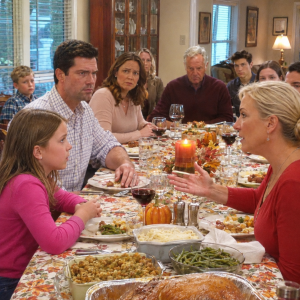
When darkness covered the yard, Gabriel turned on the string lights. Melissa accused Marcus of taking her chair, Elena served dessert, and Caleb stood beside Rebecca laughing at an argument too harmless to require repair.
Marcus had abandoned a newborn after calling him ordinary and slow. Fifteen years later, he entered an archive expecting to learn why Caleb belonged at Stanton and discovered why he himself had spent a lifetime running from belonging.
Caleb could not return the years his father had discarded. He offered something more difficult: enough room for Marcus to become accountable without allowing remorse to control the family.
His greatest achievement was not entering college at fifteen or inheriting a mathematician’s gifts. It was learning that love could leave a door unlocked without surrendering the right to decide who entered, how they behaved, and whether they were allowed to remain.
THE END