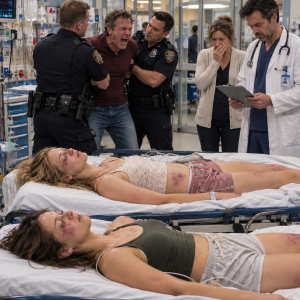
According to one entry, I supposedly wanted my husband to focus on his essential clinical responsibilities rather than visit me.
That version of me sounded familiar because I had spent years becoming exactly the wife Nathan found convenient.
I was competent.
Independent.
Understanding.
Flexible.
Eventually he had stopped asking whether I actually wanted to be any of those things at any particular moment.
Then Rebecca received additional hospital records.
Security-card data showed that Nathan had reached my floor twice.
The first time was Day Twenty-Three at 1:17 a.m.
He remained approximately seventeen minutes.
The second time was the night before my discharge.
He arrived at 11:42 p.m.
He remained forty-two minutes.
The family waiting area was roughly twenty yards from my room.
I remembered that night.
I had been awake near the window, wrapped in a gray hospital blanket, wondering whether Nathan might appear before morning.
He had appeared.
Almost.
PART 5: THE ELEVEN-PAGE STATEMENT

Nathan voluntarily submitted an eleven-page statement during the privacy investigation.
For three days, I refused to read it.
Eventually, curiosity became stronger than anger.
Nathan admitted immediately that he had known temporary exemptions were allowed during transplant isolation.
He had not misunderstood the protocol.
He simply never applied.
His explanation began professionally.
He convinced himself that leaving a tightly coordinated international transplant program would disrupt care for other patients.
Then he wrote that the professional explanation had been reasonable but personally dishonest.
The next pages revealed something I had never fully understood.
When Nathan was seventeen, his mother died after complications from leukemia.
She spent nineteen days hospitalized in Milwaukee.
Nathan visited almost every afternoon.
His father, Dr. Robert Mercer, an orthopedic surgeon working in the same hospital, rarely came upstairs.
On the night Nathan’s mother deteriorated, seventeen-year-old Nathan called his father and begged him to come.
Robert was completing surgery.
By the time he arrived, his wife was unconscious.
She never woke again.
Nathan spent decades believing his father valued medicine more than the woman he loved.
Years later, Robert explained that he had been able to function inside an operating room because surgery gave him tasks he could perform.
Beside his dying wife, there had been nothing he could fix.
Nathan had judged him mercilessly.
Then I almost died.
Nathan recognized the same terror inside himself.
At fifty-seven, the celebrated cardiovascular surgeon became the frightened seventeen-year-old boy who knew exactly what every medical term meant and could do absolutely nothing about it.
During isolation, policy became an excuse.
After isolation ended, even that excuse disappeared.
Nathan described going to my floor on Day Twenty-Three.
He saw me sleeping in a chair near the window.
He stayed in the waiting area and left without entering.
The night before discharge, he returned.
This time, I was awake.
He watched from down the corridor and kept telling himself he would enter once he was calm enough not to burden me.
Instead, shame grew stronger with every minute.
He had already been absent twenty-nine days.
Entering on the thirtieth required explaining the first twenty-nine.
So he remained twenty yards away.
At 12:24 a.m., he left.
The next afternoon, when I asked why he had never visited, he said:
“I was too busy.”
In his written statement, Nathan called that sentence a lie.
He also admitted telling care coordinators that I wanted him to focus on work.
He wrote that throughout our marriage, I had often been generous about his career, and he gradually transformed my generosity into permanent permission.
The sentence that hurt most was simple:
He had described the wife he needed me to be so he would not have to confront the husband he had become.
PART 6: UNDERSTANDING WAS NOT RECONCILIATION
My therapist, Dr. Miriam Foster, asked whether Nathan’s explanation changed my decision.
The answer came faster than I expected.
“No. I still want the divorce.”
Understanding why Nathan abandoned me emotionally did not undo the abandonment.
More importantly, I finally understood that the hospital had not created our problem.
It had exposed a pattern already present for years.
Our tenth-anniversary dinner had been abandoned for emergency surgery.
Reasonable.
My father’s seventieth birthday had been delayed by three hours because Nathan stayed to finish paperwork.
Less reasonable.
The weekend celebrating my promotion disappeared because he accepted a speaking invitation.
When a close colleague of mine died unexpectedly, Nathan comforted me briefly before returning mentally to medicine.
None of those moments individually looked catastrophic.
Together, they revealed a marriage in which I had trained myself to need my husband only when needing him was convenient.
I had called that independence.
It was actually self-erasure.
I agreed to one twenty-minute meeting with Nathan in Rebecca’s conference room.
He was already waiting when I arrived.
For one disorienting moment, he looked exactly like the man I had loved for twelve years.
Tall.
Dark suit.
Gray beginning at the temples.
Then I noticed the exhaustion.
“You look healthier,” he said.
“I am.”
Nathan did not ask me to withdraw the divorce.
He did not defend himself.
He confirmed the childhood trauma and told me his father had visited after learning about my hospitalization.
Nathan also revealed that he had taken leave from surgery.
“Because of the investigation?”
“Partly.”
“What is the other reason?”
He looked almost embarrassed.
“I started therapy.”
Despite everything, I laughed.
So did he.
It was the first moment between us in months that did not feel destroyed.
When our twenty minutes ended, Nathan promised to sign every document Rebecca sent.
At the door, I stopped him.
“I have not forgiven you.”
He nodded.
“I know.”
“But I do not hate you.”
Something in his face softened.
“That is more kindness than I expected.”
PART 7: CONSEQUENCES WITHOUT REVENGE

Franklin Memorial completed its privacy investigation.
Nathan received a formal written disciplinary action, mandatory privacy retraining, six months of enhanced monitoring, and removal from two administrative committees.
His surgical work eventually resumed on a reduced schedule.
I felt relieved that accountability had occurred without me controlling the punishment.
The hospital had treated him like any other physician.