She stared at his handwriting.
For the first time since entering the room, she had nothing to say.
Then I placed my phone on the table.
I played fifteen seconds of security footage.
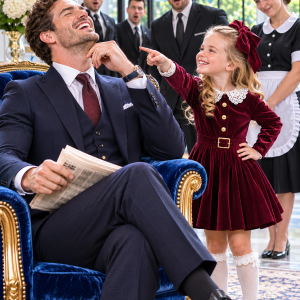
Emma reaching toward the jeweled egg.
Margaret grabbing her braid.
My daughter falling.
Lauren telling me not to make a scene.
I stopped the video.
Lauren began crying.
Margaret turned pale.
“That’s misleading. You’ve removed everything from context.”
Something inside me finally changed.
For years, I hoped my mother might eventually acknowledge her mistakes.
Now I understood she would continue looking for explanations that allowed her to avoid responsibility.
“You pulled a four-year-old child to the floor by her hair.”
Margaret looked away.
“I didn’t intend for her to fall.”
“I no longer care what you intended. I care about what you did.”
I stood.
Jonathan and I had already submitted Emma’s medical records and the security footage to the appropriate child-protection authorities and police.
We had also obtained a temporary protective order preventing Margaret from approaching Emma while the investigation remained active.
My mother stared at me.
“You reported your own mother?”
I answered.
“I protected my daughter.”
Her voice rose.
“I AM YOUR MOTHER!”
For thirty-six years, that sentence had controlled me.
It triggered guilt.
Fear.
Obligation.
And the belief that disobedience made me a bad daughter.
Not anymore.
I looked directly at her.
“And Emma is my daughter.”
Silence filled the room.
Lauren finally spoke through tears.
“Mother, you really do need medical help.”
That admission seemed to hurt Margaret more than any financial document.
She stood unsteadily.
Then she left.
PART 6 — THE CONSEQUENCES THAT FOLLOWED
The following weeks unfolded slowly.
There was no dramatic police raid.
The mansion was not sold overnight.
The legal and financial processes required time.
The mortgage entered restructuring negotiations.
As trustee, I refused to authorize the sale of protected heirlooms to cover Margaret’s personal debts.
Some investments and possessions belonging solely to her were eventually liquidated to reduce the outstanding balance.
Lauren persuaded Margaret to undergo a neurological evaluation.
Doctors diagnosed early-stage cognitive decline.
The diagnosis helped explain her increasing forgetfulness, disorganized finances, and unpredictable anger.
But it did not erase responsibility.
I learned to distinguish between understanding why someone behaved badly and pretending their behavior had caused no harm.
Lauren began therapy.
Our relationship did not heal simply because she had apologized once.
Sometimes she sent messages.
Sometimes I answered.
Sometimes I chose not to respond.
I no longer considered that cruelty.
It was a boundary.
One month after Easter, Emma sat at our kitchen table eating pancakes covered in maple syrup.
She looked up at me.
“Mommy, has Grandma learned how to be gentle yet?”
I carefully set down my tea.
“She’s still learning, sweetheart.”
Emma thought about my answer.
“When she learns, can she visit us?”
I glanced toward Jonathan.
Then I looked back at our daughter.
“When I’m completely certain it’s safe for you, we can talk about that.”
Emma nodded.
Then she returned happily to her pancakes.
For her, the answer was enough.
For the first time, it was enough for me too.
PART 7 — THE MANSION I NO LONGER CALLED HOME

The historic Savannah mansion remained protected inside the trust.
Oakridge Holdings no longer covered Margaret’s expenses automatically.
Every major decision concerning preservation required proper review.
The antiques my mother attempted to remove were returned to protected storage.
Helen Whitfield continued supervising their conservation under the trust’s authority.
I visited the mansion only when necessary for business.
Strangely, once I legally controlled its future, the building stopped controlling me emotionally.
For most of my life, I believed preserving the mansion meant preserving my family.
I had been mistaken.
A house could survive for generations while the people inside it continued hurting one another.
A respected family name could remain polished even when its relationships were damaged beyond recognition.
Money could preserve antique furniture, paintings, stonework, and silverware.
It could not manufacture kindness.
My actual home was smaller.
It had fewer chandeliers.
No ancestral portraits.
No expensive decorations that children were forbidden to touch.
Instead, it contained a four-year-old girl who regularly spilled syrup on her pajamas and a husband who made deliberately misshapen pancakes because making her laugh mattered more than preparing a perfect breakfast.
One Saturday morning, Jonathan flipped a pancake so badly that half of it folded over itself.
Emma burst into laughter.
“Daddy! That one looks like a shoe!”
Jonathan examined the pancake seriously.
“That’s because it’s a very sophisticated pancake.”
Emma giggled.
“It looks like Grandpa’s slipper!”
I started laughing too.
Jonathan pointed the spatula toward me.
“I’d appreciate a little professional support from my wife.”
I raised an eyebrow.
“I manage wealth, not pancakes.”
Emma laughed even harder.
I looked around our kitchen.
There was no Waterford crystal.
No jeweled Easter centerpiece.
No demand for $150,000.
No relatives evaluating whether my clothing was appropriate for their social standing.
There was only sunlight, warm pancakes, and the people who loved me without expecting me to disappear for their comfort.
PART 8 — THE FAMILY I ACTUALLY SAVED
For years, I believed protecting family meant absorbing their debts.
Keeping their secrets.
Enduring humiliation.
And spending whatever was necessary to prevent outsiders from discovering how unstable everything had become.
I confused sacrifice with loyalty.
Eventually, I learned that protecting family could require doing the opposite.
Sometimes it meant refusing to continue financing destructive decisions.
Sometimes loving someone meant insisting that they receive medical treatment while maintaining distance from the harm they caused.
And sometimes protecting a child meant accepting that relatives would call you cruel because you refused to exchange her safety for artificial peace.
Margaret spent decades teaching me that motherhood entitled her to obedience.
Emma taught me something different.
Motherhood was responsibility.
When Margaret threw us out of Easter dinner, I initially believed I had finally lost the family whose approval I had spent thirty-six years trying to earn.
Months later, I understood that evening differently.
I had not lost my family.
I had stopped losing myself to preserve relationships that demanded too much and protected too little.
The mansion still stood outside Savannah.
It remained preserved through a trust my father had established because he understood the danger of confusing inheritance with unrestricted ownership.
Perhaps Emma would someday walk through those historic rooms again.
Perhaps Margaret would eventually become stable enough, gentle enough, and accountable enough to see her granddaughter safely.
Perhaps not.
I no longer needed to predict that future.
My responsibility was not to guarantee Margaret access to Emma.
My responsibility was to keep my daughter safe.
One morning, Jonathan carried another plate of imperfect pancakes toward our kitchen table.
Emma looked at me with maple syrup on the tip of her nose.
“Mommy, are we staying home today?”
I wiped her face gently with a napkin.
“Yes, sweetheart. We’re staying home.”
For most of my life, I believed home meant the historic estate my ancestors had protected for generations.
Now I understood that property records and beautiful walls had never defined it.
Home was where my daughter could admire something beautiful without being afraid of punishment.
Home was where nobody demanded pain as proof of loyalty.
Home was where love and safety were allowed to mean the same thing.
And after thirty-six years, I finally knew exactly where mine was.
THE END