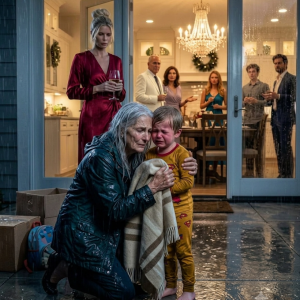
I realized he’d manipulated both his sister and his wife to create an arrangement that benefited him.
I sent Nicole a brief explanation.
“I never volunteered to supervise the boys or finance their vacation, and Brandon made those promises without consulting me.”
I also reminded her that her brother was an adult who had willingly taken responsibility for the trip.
At O’Hare, I checked in for my flight, passed through security, and found a quiet seat near the departure gate.
My hands were still trembling slightly.
But when I looked at my boarding pass, I felt something I’d almost forgotten.
I was allowed to make decisions about my own life.
PART 4 — FOURTEEN DAYS IN THE INDIAN OCEAN
The journey to the Maldives included a long international flight, a connection through Doha, and a final transfer across the Indian Ocean.
By the time the seaplane approached the resort, exhaustion had been replaced by excitement.
Below us stretched turquoise lagoons, brilliant coral formations, and tiny islands surrounded by pale sand.
Two resort employees welcomed me with chilled towels and fresh coconut water.
My villa stood above the ocean, with glass floor panels, a private infinity pool, and wooden steps leading directly into the lagoon.
I placed my suitcase beside the bed and walked onto the terrace.
For several minutes, I simply listened to the water moving beneath the structure.
Then I cried.
The tears weren’t caused by regret.
They came from recognizing how long I’d treated my own happiness as something that required another person’s approval.
I silenced the family group chats, leaving one emergency contact channel available in case the children experienced a genuine medical problem.
During the following days, I swam near colorful reef fish, watched sea turtles, read novels beside the water, and enjoyed meals without checking the time.
I slept until I felt rested.
I booked spa treatments and watched brilliant sunsets without worrying about somebody else’s schedule.
Occasionally, messages from Brandon interrupted the peace.
At first, they were furious.
“I cannot believe you left me responsible for three children when you knew how difficult this trip would become!”
Later, they became increasingly desperate.
“Nicole won’t send more money, Andrea, and everything in Myrtle Beach costs considerably more than I expected.”
Then came a request to transfer money into our joint account because his credit card was approaching its limit.
I didn’t send additional money.
He had arranged the trip, and the children’s mother remained available to assist with their needs.
I later learned that the vacation had been considerably less relaxing than Brandon imagined.
The eighteen-hour Greyhound journey was exhausting, particularly when Leo became carsick and Mason lost his tablet.
Their inexpensive Airbnb was located farther from the beach than advertised, with unreliable air-conditioning and worn furniture.
Nicole had given Brandon only three hundred dollars toward the children’s expenses for the entire two weeks.
When he requested more money, she reminded him that he’d promised everything was already covered.
Brandon eventually used his personal credit card for meals, attractions, and necessities.
On the fourth day, Mason became ill after eating seafood from a street vendor.
Brandon took him to urgent care and received a medical bill exceeding eight hundred dollars.
Thankfully, Mason recovered without lasting complications.
On the seventh day, Tyler accidentally dropped Brandon’s iPhone into the swimming pool, damaging it beyond practical repair.
Two days later, Leo spilled a blueberry smoothie across Brandon’s work laptop.
The device required professional attention.
Between the damaged electronics, childcare responsibilities, and unexpected expenses, Brandon’s dream of relaxing with cold beer on the beach collapsed.
He spent his days washing clothes, managing arguments, preparing meals, and making sure three children remained safe.
For the first time, he experienced the constant responsibility he’d previously dismissed as simple.
Meanwhile, I spent fourteen days rediscovering the pleasure of choosing how to spend my own time.
PART 5 — THE FOUR-THOUSAND-DOLLAR LESSON

My flight returned to Chicago after two peaceful weeks.
When I switched on my telephone, hundreds of notifications appeared.
Brandon had called repeatedly, Nicole had sent accusatory messages, and my mother-in-law, Margaret, had left a voicemail criticizing my behavior.
“A good wife doesn’t leave her husband struggling with family responsibilities, Andrea, especially when those responsibilities involve innocent children.”
I listened without responding.
Nicole’s messages complained that I’d ruined the only vacation she’d planned for herself that year.
Brandon’s final messages sounded different.
“Please come home, Andrea, because I know I handled everything terribly, and I need to apologize properly.”
I returned to our apartment around eight that evening.
The living room looked as though a small storm had passed through it.
Children’s shoes, deflated swimming toys, open suitcases, and leftover food containers occupied nearly every surface.
Brandon sat at the dining table with his head resting in his hands.
His face was sunburned, his eyes were shadowed by exhaustion, and he hadn’t shaved properly in days.
When he looked up, he stared at me in disbelief.
“You really spent two weeks in the Maldives while I was dealing with everything that happened in Myrtle Beach?”
I placed my suitcase beside the door.
“Yes, Brandon, and those fourteen days were exactly the vacation I’d worked so hard to afford.”
He laughed bitterly.
“I spent more than four thousand dollars, barely slept, and dealt with one disaster after another.”
I sat across from him.
“How much money did Nicole contribute toward the trip you told her I was financing?”
He looked away.
“Three hundred dollars, although I genuinely believed you’d help cover the expenses once we arrived.”
I opened the screenshot Nicole had sent.
“Explain why you told your sister I wanted to practice being a mother and volunteered to pay for everything.”
His expression changed immediately.
He admitted he’d exaggerated my enthusiasm because he wanted Nicole to feel comfortable leaving the boys with us.
I shook my head.
“You didn’t exaggerate anything, Brandon, because you invented my agreement and then expected me to protect your reputation by accepting the consequences.”
He stared down at the table.
“I thought you’d eventually enjoy spending time with the boys, and I didn’t realize how overwhelming the responsibility would become.”
I reminded him that I’d warned him repeatedly.
“You knew I wanted a quiet holiday, and you chose to replace it with unpaid childcare because you assumed my wishes mattered less than your family’s convenience.”
For several moments, he said nothing.
Then he began describing the sleepless nights, financial stress, and constant worry involved in supervising three children.
His voice sounded genuinely exhausted.
I listened without interrupting.
Finally, he looked directly at me.
“I understand now that I treated your work and your time as though they belonged to me, and that was selfish.”
I appreciated the acknowledgment.
But I wasn’t ready to accept an apology as proof that everything had changed.
PART 6 — THE CONFRONTATION WITH HIS FAMILY
The following morning, Margaret and Nicole arrived at our apartment, determined to discuss what they described as my irresponsible behavior.
Margaret entered first, wearing an expression of practiced disapproval.
“We need a serious conversation about your responsibilities to this family, Andrea, because what happened during that vacation was unacceptable.”
Nicole immediately began complaining.
“You ruined my break completely, and Brandon kept calling me because he couldn’t manage the children or afford their expenses.”
I poured myself a cup of coffee and remained seated.
“Those are your children, Nicole, and Brandon was the person who promised to supervise them without asking whether I agreed.”
Nicole insisted that families should support one another.
I agreed with the principle but challenged her interpretation.
“Family support requires agreement, honesty, and reasonable expectations, rather than secretly assigning somebody else two weeks of childcare and financial responsibility.”
Margaret slammed her hand against the table.
“I won’t allow you to insult my daughter in a home that belongs to this family!”