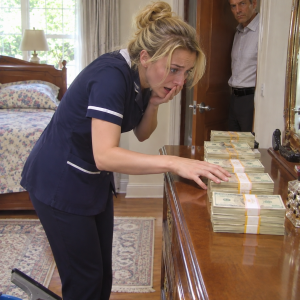
I showed him the documents.
Then another folded page slipped from the blue folder.
It was a letter from Robert Harrison, written two months before Mother’s death, recommending immediate revisions to her estate plan because of concerns about unauthorized property transactions.
Matthew’s expression changed.
“Mother knew Nathan was trying to control the house, and she never told either of us how serious things had become.”
Before I could answer, my telephone vibrated.
Nathan had sent a photograph of Mother’s house taken from across the street.
The message underneath read:
“You need to decide whether you want to cooperate or make this situation unpleasant for everyone.”
I preserved the message.
The following morning, I visited Harrison’s office and described the threat.
He confirmed that Mother had amended her estate documents, although he explained that certain supporting materials had to be handled through the formal estate process.
Then he gave me advice that surprised me.
“Stop discussing property decisions with your husband, Caroline. Preserve every message, and let the evidence establish what actually happened.”
He also recommended consulting an independent attorney about my marriage.
I left knowing that Mother had prepared something more substantial than an ordinary inheritance.
She had apparently anticipated the very confrontation Nathan was trying to force.
Part 4 — The Signature I Never Wrote
When I returned to Mother’s house, an unfamiliar envelope lay on the kitchen table.
The doors were locked, and I couldn’t determine when it had been delivered.
Inside was another copy of the property-management authorization.
This time, the signature line wasn’t blank.
Someone had written my name in handwriting that closely resembled mine.
The document was dated three weeks before Mother’s death.
Vanessa’s signature appeared beside a statement identifying her as a witness.
I knew immediately that I hadn’t signed it.
I photographed each page, recorded where I’d found the envelope, and contacted Harrison.
He advised me to preserve the document exactly as received and avoid discussing its authenticity directly with Nathan.
Twenty minutes later, my husband called.
“Did you receive the paperwork, Caroline? I think it’s time you stopped pretending you don’t understand what you’ve already agreed to.”
I kept my voice steady.
“I received a document bearing my signature, but I know exactly which documents I’ve signed and which ones I haven’t.”
Nathan’s tone changed.
“If you continue questioning me, I can show everyone the paperwork and let them decide whether you’re being reasonable.”
I didn’t argue.
Instead, I asked him to direct further estate-related communications to the attorney.
After the call ended, I returned to Mother’s desk.
Behind the property records, I discovered a shallow compartment containing a sealed envelope addressed to me.
A handwritten instruction appeared beneath my name.
Open this only when you understand why I saved it.
I sat at her desk for a long time before opening it.
Inside was a letter, a certified copy of the deed, and a small USB drive.
Mother wrote that Nathan had approached her during the previous autumn, proposing that she transfer the property into my name while allowing him to administer it.
She had refused.
She’d also discovered that Vanessa had attended at least one meeting concerning the house without authorization to act on Mother’s behalf.
Mother had preserved copies of the proposed documents and communications because she feared Nathan would pressure me after her death.
I connected the USB drive to my laptop.
Several folders contained emails, drafts, and scans.
One exchange showed Nathan proposing that he and Vanessa move quickly after obtaining my authorization.
Vanessa warned that I might refuse if I understood the proposed sale.
Nathan responded:
“Then we won’t tell Caroline what we’re planning until the documents are completed.”
Another folder contained an unsigned authorization, a version displaying the disputed signature, and a scan of my driver’s license.
The resemblance between the documents was unmistakable.
I copied the materials for legal review, taking care not to alter the originals.
Mother hadn’t merely suspected her son-in-law.
She’d documented what she could while she was still alive.
Part 5 — The Missing Seventh Document

Harrison examined Mother’s letter and digital records the following morning.
He explained that the materials raised serious concerns about misrepresentation and possible forgery, but proper authentication and investigation would still be necessary.
I appreciated his caution.
My professional experience had taught me that strong suspicions were not substitutes for verified evidence.
“Mother knew you might need these records, Caroline, and she instructed the estate to preserve them if anyone attempted to use unauthorized documents involving the property.”
I asked about a missing item in the numbered estate files.
The sequence moved directly from document six to document eight.
Harrison identified document seven as a special instruction Mother had approved when she revised her estate plan.
It directed the executor to safeguard and disclose relevant evidence to appropriate parties if anyone attempted to obtain control of the house through unauthorized representation or fraudulent paperwork.
The instruction didn’t automatically determine criminal guilt or remove legal rights.
But it made Mother’s intentions unmistakable.
“She wanted her wishes documented, not debated with someone who might profit from confusing the facts,” Harrison explained.
He then showed me the confirmed provisions concerning the house.
Mother intended to leave it to me alone, subject to ordinary estate administration.
She’d made separate arrangements for Matthew and left small gifts to charities she’d supported for years.
I was overcome by the care she’d taken.
Then Harrison explained the next step.
A meeting would be held that afternoon so the interested parties could receive an explanation of the will and the relevant documentary concerns.
Nathan had insisted on attending.
Vanessa was accompanying him.
I asked whether it was wise to allow them into Mother’s house.
Harrison assured me that the meeting would be controlled and that unauthorized demands would not be entertained.
Matthew arrived shortly afterward.
I finally showed him everything, including the USB files and the document bearing my disputed signature.
He read the emails without speaking.
Then he looked at me.
“I’m sorry I kept searching for an innocent explanation, Caroline. I thought Nathan couldn’t possibly be planning something this deliberate.”
I understood his disbelief.
Nathan had spent years presenting himself as calm, helpful, and practical.
He rarely raised his voice until someone refused to follow his plans.