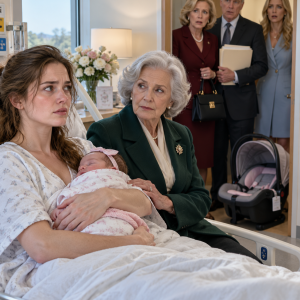
The Morning No One Would Listen

Three days after giving birth to her first child, Caroline Hartwell stood barefoot in the living room of her home outside Madison, Wisconsin, holding her newborn son against her chest and begging her husband to look at him.
Samuel had been restless through the night, but shortly after sunrise his breathing changed. Each breath seemed shallow and uncertain, followed by pauses that lasted long enough to frighten her. His fingers felt unusually cool, and a faint bluish tint had appeared around his lips.
Caroline knew exhaustion could magnify a new mother’s fears, yet this was not imagination. Something was wrong.
Her husband, Peter Langford, was beside the front door checking flight information on his phone. Two suitcases stood behind him, along with the expensive leather carry-on belonging to his mother, Marilyn.
“Peter, please put the luggage down and call an ambulance,” Caroline said. “Samuel needs a doctor.”
Peter barely glanced in her direction.
“You haven’t slept,” he replied. “You’re working yourself into another panic.”
Marilyn adjusted the silk scarf around her neck and sighed as though Caroline were delaying an important appointment. She had arrived before Samuel’s birth promising to help, but most of her time had been spent correcting Caroline’s feeding schedule, criticizing the nursery, and explaining that women of her generation had been much stronger.
“Babies get cold,” Marilyn said. “Wrap him in another blanket and stop searching for problems.”
Caroline pulled the blanket away instead. Samuel’s chest moved unevenly beneath his cotton sleeper.
“Look at his mouth,” she pleaded. “That color isn’t normal.”
Peter stepped closer, studied his son for only a moment, and shook his head.
“My mother raised three children,” he said. “You’ve been doing this for seventy-two hours. Maybe trust someone with experience.”
The words landed more heavily than Caroline expected. During her pregnancy, Peter had attended every appointment, assembled the crib twice because the first arrangement did not satisfy him, and promised that they would make every decision together. Now, when their child needed him most, he treated Caroline like an inconvenience.
She reached toward the coffee table for her phone.
Marilyn picked it up first.
“You are not calling emergency services because a baby’s hands feel cool,” she announced.
“Give it back to me.”
“After you rest.”
Caroline tried to cross the room, but pain from the recent delivery forced her to stop. Her knees weakened, and she steadied herself against the sofa while keeping Samuel secure in her arms.
“Peter, tell her to return my phone.”
Instead, Peter opened Caroline’s handbag and removed her credit card.
“We’re already late,” he said.
Caroline stared at the suitcases. Until then, she had assumed the trip had been postponed.
Months earlier, Peter and Marilyn had reserved five nights at an oceanfront resort near Savannah, Georgia. Caroline’s delivery had come sooner than expected, and she believed no reasonable father would leave his three-day-old child for a vacation.
“You’re still going?” she asked.
“I need a few quiet days,” Peter answered. “Everything lately has become an emergency with you.”
“Your son is struggling to breathe.”
Marilyn slipped Caroline’s phone into her coat pocket.
“Your son is fine,” she said to Peter. “Your wife needs sleep and perspective.”
Before leaving, Peter leaned toward Samuel and touched his forehead.
“We’ll sort everything out when I get home.”
Then he followed his mother outside.
The front door closed, and their car pulled away from the curb. Caroline was left alone in a silent house, without her phone, without access to her credit card, and barely able to walk across the room.
Samuel released a thin, strained sound.
That was when Caroline stopped asking herself whether she might be overreacting. She wrapped him carefully against her chest, opened the front door, and stepped into the cold Wisconsin morning.
The Record of Every Minute

Caroline could not move quickly, but she made it as far as the sidewalk before calling for help. Her voice carried across the quiet street until Margaret Bell, a retired librarian who lived two houses away, came outside with a grocery bag in her arms.
The moment Margaret saw Samuel, she placed the bag on the pavement and dialed emergency services.
“Help is coming,” she told Caroline, putting an arm around her shoulders. “Stay with me. You did the right thing.”
At St. Catherine’s Children’s Hospital, nurses carried Samuel into a treatment room while another staff member helped Caroline into a wheelchair. Bright lights passed above her as she was taken down a corridor, still trying to explain that her husband had left with her phone.
A pediatric specialist eventually sat beside her and spoke in a calm, measured voice. Samuel had been born with a serious heart condition that had not appeared during the routine screening performed after delivery. His body was not receiving enough oxygen, and he needed immediate treatment.