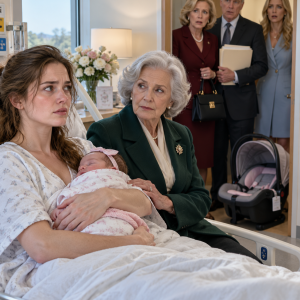
“You noticed an important change,” the physician said. “Bringing him here gave our team a chance to help him.”
A hospital social worker named Linda Avery arrived soon afterward.
“You said someone prevented you from calling us,” Linda said gently. “Can you tell me exactly what happened?”
Caroline described the suitcases, the missing phone, the credit card, and Peter’s decision to leave. As she spoke, Linda wrote down every detail, including the approximate time of each conversation.
For the next two days, Samuel remained in intensive care while specialists did everything available to support him. Caroline stayed nearby, wrapped in a hospital robe, watching monitors and touching his tiny hand whenever the nurses allowed it.
Peter did not call.
Instead, photographs began appearing online.
In the first one, Peter stood on the deck of a charter boat wearing a white linen shirt, with Marilyn smiling beside him beneath the Georgia sun. The caption read:
“Finally enjoying a little calm after an exhausting week.”
Several hours later, Marilyn shared a picture of shopping bags arranged across her hotel bed.
“Some people create problems. Others choose gratitude.”
Caroline saved both posts.
On the third morning, Samuel’s condition worsened. By that afternoon, the physician returned, sat beside Caroline, and quietly explained that her son’s small body could no longer continue.
Samuel passed peacefully while Caroline held him.
For several hours afterward, she remained in the same chair, one hand resting on the blanket that had covered him. Her grief was too large for tears and too private for words. Yet beneath it, another part of her mind—the disciplined part shaped by years of examining insurance fraud for a regional bank—began arranging the previous days into a timeline.
Caroline requested certified copies of the admission records, the ambulance report, Margaret’s witness statement, the social worker’s notes, and every message she had sent Peter from the hospital.
Then she called Evelyn Shaw, a longtime friend who practiced family law in Milwaukee.
“I need you to preserve evidence,” Caroline said. “Phone records, security-camera footage, travel reservations, bank transactions—everything.”
Evelyn was silent for a moment.
“Tell me where Peter is.”
“At a resort near Savannah with his mother. They paid with the card they took from my bag.”
“I’ll begin today.”
Peter finally answered one of Caroline’s emails ten hours after Samuel had passed.
“Please stop using the baby to pressure me. We’ll be home Monday.”
She forwarded the message to Evelyn without responding.
After leaving the hospital, Caroline returned to the house. The nursery remained untouched, with clean sleepers folded inside the dresser and a wooden mobile hanging above the crib. She stood in the doorway for a long time before going into Peter’s office.
His computer password had not changed. Inside a recently deleted message folder, she found the conversation she needed.
Marilyn: “Take her phone before she calls anyone and ruins the trip.”
Peter: “Already handled it. I took the card too.”
Marilyn: “Good. A few days alone might teach her to stop making everything about herself.”
Caroline printed the exchange and placed it beside the hospital records. By Monday afternoon, four carefully labeled folders rested on the dining-room table.
Between them sat a small wooden keepsake box the hospital had given her.
When the Vacation Ended

Peter and Marilyn arrived shortly after sunset, laughing as they carried their luggage through the front door. Marilyn wore a new cream-colored dress and several gold bracelets. Peter looked rested, his face warmed by days in the sun.
Their laughter faded when they saw Caroline seated at the dining table in a simple black dress.
The baby swing had been removed from the living room. The monitor was silent. No bottles stood near the kitchen sink.
Peter looked toward the hallway.
“Where’s Samuel?”
Caroline met his eyes.
“He passed on Friday afternoon.”
Peter’s suitcase tipped sideways, striking the floor. He stared at her as though he had misunderstood the sentence.
“No,” he said. “That can’t be true.”
Marilyn looked from Caroline to the wooden box.