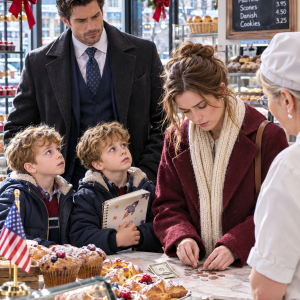
PART 1 — THE MONEY HE LEFT IN MY DRIVEWAY
“There’s your final paycheck, Becky. Every last cent. You can count it yourself.”
My former boss stood beside his pickup while ninety-one thousand five hundred pennies lay scattered across my driveway. He’d poured used motor oil over them, leaving a black, sticky mess that smelled like the bottom of an old engine.
Then he taped my pay stub to an empty bucket, set it on top of the pile, and drove away.
My eight-year-old son, Noah, watched from the porch. After the truck disappeared, he looked up at me.
“Mom, did you do something wrong at work?”
I was still trying to answer when I noticed something written across the back of my pay stub. Dale had added four words in thick black marker.
Don’t forget who paid.
Eight days later, that same man would stand crying in an elementary school office, holding a single clean penny. But getting there would take more than an apology, and I had no intention of letting him forget what he’d done.
My name is Becky Lindahl. I was thirty-four, living with my husband, Jake, and our two children in a little yellow house outside Merrill, Wisconsin.
For six years, I’d managed the parts counter at Heckert Auto & Diesel. Dale Heckert inherited the shop from his father and ran it the same way his father had: early mornings, long hours, and very few compliments.
Dale wasn’t an easy man, but I understood him. He wanted orders filled correctly, customers called back promptly, and nobody standing around when there was work to do.
I knew every supplier we used, most of our customers’ trucks, and enough part numbers to make the mechanics stop bothering with catalogs. When something went wrong, Dale called for me. When everything went right, he said nothing.
I didn’t expect much more.
But when the Lincoln County Farmers Co-op offered me a position with health insurance, I accepted. The pay was nearly identical, but our son had asthma, and Jake’s trucking company had recently switched to a more expensive insurance plan.
We needed better coverage.
I gave Dale two weeks’ notice on a Monday morning.
He read my letter, then looked over his glasses.
“You’re leaving me for the co-op?”
“I’m taking a job with benefits, Dale. Noah’s specialist appointments are getting expensive.”
“I’ve kept you employed for six years.”
“And I’ve worked hard for you for six years.”
His expression changed.
“Well, I guess loyalty doesn’t count for much anymore.”
I tried explaining again, but he picked up an invoice and began reading.
For the next two weeks, he barely spoke to me. If he needed a part ordered, he asked Carl, our senior mechanic, to pass along the request.
On my last day, I left a binder containing supplier contacts, inventory notes, and ordering instructions. I cleaned out my drawer, hugged the mechanics goodbye, and went home.
My final paycheck was $915 after taxes, including unused vacation time.
I expected a direct deposit.
Instead, Dale brought the pennies.
Jake was hauling logs near Tomahawk when I called him.
I sent him photographs of the driveway, the buckets, and the pay stub.
He called back immediately.
“Tell me you didn’t touch that mess.”
“I haven’t.”
“I’ll borrow my brother’s trailer. We’ll take every penny back to his shop.”
“No, Jake. I’m not giving him another excuse to cause trouble.”
“Becky, he dumped oil-covered money where our kids play.”
“I know. That’s why I’m documenting it.”
That evening, I emailed the Wisconsin Department of Workforce Development about the wage payment and contacted the county about the contaminated gravel. I also called our bank.
The teller explained that they couldn’t accept loose, oil-covered coins. Once cleaned, the pennies would have to be packaged and processed through an arrangement with the branch.
The grocery-store coin machine wasn’t an option either. Even if it accepted that many pennies, the service fee would cost us more than a hundred dollars.
I stood at the kitchen window looking at the pile.
Nine hundred fifteen dollars wasn’t a fortune, but my first co-op paycheck was two weeks away. We needed that money for groceries, gas, and Noah’s next prescription refill.
Dale knew all of that.
He’d heard me explain why I was leaving.
And he’d still chosen to make me kneel in my driveway to collect what I’d earned.
Noah came into the kitchen while I was putting away the dishes.
“Mom, are we in trouble?”
I turned around.
“What makes you think that?”
“Because Mr. Heckert looked really mad. And he said you had to count everything.”
I crouched beside him.
“We’re not in trouble, sweetheart. Mr. Heckert was angry because I changed jobs, and he handled it badly.”
“But you worked for him.”
“I did.”
“Then why was he mean to you?”
I wished I had an answer that would make sense to an eight-year-old.
“Sometimes grown-ups get upset and make choices they shouldn’t. That doesn’t mean we have to make the same choices.”
Noah thought about that.
“Are you going to be mean back?”
I looked toward the driveway.
“No. But I’m going to make sure he takes responsibility.”
The next morning, Jake came home early.
We bought heavy gloves, absorbent material, plastic tubs, and cleaning supplies. We contacted a local cleanup service for advice about containing the oily runoff and removing contaminated gravel.
The children stayed away from the dirty coins. Jake and I collected them in manageable batches, separated the oily material, and cleaned the pennies without letting the wastewater run into the yard.
It was slow, unpleasant work.
By Saturday evening, my shoulders ached, and Jake had developed a blister on his thumb.
“You know,” he said, lowering another container onto the garage floor, “I used to think Dale was just a cranky old man.”
“So did I.”
“This wasn’t cranky, Beck. He planned this.”
I remembered the message on the pay stub.
Don’t forget who paid.
“I know.”
Once the coins were clean and dry, the children helped count them at the kitchen table.
Noah discovered that stacking pennies in groups of ten made the work faster. Lily, who was five, preferred making towers of five and insisted on inspecting every finished roll.
“Daddy, that one’s crooked.”
Jake examined the wrapper.
“It’s got fifty pennies in it.”
“But it’s still crooked.”
“Well, I guess the penny inspector has spoken.”
Lily giggled.
For the first time since Dale’s visit, our house sounded normal again.
We worked around school, jobs, dinner, and bedtime. The kitchen table became a small coin-counting station, with wrappers stacked beside the napkins and shoeboxes lined against the wall.
On Sunday evening, Noah sat beside me while I rested my sore hands.
“Mom, what happens if somebody doesn’t have lunch money?”
“At school?”
He nodded.
“Mason got the cheese sandwich again on Friday.”
I looked at him.
“What cheese sandwich?”
“It’s what they give kids when their lunch account is empty. Just bread and cheese and milk. Everybody can tell it’s different.”
He pulled at a loose thread on his sleeve.
“Tyler calls him Cheese Boy.”
My stomach tightened.
“Does Mason say anything?”
“No. Sometimes he doesn’t eat it.”
I thought about a little boy sitting in a crowded cafeteria, pretending not to care while the other children watched him.
Noah looked toward the shoeboxes.
“Could some of those pennies buy Mason lunch?”
I didn’t answer immediately.
That money was supposed to carry us through the next two weeks. We’d already spent money on cleanup supplies, and Jake’s paycheck barely covered our regular bills.
But I kept thinking about Dale’s expression when he’d emptied the last bucket.
He’d wanted those pennies to become a burden.
I didn’t want that to be the only thing they ever meant.
“Let me call the school tomorrow,” I told Noah.
Monday morning, I called Washington Elementary and asked about donating toward unpaid lunch balances.
The secretary transferred me to Edna Fogle, who had worked in the cafeteria for thirty-one years.
“That’s very kind of you, honey,” she said. “But I can’t give you children’s names or account information.”
“I understand. I’m not asking for names. I just want to know whether there’s a way to help the second grade.”
She arranged for the school office to confirm the total amount of eligible overdue balances.
Later that morning, she called back.
“Becky, there are twenty-three second graders with negative accounts. Together, they owe nine hundred eight dollars and forty cents.”
I wrote the number down.
$908.40.
Out of the $915 Dale had dumped in my driveway.
“Mrs. Fogle, I’d like to pay all of it.”
“All twenty-three accounts?”
“Yes, ma’am.”
“Honey, that’s a lot of money.”
“I know.”
That evening, I talked it over with Jake. We’d have to use a little of our emergency savings until my new paycheck arrived, but we could manage.
He listened while I explained the amount.
“You’re sure?”
“I am.”
He nodded.
“Then let’s finish counting.”
Before hanging up with Mrs. Fogle, I’d told her where the pennies came from.
There was a long silence.
“Oh, Becky,” she finally said. “I wish your old boss understood what he’s done.”
“So do I.”
The work took several more evenings.
Jake and I handled the remaining dirty coins while the children counted and rolled the clean ones. By the end, we had 1,830 rolls packed into shoeboxes.
One night, Lily insisted on making the final roll herself.
I counted out fifty pennies and watched her carefully slide them into the wrapper.
The paper folded unevenly. One end bulged, and she’d left a little peanut butter fingerprint near the edge.
“Is it good, Mommy?”
I examined it.
“It’s perfect.”
Noah picked it up.
“Can I give this one to the school?”
“Of course.”
He tucked it into his coat pocket like something precious.
On Wednesday morning, Jake and I delivered the boxes to Washington Elementary. The school had arranged for the bank to collect and verify the coins, and the office staff helped us move everything into a secure room.
Mrs. Fogle stood beside the principal, Mr. Okonkwo, watching the boxes pile up.
When we’d finished, Noah approached her.
He held out Lily’s crooked roll with both hands.
“My sister made this one,” he said. “It’s for the kids who get cheese sandwiches.”