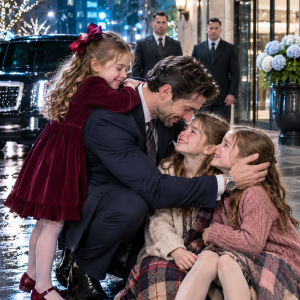
Noah looked at his shoes.
“Mason gets made fun of too. Tyler calls him Cheese Boy.”
He glanced at me, then back at Dale.
“Did anybody help you when they called you that?”
Dale shook his head.
“Not with the name-calling, no.”
Noah reached into his pocket and pulled out a clean penny.
“I kept this one,” he said. “It’s from the money you brought to our house.”
He held it out.
“You can have it back.”
Dale looked confused.
“Why?”
Noah shrugged.
“Because you said sorry to my mom. And because I’m sorry those kids called you Cheese.”
He held the penny a little higher.
“Nobody should have to feel like that.”
Dale took it.
For several seconds, he stared at the coin resting in his palm.
Then he sat down and covered his face.
I put my arm around Noah.
He looked up at me, worried.
“Did I say something wrong?”
I kissed the top of his head.
“No, sweetheart. You said something kind.”
The bank finished verifying the coins that Friday.
There were exactly 91,500 pennies.
One thousand eight hundred thirty rolls.
Nine hundred fifteen dollars.
The school applied $908.40 toward the second-grade lunch balances and placed the remaining $6.60 in its student meal assistance fund.
Dale’s donation covered the outstanding balances in the other elementary grades, with the final amount processed through the district office.
Mrs. Fogle called to tell me.
“Becky, every overdue elementary lunch account is cleared.”
I sat down at the kitchen table.
“All of them?”
“Every one.”
I thought about Mason, who would no longer have to worry about his account balance when he went through the lunch line.
I thought about Noah asking whether a few pennies could help.
“That’s wonderful, Edna.”
She was quiet for a moment.
“Your children started something good.”
I looked toward the living room, where Lily was trying to teach Baxter to shake hands.
“They certainly did.”
The following week, Dale called me.
I almost didn’t answer.
But I did.
“Becky, I’ve got a question.”
“All right.”
“There’s an old jar under the counter at the shop. My dad started putting spare change in it back in the sixties.”
I waited.
“Mostly pennies. Probably forty pounds of them by now.”
“What about them?”
Dale cleared his throat.
“I was thinking maybe we could roll them for the middle school lunch fund. Edna says they’ve got families who need help too.”
I smiled despite myself.
“Dale, you can take them to the bank.”
“I know. But I thought maybe we could get people together. Make a Saturday out of it.”
He hesitated.
“Would you and the kids show me how you did it?”
I looked at the calendar.
“I’ll talk to Jake. But the kids aren’t cleaning dirty coins.”
“No oil,” Dale said quickly. “I promise.”
Two Saturdays later, we set up folding tables at the Merrill Fire Hall.
Dale brought his old jar, cleaned and sorted. I brought our blue dish tub, which had become something of a family joke, along with extra wrappers and counting trays.
Noah brought his method for stacking pennies in groups of ten.
Lily brought her stuffed rabbit.
We called it Penny Saturday.
We expected a handful of people.
More than two hundred came.
There were grandparents carrying coffee cans full of change, children with piggy banks, mechanics from Dale’s shop, and neighbors who’d read about the lunch donations.
Some brought bills instead of coins. Others volunteered to count, sort, and help the organizers arrange bank deposits.
Dale sat at a table beside my children.
He was terrible at rolling pennies.
His fingers were too large for the wrappers, and he kept folding the ends before the coins were straight.
Lily watched him struggle.
“Mr. Dale, you’re squishing them.”
He looked at his crooked roll.
“I’m doing my best, young lady.”
“You have to tuck the paper first.”
“I am tucking it.”
“No, you’re squishing.”
Noah laughed so hard he nearly fell out of his chair.
By the end of the day, we’d collected more than $4,000 in coins and cash donations, enough to make a meaningful contribution toward lunch assistance at the middle school and high school.
Dale stood beside the donation table while volunteers packed the last boxes.
“Never thought I’d spend a Saturday asking people for pennies,” he said.
I looked at him.
“Neither did I.”
He smiled.
For once, it wasn’t a bitter one.
The following Monday, I came home from work and found a crew replacing the oil-stained gravel in our driveway.
Dale stood beside a small dump truck.
I got out of my car.
“What’s all this?”
He pointed toward the dark patch where the pennies had been.
“The cleanup company said the contaminated gravel needed to come out. I’m paying for the removal and replacement.”
I’d already received an estimate and agreed to the work after he offered to cover it. Still, seeing the crew there made the whole thing feel strangely final.
“You didn’t have to come supervise,” I said.
Dale shrugged.
“Wanted to make sure they did it right.”
Then he reached into his pocket.
He pulled out a key ring.
Attached to it was a single shiny penny, held in a small clear coin holder.
I recognized it immediately.
“Noah’s penny?”
Dale nodded.
“Carry it every day now.”
He turned it between his fingers.
“Reminds me that somebody finally said something when it mattered.”
I looked toward the house.
Noah was at the window, watching the workers spread fresh gravel.
“He’s a good kid,” I said.
Dale smiled faintly.
“He sure is.”
A year has passed since then.
I still work at the co-op, and the insurance has made a real difference for our family. Noah’s asthma is well managed, and Lily is still convinced she’s the best penny roller in Wisconsin.
Jake still hauls logs, although he says he never wants to see another paper coin wrapper.
Dale still runs Heckert Auto & Diesel.
After the school fundraiser, he began offering health insurance to his employees. He told me it was expensive, but he’d finally understood why people needed it.
Penny Saturday became an annual event, organized with the school district and local volunteers. The donations now support a meal assistance fund named after Irene Bauer, the cafeteria worker who quietly helped Dale when he was a boy.
And Noah?
He told Tyler Beckman to stop calling Mason Cheese Boy.
Apparently, Tyler tried it again one afternoon, and Noah stood beside Mason in the lunch line.
“That’s not his name,” Noah told him. “And it’s not funny.”
Tyler rolled his eyes, but he stopped.
Last month, I visited Dale’s shop to pick up a fuel filter for Jake’s truck.
The place looked almost exactly as it had when I worked there. Same gray steel building, same old coffee maker, same calendar from the tire company.
But there was something new on the parts counter.
A large glass jar stood beside the register, half full of clean pennies.
A piece of masking tape was stuck to the front.
FOR THE LUNCH KIDS. EVERY PENNY COUNTS.
Underneath, in smaller handwriting, were three names.
Thank you, Becky. Thank you, Noah. Thank you, Lily.
Dale came out of the back office while I was reading it.
“Carl says you need a fuel filter.”
I turned around.
“That’s right.”
He reached under the counter and handed me the box.
For a moment, neither of us mentioned the jar.
Then I took a penny from my purse and dropped it through the opening.
It landed with a bright little clink.
Dale looked at the jar, then at me.
“Thanks, Beck.”
I smiled.
“You’re welcome.”
As I walked out to my car, I thought about the mountain of oily pennies that had once covered my driveway. Dale had wanted me to spend days counting them so I’d remember how angry he was that I’d left.
I did remember those days.
But now, whenever I heard the sound of a penny dropping into a jar, I thought of my little boy standing in a school office, offering one back to the man who’d tried to make his mother feel small.