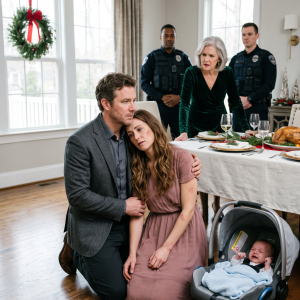
Laurel stared at him.
“Dad, I know there is a process.”
“Then you know why I cannot become personally involved.”
“I’m not asking Judge Sloan for help.”
Her voice had trembled.
“I’m asking my father.”
Everett remembered looking down at the papers on his desk.
There were rumors that he might soon be considered for a federal appointment. His reputation mattered more than ever.
He told himself he was being responsible.
He told himself that becoming involved would create questions.
He told himself that Laurel was emotional and would eventually understand.
“Anything I do could be viewed as interference,” he had explained. “You chose your own path, Laurel. You have to work through this legally.”
She stared at him for several seconds.
The disappointment on her face remained clearer in his memory than any photograph.
“Do you hear yourself?”
Everett said nothing.
“I spent my childhood waiting for you to finish one more hearing, one more meeting, one more important case. I kept telling myself that someday I would matter enough for you to put down the title and just be my dad.”
He stood.
“Laurel—”
She stepped backward.
“Today I came here because your granddaughter needed someone in her corner.”
Her eyes filled with tears.
“And somehow your reputation still came first.”
She walked toward the door.
Everett called her name.
She turned once.
“Don’t contact me until you understand the difference between being respected and being present.”
Then she left.
For two years, Laurel kept her distance.
Everett buried himself in work.
It was easier than admitting she might have been right.
The Case Sitting Right in Front of Him
Back in the courtroom, Everett finally took Maisie’s phone.
His voice was almost a whisper.
“Laurel?”
Silence.
Then came the word he had not heard her say in two years.
“Dad.”
His eyes closed briefly.
“Why is Maisie here?”
Laurel took a slow breath.
What she told him next made Everett look down at the file resting beside his hand.
For several months, Laurel had been dealing with a serious health problem that required frequent treatment and long periods of rest.
She had continued caring for Maisie whenever she could, supported by friends and a trusted neighbor.
Caleb had learned about her condition and filed a request to change their parenting arrangement.
He argued that Laurel was no longer capable of providing enough stability.
The case had moved rapidly through the system.
Due to a combination of administrative transfers, shortened names in the records, and information Everett had never bothered to examine personally, he had not realized the woman involved was his daughter.
He looked at the folder again.
L. Sloan.
C. Voss.
He felt cold.
This was the case scheduled in his courtroom that morning.
The paperwork sitting in front of him concerned his own granddaughter.
Worse, Everett had been preparing to approve an interim recommendation that favored Caleb until a more extensive review could be completed.
He had accepted what appeared in the documents.
He had not looked deeper.
Once again, he had allowed procedure to create distance between himself and the people who mattered most.
“Why didn’t you tell me?” Everett asked.
Laurel’s response was quiet.
“Because two years ago I already told you what I needed.”
Everett could barely speak.
Laurel continued.
“I didn’t need your connections. I didn’t need special treatment. I needed my father to care enough to ask whether we were okay.”
Everett looked at Maisie.
She stood beside the bench watching him with innocent curiosity.
“I was wrong,” he said.
Laurel did not respond.
“I was wrong two years ago, and I was wrong to believe staying neutral meant I was doing nothing wrong.”
His voice became unsteady.
“Sometimes doing nothing is still a choice.”
The Question Only Maisie Could Ask
Maisie gently touched his sleeve.
Everett lowered the phone.
“Grandpa?”
He turned toward her.
“Yes?”
She pointed around the courtroom.
“Are you the boss of this room?”
Despite everything, a tiny smile appeared on his face.
“Not exactly, but I am responsible for what happens here.”
Maisie considered his answer.
“Then can you make sure nobody makes Mommy leave me?”
The courtroom went completely silent.
Everett looked at his granddaughter.
She was not asking about legal procedure.
She did not understand motions, recommendations, jurisdictions, or conflicts of interest.
She simply wanted to know whether the adults around her were going to keep her world from falling apart.
Everett stood.
His voice was different when he spoke to the courtroom.
There was still authority in it, but the arrogance was gone.
“This hearing will not continue before me.”
Several attorneys looked at one another.
Everett continued.
“I have a direct personal relationship with the parties involved that was not identified to me before this morning. I am removing myself from all judicial involvement in this matter immediately.”
He turned toward his clerk.
“Please arrange for reassignment and ensure that all relevant records receive a complete independent review.”
Then he looked at Maisie.
For perhaps the first time in his career, leaving the bench felt more important than sitting on it.
What Everett Did Next
Everett did not try to use his position to decide the case.
He knew that would only repeat the same mistake in another form.
Instead, he became something far simpler.
A father.
He drove directly to the medical center where Laurel was receiving treatment.
When he entered her room, she looked thinner than he remembered.
For several seconds, neither of them spoke.
Then Everett pulled a chair beside her bed.
“I’m not here as a judge.”