“Because she asked me not to let a good home become an empty symbol.”
That sentence stayed with me.
Robert took me there that afternoon.
The cottage was small, with white siding, dark green shutters, two bedrooms, and a narrow kitchen overlooking a fenced backyard.
Nothing about it was impressive.
Yet when I walked into the kitchen, I noticed faint pencil marks on the wall near the window.
Sophie — age 3.
I touched the writing.
“She lived here?”
“For several months.”
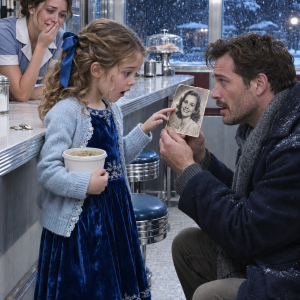
Suddenly the little girl in the diner was no longer a coincidence.
She had once stood in a house my wife had tried to preserve for her family.
Five years later, without knowing who I was, she had walked into my life and asked why I looked lonely.
I sat at the kitchen table.
For years, I had thought grieving Caroline meant preserving the life we had shared exactly as it was when she left it.
I had changed almost nothing at home.
Her favorite mug remained in the cupboard.
Her gardening gloves remained by the back door.
Her notebook remained unopened.
I had mistaken stillness for loyalty.
But Caroline had not spent her life teaching people to remain still.
She had spent it helping them move forward.
The Door Left Open

That afternoon, Robert and I began making calls.
The cottage would become the first property in a small affordable-ownership program funded jointly by my firm and Caroline’s original account. Families accepted into the program would pay according to their circumstances, participate in maintaining the property, receive financial counseling, and gradually build ownership.
Nobody would be handed a house.
Nobody would be treated like a charity case either.
The following evening, I returned to Maple Street.
Sophie opened the door.
“Did you find the notebook?”
“I did.”
“Did it tell you why you were sad?”
I smiled.
“Not exactly.”
“Then what did it tell you?”
“What I could do about it.”
Margaret and Emily listened while I explained the housing program.
Emily immediately shook her head.
“We cannot accept a house.”
“Good,” I said.
She frowned.
“Good?”
“Because I’m not offering you one.”
I explained that they could apply for the program, just like any other qualifying family. There would be written protections, affordable payments, clear expectations, and no mysterious benefactor who could suddenly change his mind.
Emily stared at me.
“And if we struggle?”
“Then we adjust the plan.”
“And if we need help?”
“You ask.”
She laughed quietly.
“You make asking sound simple.”
“A little girl taught me recently that it isn’t.”
Sophie grinned.
Several weeks later, after Margaret had recovered and the paperwork had begun moving forward, we visited the Cedar Lane cottage together.
Sophie remembered almost nothing about having lived there.
But the moment she entered the kitchen, she ran to the low window overlooking the backyard.
“I like this window.”
Robert and I exchanged a glance.
Apparently some memories live deeper than words.
Emily found the old pencil marks.
Sophie — age 3.
“Mom,” she whispered.
Margaret came beside her.
For a moment, nobody spoke.
Then Sophie found a pencil in a kitchen drawer.
“Can I write something?”
Emily laughed.
“Apparently you already did once.”
Sophie carefully added another line beneath the faded writing.
Sophie — age 8.
Then she turned toward me.
“Mr. Whitmore?”
“Yes?”
“Do you still look lonely?”
The question caught me completely unprepared.
I looked around that small kitchen—at Margaret standing stronger than she had the night we met, at Emily reading program paperwork with the seriousness of someone determined to earn every step forward, at Robert leaning against the doorway after years of silence between us, and at Sophie, whose three dollars had somehow reopened a part of my life that money never could.
“Sometimes,” I said.
She frowned.
Perhaps she expected a happier answer.
So I continued.
“But lonely isn’t the same as lost.”
Sophie considered this and nodded as if approving an important distinction.
That evening, I returned home and opened Caroline’s green notebook again.
Near the final pages, in handwriting I had somehow overlooked, she had written one sentence:
A good life is not measured by how tightly we hold what we love, but by how much of that love we allow to keep moving through us.
I sat there for a long time.
Then I walked into the kitchen and took Caroline’s favorite mug from the cupboard.
For five years, I had refused to use it because some foolish part of me believed keeping it untouched meant keeping something of her untouched too.
I made coffee in it.
Then I called Robert.
“Are you busy Sunday?”
There was a pause.
“Why?”
“Come over for dinner.”
Another pause, longer this time.
“Are you actually inviting me into that enormous house of yours?”
“I am.”
“Should I be worried?”
I laughed.
It felt unfamiliar.
But it felt good.
“Probably.”
Before hanging up, Robert said something I thought about for a long time afterward.
“Caroline would be glad you finally opened the notebook.”
I looked toward the dark window above the sink.
“I think she’d be happier that I finally closed it.”
Because eventually I understood what she had been trying to leave me.
It was never the cottage.
It was never the housing program.
It was not even the Bennett family.
Caroline had understood something about me long before I was ready to understand it myself: sorrow could become a room, and if I stayed inside it long enough, I would eventually forget there was a door.
Five winters later, an eight-year-old girl walked into a diner with three dollars, asked for one bowl of soup, and noticed a lonely stranger sitting in the corner.
She thought I was helping her that night.
For a while, I thought so too.
But sometimes the person standing outside the closed door is not the one waiting to be rescued.
Sometimes they are simply the one who knocks.