PART 1: THE DAY I FOUND MY MOTHER IN THE BARN
“SHE’S SEVENTY-SIX, EMILY. SHE CAN’T TAKE CARE OF HERSELF ANYMORE. WHAT DID YOU EXPECT ME TO DO WITH HER?”
My brother said those words while our mother sat on a filthy mattress inside the old horse barn, wearing a torn sweater and clutching an empty water bottle. I’d just returned to Kentucky after fifteen years of military service, expecting to find her enjoying the retirement she’d worked so hard to earn. Instead, I found a padlock on the barn door and a woman who seemed almost ashamed to look at me.
But when I wrapped my coat around her shoulders, Mom caught my sleeve and whispered something that made me turn toward the farmhouse.
“Emily, your brother’s been signing papers with your father’s name. And your father has been gone for six years.”
I was fifty-one years old, a colonel in the United States Army, and I’d spent most of my adult life learning how to remain composed under pressure. Nothing in my training prepared me for finding my own mother living in a building where we used to keep horses.
Her name was Margaret Carter. She was seventy-six, a retired school secretary who’d spent nearly fifty years making our farmhouse outside Lexington a place where everyone felt welcome. She was the kind of woman who remembered birthdays, sent handwritten thank-you notes, and never let a visitor leave without something to eat.
The last time I’d visited, two years earlier, she’d been slower on her feet but still fiercely independent. She tended her vegetable garden, attended church every Sunday, and complained that my brother Richard bought expensive equipment when perfectly good machinery was sitting in the shed.
Now her gray hair was tangled, her hands trembled, and she had a fading bruise around one wrist. The barn smelled of damp hay and old wood. A thin mattress lay against the wall beside a plastic bowl, a worn blanket, and a few pieces of clothing.
“Mom, how long have you been staying out here?” I asked, kneeling beside her.
She glanced toward the doorway before answering.
“Richard said it was temporary. Just until they finished fixing up the house.”
I looked across the yard. The farmhouse had fresh white siding, new windows, and a beautifully restored front porch. Two expensive pickup trucks sat beneath the maple trees.
“When did they start fixing the house?”
“Last winter, I think.”
My stomach tightened.
“Mom, it’s November.”
She lowered her eyes.
“I know, sweetheart.”
I removed my coat and wrapped it around her shoulders. She tried to straighten her back, smoothing her torn sweater as though she were embarrassed by her appearance.
“I would’ve cleaned up if I’d known you were coming,” she whispered.
I had to look away.
My mother was apologizing for the condition of a barn she should never have been living in.
I’d called her regularly throughout my assignments, but during the previous year, Richard had increasingly answered her phone. He said she was sleeping, visiting friends, or having trouble remembering things. When I insisted on speaking directly with her, he usually promised she’d call back.
Sometimes she did, but our conversations were brief. She sounded tired and rarely answered questions about the ranch. I’d convinced myself she was simply growing older.
Now I wondered how many warnings I’d overlooked.
Footsteps sounded behind me.
“Well, look who finally decided to come home.”
My older brother Richard stood in the doorway with his wife, Vanessa. He was fifty-six, broad-shouldered, and dressed in a clean flannel shirt and expensive boots. Vanessa wore a cream-colored sweater and carried her phone in one hand.
“Why is Mom living in the barn?” I asked.
Richard folded his arms.
“You haven’t been here, Emily. You don’t know what we’ve dealt with.”
“Then explain it.”
He glanced at Mom.
“She forgets things. She complains about everything. Vanessa can’t spend her whole day looking after her.”
“So you locked her out here?”
Vanessa sighed impatiently.
“Oh, don’t make it sound worse than it is. We bring her meals, and she has blankets. She’s been getting confused inside the house.”
I looked at the empty water bottle beside Mom’s mattress.
“When did she last eat?”
Richard’s expression hardened.
“Don’t start interrogating us. We’ve done more for her in the last year than you’ve done in fifteen.”
The accusation landed exactly where he intended. I’d missed birthdays, holidays, and ordinary afternoons I could never get back. But my absence didn’t excuse what I was seeing.
“You can be angry that I was away,” I said. “But you don’t get to treat Mom like this.”
Richard gave a bitter laugh.
“That’s rich coming from you. I stayed here when Dad got sick. I handled the cattle, the bills, the repairs. You flew home for a few days, gave everybody a hug, and went right back to your career.”
I knew he’d carried responsibilities I hadn’t shared equally. I had thanked him for them many times, and I’d sent money whenever he said the ranch needed help.
“You worked hard, Richard. I know that. But she’s our mother, not another problem you can move out of the house.”
His face reddened.
“She’s seventy-six, Emily. She can’t do much anymore. What exactly do you expect me to do with her?”
Mom lowered her head.
That small movement hurt more than his words.
“I expect you to treat her like a human being.”
Richard stepped into the doorway.
“This is my property. You don’t get to show up and start giving orders.”
“Then we’ll find out who actually owns it.”
I took out my phone and called 911, explaining that I’d found an elderly woman confined in an unsafe outbuilding and needed emergency medical assistance.
Richard stared at me.
“You called the police on your own brother?”
“I called for help for our mother.”
While we waited, I photographed the sleeping area, the padlock, and the empty containers. Then I helped Mom outside and settled her on a chair beneath the shade of an oak tree.
She held my hand tightly.
“Are you in trouble because of me?”
I knelt in front of her.
“No, Mom. You haven’t done anything wrong.”
She looked toward the farmhouse.
“There’s something your father left you. Richard doesn’t want you to find it.”
I remembered her warning about the documents.
“What did Dad leave?”
“A brown folder. Behind the old bookcase in his study. He told me to keep it safe if Richard ever tried to take over everything.”
Before I could ask another question, Richard approached.
“Mom, stop filling her head with nonsense.”
She flinched.
I stood between them.
“She was talking to me.”
“She’s confused, Emily. Half the things she says don’t make sense anymore.”
Mom lifted her chin.
“I know exactly what I’m saying, Richard.”
For the first time, my brother looked uncomfortable.
The ambulance arrived a few minutes later, followed by two sheriff’s deputies. I explained what I’d found and showed them the photographs. The paramedics examined Mom and recommended taking her to the hospital for evaluation.
Richard insisted she didn’t need treatment.
One of the paramedics asked Mom directly whether she wanted to go.
“Yes,” she answered. “I’d like my daughter to come with me.”
I squeezed her hand.
Before they helped her onto the stretcher, she leaned toward me.
“Emily, please don’t let him get that folder.”
“I won’t, Mom.”
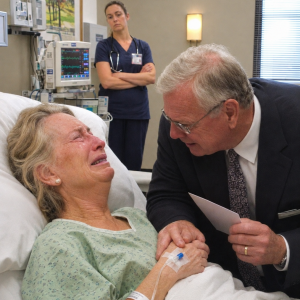
At the hospital, doctors found that she was dehydrated and undernourished. They also documented bruising on her wrists and arranged further assessments. A social worker spoke with her privately about the conditions at the ranch.
I sat outside the examination room, remembering the woman who’d driven me to basic training with a homemade sandwich wrapped in aluminum foil.
She’d hugged me at the bus station and told me to make something of myself.
I’d promised I’d always come home.
Somewhere along the way, I’d begun believing that sending money and making phone calls counted as being present.
When I was finally allowed back into her room, Mom was sitting upright with a glass of water beside her.
“I thought you’d forgotten about me,” she said.
I pulled my chair closer.
“Mom, why would you think that?”
“Richard said you didn’t want to come back. He said you were tired of hearing about my problems.”
My throat tightened.
“I’ve been calling you for months.”
“He told me you were too busy to talk.”
I reached for her hand.
“I should’ve come sooner. I’m sorry.”
She squeezed my fingers.
“You’re here now, sweetheart.”
We sat quietly until she began telling me what had happened after Dad died.
Richard had taken over the ranch’s daily operations, which made sense at first. He’d worked beside our father for years, and Mom trusted him to handle the equipment, cattle, and bills.
But as time passed, he began insisting that she sign documents she didn’t understand. He told her the ranch was losing money and that her questions were making everything harder.
“Your father left the property to both of you,” Mom said. “He wanted me to stay in the house for the rest of my life.”
“Did Richard know that?”
She nodded.
“He was furious when the lawyer explained it. He said he’d spent his whole life working that land while you were away.”
“What happened when you refused to sign?”
Mom looked down.
“He said the house needed repairs. First they moved me into the guest room. Then Vanessa said the workers needed that room too.”
“And they sent you to the barn?”
She nodded.
“They promised it would only be a few nights.”
I held her hand while she cried.
Later that afternoon, Detective Sarah Mitchell called me. She’d been assigned to investigate the allegations involving Mom’s treatment and possible financial exploitation.
I explained everything, including the brown folder and Mom’s concerns about the property documents.
“Your brother says your mother voluntarily moved into the barn because she preferred being near the animals,” Sarah told me.
I stared at the phone.
“There haven’t been horses in that barn for years.”
“We’re documenting the conditions. We’ll also review the financial allegations. If your mother can identify the original estate documents, that will help.”