Instead, one bad decision became another.
Jobs disappeared. Money ran out. Robert moved from town to town. Letters came promising that he was almost ready to come home, then months passed again.
Margaret eventually stopped giving the younger Caleb those letters because every promise reopened the same wound.
Meredith received her letters when she became an adult.
Caleb did not find his until years later, while clearing Margaret’s house after she passed away.
There had been eleven.
“Did Caleb know you’d spoken to Robert?” I asked.
Meredith nodded.
“I told him shortly before his diagnosis.”
“And?”
“He asked me how to find him.”
I stared at her.
“Did he?”
“He met Dad twice.”
The room seemed strangely still.
Caleb had met his father while I was pregnant.
He had come home afterward, eaten dinner with me, debated baby names with me, and said nothing.
Before I could decide whether I felt hurt or angry, I picked up the recorder and pressed play.
There was a rustle.
Then Caleb’s voice filled the nursery.
“Apparently I’m supposed to introduce myself, which seems unnecessary because my wife already knows who I am.”
I closed my eyes.
His voice was clear and unmistakably alive in my memory.
“I’m Caleb. Husband, mediocre gardener, very good architect, and unfairly criticized pancake maker.”
I whispered, “You burned them.”
A woman laughed quietly in the background.
Caleb continued.
“If Julia is listening, she just said I burned them.”
I laughed so hard that for one brief second the grief loosened its grip on me.
Then his tone grew quieter.
“There’s something I never explained properly.”
A pause.
“I spent most of my life believing my father left because we weren’t important enough for him to stay.”
I pressed the recorder closer.
“The letters changed that story, but they didn’t erase what happened. That took me a long time to understand.”
He explained that he had found Robert less than an hour away and met him twice at a roadside diner.
Robert had apologized without defending himself.
He had admitted that he left because he believed he needed to rebuild their lives financially, but eventually shame became easier than returning to face the children he had disappointed.
“I’m still angry,” Caleb said. “But I’m not eleven anymore, and being older means admitting that two things can be true at once.”
He paused.
“He hurt us. He also loved us.”
I looked at the key.
“He kept things from our childhood in a storage unit. Mom’s things. Meredith’s things. Mine. He gave me a key.”
Another pause.
“I never opened it.”
I whispered, “Why not?”
Then Caleb answered the question I had asked an empty room.
“Maybe because opening that door meant giving up the comfort of being completely right.”
My eyes filled.
“The key is for you now, but not because I want you to fix my relationship with him. You can’t. I only want our daughter to grow up knowing the truth is sometimes larger than the story a family repeats.”
His voice weakened slightly.
“Don’t tell her Robert was a wonderful father. He wasn’t. Don’t tell her he was some kind of villain either.”
A soft breath.
“Tell her people can make choices that hurt the people they love, and regret only matters when it eventually becomes action.”
Then, in typical Caleb fashion, he added:
“Also, put the key down. I know you’re holding it.”
I looked at my hand.
I was.
Laughing through my tears, I placed it on the carpet.
“Wait until the baby is here,” his recording continued. “You don’t need to solve my childhood while learning how to be a mother.”
His next words were slower.
“I’m sorry I won’t see her face.”
I bent forward.
“I’m sorry you’ll have to do the ordinary things without me—the midnight feedings, the school forms, the fevers, the terrible first driving lesson.”
He took a breath.
“But don’t let my absence become the biggest thing in her life.”
I covered my face.
“Let her life be bigger than what she lost before she could remember it.”
Then he added softly:
“And Julia, let yours be bigger too.”
The Daughter He Already Knew

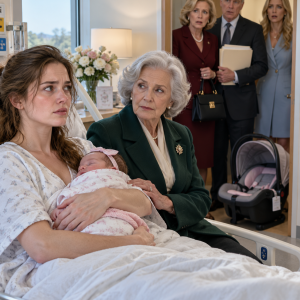
Our daughter arrived three weeks later on a rainy April morning.
The first thing I noticed was her chin.
It was Caleb’s.
The nurse settled her against my chest, and I stared at the tiny person whose existence had carried me through the hardest weeks of my life.
“Hi,” I whispered.
Her fingers curled around mine.
Meredith stood beside the bed, crying.
“What are you going to name her?”
Caleb and I had never made a final decision.
I studied my daughter’s face.
“Nora,” I said.
It had been the name of Caleb’s favorite elementary-school teacher, the woman he credited with first noticing that he could draw.
Meredith smiled.
“He’d love that.”
That evening, I opened the envelope marked For the day she arrives.
Caleb had written:
I don’t know what you named her, which is irritating because I like being informed.
Tell her I loved her before I knew her face.
Tell her she kicked me every time I rested my hand on your left side.
Tell her I once read forty pages of a municipal design handbook to her because I panicked and couldn’t find the children’s book.
Then came one final instruction.
Now you can open the envelope marked “For later.”
Inside was a recent photograph.
Caleb stood outside a diner beside an older gray-haired man whose uncertain smile somehow looked familiar.
Robert.
On the back, Caleb had written:
Our second meeting.
He never knew about Nora.
Below that:
If you decide to see him, ask why he kept the blue room.
And then one more line.
There is something there for Meredith and me.
Four days later, I called Robert.
When he answered, I almost hung up.
“Is this Robert Whitmore?”
“Yes.”
I swallowed.
“I’m Caleb’s wife.”
Silence followed, but it was the silence of recognition.
“Julia,” he finally said. “I’m so sorry.”
“You knew about his condition.”
“He told me the second time we met.”
“Did you know about the baby?”
“No.”
His voice changed.
I could hear a question forming, but he did not ask it.
Instead he said, “He gave you the photograph, didn’t he?”
“Yes.”
“Then I suppose he wanted you to decide whether to call.”
“He also wrote something about a blue room.”
Robert stopped speaking.
When he finally answered, his voice was much softer.
“I didn’t think he remembered that.”
The Blue Room
Meredith came with me the following weekend.
Robert lived outside York in a modest white ranch house with flower pots along the front steps and an old pickup in the driveway. The normality of the place unsettled me.
For years, I had imagined Caleb’s father as a distant figure somewhere far away.
Instead he had been forty-five minutes from us.
Robert did not try to hug Meredith when we reached the porch.
“Meredith.”
“Dad.”
His eyes closed briefly.
Then he stepped aside and invited us in.
He had prepared enough sandwiches for a family reunion.
Meredith looked at the table.
“Planning to feed the entire county?”
Robert gave an embarrassed shrug.
“I didn’t know what people serve at a conversation like this.”
For one aching second, he sounded exactly like Caleb.
We sat.
Robert did not rewrite the past.
He admitted that after losing his wife, June, he could not bear the house they had shared, so he convinced himself that leaving temporarily to earn money was responsible.
Then pride took over.
“Every month I stayed away made coming back harder,” he said.
Meredith’s face remained stiff.
“We didn’t need money.”
Robert nodded.
“I know.”
“We needed you.”
His gaze dropped to his hands.
“I know that too.”
He did not ask her to forgive him.
That mattered.
After a while, Robert stood.
“There’s something you should see.”
At the end of the hallway, he opened a door.
The room beyond was painted a faded powder blue.
Meredith stopped beside me.
Along one wall stood a small wooden bookcase filled with old children’s books. A model airplane sat on the top shelf. There was a sewing basket by the window, an old quilt folded over a chair, photographs on the walls, and a brass lamp that looked at least thirty years old.
“This looks like Aunt Margaret’s spare room,” Meredith whispered.
Robert nodded.
After Margaret’s belongings were sold, he had quietly purchased whatever remained from the Whitmore family—things no one else considered valuable enough to keep.
An old baseball glove.
Children’s books.
June’s sewing supplies.
Report cards.
Photographs.
Recipe cards.
Objects that were almost worthless to strangers and priceless to the people whose childhoods were attached to them.
At the back of the room was a wooden chest.
Inside, Meredith found an envelope with her name written across the front.
She touched the handwriting.
“Mom wrote this.”
Underneath it lay a second envelope.
For Caleb.
My hands began trembling.
Robert turned away.
“I never opened either one.”
I looked at him.
“Caleb never knew this existed?”
“No. I told him there were things here for him. He said he wasn’t ready to come.”