The House He Thought Was His

The Last Place at the Table
For most of my marriage, I believed loyalty was something quiet. It was not the kind of virtue people applauded at dinner parties, and it rarely appeared in photographs. It looked like remembering which pills belonged beside breakfast and which had to wait until evening. It looked like driving through freezing rain to pick up a prescription, warming soup at two in the morning, and sitting beside an older man who was frightened but too proud to admit it.
That older man was my father-in-law, Walter Prescott.
Walter had built a successful network of commercial greenhouses along the Maine coast, beginning with one drafty structure outside Portland and ending with farms, distribution centers, and valuable parcels of land across three states. By the time I married his only son, Nolan, newspapers called Walter a visionary. At home, he was simply a widower who forgot where he put his glasses and disliked eating alone.
Nolan and I had been married for ten years. When we first met, he was charming in a polished, practiced way, the sort of man who could make a waiter, a banker, and a room full of strangers feel that his attention was a prize. I worked as an elementary school librarian, and I mistook his certainty for strength. After our wedding, he persuaded me to leave my position and help with family obligations while he expanded a luxury landscaping company that used his father’s connections.
At first, it seemed sensible. Then every temporary arrangement became permanent. Walter needed more help. Nolan traveled more often. The household grew larger, but my world became smaller.
Still, I loved Walter. He never treated my care as invisible. On difficult mornings, when his hands shook too much to fasten his cuff links, he would give me an embarrassed smile and say, “I seem to have misplaced my dignity again, Claire.”
I would straighten his collar and answer, “It’s right where you left it. You’re just making me look for it.”
That always made him laugh.
Nolan rarely joined us. He visited his father when an attorney was present, when business papers needed signatures, or when someone important might notice. During Walter’s final months, Nolan began asking oddly specific questions about trusts, voting shares, property deeds, and whether the estate plan had been updated. Walter would become quiet afterward, and more than once I found him watching his son leave with an expression I could not read.
One evening, after Nolan had hurried away to what he called an urgent client dinner, Walter reached for my hand.
“You see people as they are,” he said.
“I try.”
“That is a gift, Claire, but it can also make you slow to protect yourself. You keep hoping kindness will wake kindness in someone else.”
I assumed he was tired and speaking generally. I wish I had asked him what he meant.
Walter passed away early the following spring, with rain tapping softly against the windows of his bedroom. I was beside him. Nolan arrived nearly four hours later, carrying two phones and complaining that the driveway was blocked by delivery vans. At the gathering afterward, he accepted condolences with one hand while answering messages with the other.
Three days later, he told me the estate had been settled.
“Seventy-five million, once everything is valued,” he said, pouring himself a drink in Walter’s study. “Dad left all of it to me. I’m his only child. Obviously, that’s how it should be.”
There was something triumphant in his voice that made me uncomfortable, though I was too worn down to challenge it. I asked only whether Walter had left instructions about the greenhouse employees or the small scholarship program he funded.
Nolan stared at me as if I had interrupted an important speech.
“You don’t need to concern yourself with any of that anymore.”
I did not yet understand how much he meant those words.
Ten Thousand Dollars in the Rain
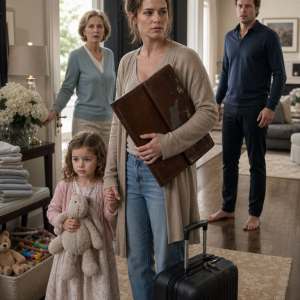
A week later, I came home from a meeting at the funeral home and found two suitcases standing beneath the covered entrance. My clothes had been folded carelessly into them, along with a jewelry box that belonged to my mother and three framed photographs wrapped in kitchen towels. The locks had been changed.
Nolan stood inside the open doorway in a new charcoal suit. Behind him were two security employees I recognized from Walter’s company headquarters.
“What is this?” I asked.
He held out an envelope. “A clean ending.”
Inside was a check for ten thousand dollars and a set of divorce papers.
For several seconds, I could hear only the rain striking the stone steps. “You’re asking me to leave my own home?”
“It was never your home. Dad allowed us to live here, and now it belongs to me.”
I looked past him toward the staircase I had decorated every Christmas, the kitchen where I had prepared Walter’s meals, and the small sitting room where Nolan and I had once planned a future together. “We have been married for ten years.”
“And for most of those years, I paid for everything.”
“I cared for your father.”
His mouth tightened. “You kept him company. Don’t turn that into a career.”
The remark struck more deeply than I wanted him to see. I had given up my work, my savings, and much of my independence because he said the family needed me. Now he was using those sacrifices as evidence that I had contributed nothing.
“Why are you doing this now?”
Nolan lowered his voice. “Because I finally have the means to live the life I was supposed to have, and I’m not carrying an obligation from the old one.”
He placed the envelope on top of my suitcase. One of the security employees avoided my eyes.
“Take the check, sign the papers, and make this easy,” Nolan said. “It’s more generous than you realize.”
I left without signing anything. Pride kept me upright until I reached the car; then I sat behind the wheel with both hands gripping it, unable to turn the key. I had forty-three dollars in my purse, no current job, and no nearby family. Nolan had closed the joint checking account that morning. Even my phone plan stopped working before sunset.
For the next twelve nights, I slept in my car behind a twenty-four-hour grocery store in South Portland. I washed in the restroom, changed clothes before dawn, and applied for library and office positions using the store’s public internet. I told myself that the car was temporary, that humiliation could not become an address unless I allowed it to.
On the thirteenth morning, an employee tapped on my window and handed me a thick envelope that had been left at the customer service desk. My full name was typed across the front.
Inside was a formal notice from Bennett, Ross & Cole, the firm that had represented Walter for nearly thirty years. It requested my presence at a hearing concerning his estate.
I read it several times, then called the number at the bottom.
“Bennett, Ross & Cole,” a woman answered.
“My name is Claire Prescott. I received a notice about Walter Prescott’s estate.”
There was a careful pause. “Mrs. Prescott, we have been expecting your call.”
“My husband said everything was already settled.”