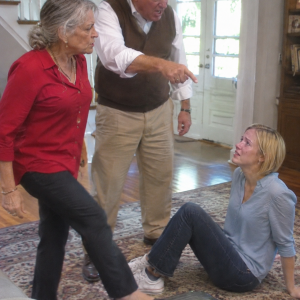
Officer Collins arranged for me to provide a formal statement and explained the next steps for preserving evidence and seeking protection.
When Bennett reached toward my arm and tried to take my phone, the officer stepped between us.
There was no dramatic resolution that night, no immediate answer to every question, and no promise that the months ahead would be easy.
But there was something I had not possessed when the patrol cars first arrived.
My account of what happened had been heard.
And the evidence was no longer something Bennett could dismiss simply by telling people I was confused.
The Long Road Back to Myself
By sunrise, I was sitting in Margaret’s office with a paper cup of coffee growing cold between my hands.
Oliver was staying with Mrs. Abbott, who had known my mother for more than thirty years and had offered to help without asking for explanations.
Margaret organized the original nursery recordings, the laboratory report, the bank correspondence, and the messages I had preserved.
Over the following days, we began the process of protecting my interest in the house, filing for divorce, and requesting appropriate arrangements for Oliver’s safety.
The investigation moved slowly.
Financial documents had to be examined, signatures compared, communications reviewed, and statements taken from everyone involved.
The laboratory findings required further verification, and investigators examined the circumstances surrounding the medication and the medical transport request.
The physician whose name appeared on the paperwork also became part of the inquiry.
I learned that having evidence did not mean every question would be answered immediately.
There were appointments, legal expenses, sleepless nights, and mornings when I sat at the kitchen table wondering how I would manage everything alone.
I returned to work gradually.
My supervisor allowed me flexibility for appointments, and a coworker quietly took over several projects when I needed time away.
Mrs. Abbott watched Oliver whenever she could, sometimes arriving with homemade soup and refusing to accept anything in return.
“Your mother would have done the same for my family,” she told me one afternoon. “Now it’s my turn.”
Her kindness reminded me that not every act of generosity came with an expectation hidden behind it.
As the months passed, the unauthorized loan never went forward.
The property remained protected while the financial and marital issues were addressed, and arrangements concerning Oliver were handled with his well-being as the priority.
Vanessa eventually provided additional communications as investigators examined her involvement.
Bennett’s financial problems became increasingly apparent, and his relationship with Vanessa ended.
I heard these developments through Margaret rather than through Bennett himself.
I no longer wanted to spend my days trying to understand every decision he had made.
There was a child to raise, a career to rebuild, and a version of myself I was slowly learning to recognize again.
The Apology I Couldn’t Accept
Several months later, during a legal appointment, Bennett asked whether he could speak with me.
I agreed to a brief conversation in a supervised setting.
He looked older than I remembered, with tired eyes and a suit that hung awkwardly from his shoulders.
For a moment, seeing him brought back memories of ordinary happiness: Sunday breakfasts, walks through the neighborhood, the way he had cried when Oliver was born.
Eight years of marriage did not simply disappear because I finally understood what had been happening behind my back.
“Rebecca, I know I made terrible choices,” he began. “I’ve lost my job, Vanessa is gone, and my mother hasn’t been well. I never imagined things would turn out this way.”
I waited.
“I don’t want Oliver growing up thinking I’m a terrible father.”
His voice trembled.
For one brief moment, I wanted to believe that he had finally understood the pain he had caused.
But he had not asked whether Oliver was sleeping well, whether I had managed to keep working, or whether the little boy who once reached for him every evening still remembered his face.
He was asking whether the consequences of his choices might eventually become easier for him to bear.
“Oliver doesn’t need to grow up hating you,” I said. “But he also deserves to understand that love means being safe with someone, not being afraid of what they might do.”
Bennett lowered his eyes.
“Does that mean you’ll never forgive me?”
I thought carefully before answering.
“Forgiveness and trust aren’t the same thing, Bennett. I may eventually find peace with what happened, but that doesn’t mean I can pretend it never happened.”
He looked toward the window.
“I wish I could go back.”
“So do I,” I admitted. “But wishing doesn’t change what you chose.”
When our conversation ended, I walked outside into the afternoon sunshine and realized that, for the first time, I had not felt responsible for comforting him.
I had spent years making room for his feelings, his worries, his ambitions, and his disappointments.
That afternoon, I finally made room for my own.
The Last Conversation With Patricia
The final time I spoke to Patricia was outside a courthouse several months later.
She stood near the entrance wearing a gray cardigan, looking smaller and more fragile than the woman who had once seemed capable of managing everyone around her.
When she saw me, her expression softened.
“Rebecca,” she said quietly. “I never wanted things to go this far.”
I stopped a few feet away.
There had been a time when I would have rushed to embrace her, especially seeing how tired she looked.
Now I simply waited.
“I was trying to save my sons,” she continued. “Russell was in trouble, and Bennett was so worried. I thought if I could just fix the money problem, everything would settle down.”
I remembered her sitting beside Oliver’s crib, singing lullabies.
I remembered the meals she had prepared, the blankets she had folded, and the way she used to call me her girl.
Some of those memories might have contained genuine affection.
I would probably never know.
But affection did not excuse what she had helped arrange.
“You were trying to protect your children,” I said. “And you were willing to separate mine from his mother to do it.”
Tears filled her eyes.
“I never thought you’d actually lose him.”
“But you knew I was afraid of losing him, and you planned to use that fear.”
She looked down at her hands.
For once, she did not have an explanation ready.
I wished her well and walked away.
There was nothing left to argue about.
The Home We Found Again

By the following spring, Oliver had begun taking his first uncertain steps.
We were still living at my mother’s farmhouse, where the apple trees had started blooming and the morning sunlight spilled across the kitchen floor.
I had once thought of that house as a place filled with memories of someone I had lost.
Now it was becoming the place where my son and I were building a new life.
Mrs. Abbott came by most mornings, usually carrying something from her garden or a small bag of groceries she insisted she had purchased by mistake.
One afternoon, I returned from work to find Oliver standing beside the living room sofa, holding on with one hand while Mrs. Abbott encouraged him from a nearby chair.
When he saw me, his entire face brightened.
“Mama!”
It was one of the clearest words he had spoken.
I set down my bag and knelt on the rug.
“Come here, sweetheart. You can do it.”
He released the sofa.
For a second, he stood perfectly still, surprised by his own courage.
Then he took two unsteady steps toward me before tumbling into my open arms.
He laughed so hard that I began laughing too.
And then, without warning, I started crying.
Not because I was frightened anymore, or because I wanted Bennett back, or because I was grieving the house we had once shared.
I cried for the woman I had been, the woman who believed that keeping everyone happy was the same as keeping a family together.
I cried for all the nights I had questioned my own judgment because someone I loved insisted that he knew better.
And I cried because my son was safe in my arms, laughing at the tears on my face as though they were the funniest thing he had ever seen.
I held him close and looked around the room.
The furniture was old, the wallpaper needed replacing, and the kitchen window still stuck whenever it rained.
But for the first time in a very long while, I felt completely at home.
I have thought often about the night the police came to my mother’s house.
Sometimes I wonder what might have happened if I had ignored the unusual messages, dismissed the missing documents, or convinced myself that the bitterness in my tea was nothing worth questioning.
I also wonder how long I would have continued believing that Patricia loved me like a daughter simply because she knew how to say the words I had always wanted to hear.
What I know now is that love is not measured by how gently someone speaks when everything is going their way.
It is revealed in the choices they make when honesty becomes inconvenient, when money becomes scarce, and when protecting someone else would require them to surrender something they want.
I cannot give Oliver the family I once imagined for him.
I cannot promise that he will never be disappointed by someone he trusts, or that every person who offers him kindness will have honorable intentions.
But I can teach him that love should never require him to surrender his dignity, his judgment, or his sense of safety.
And someday, when he is old enough to ask why we left our beautiful house in the middle of the night, I will tell him the truth in words he can understand.
I will tell him that his mother was frightened, that she did not know what the future would hold, and that leaving behind the life she had worked so hard to build was one of the hardest decisions she ever made.
But I will also tell him that courage does not always look like standing your ground.
Sometimes it looks like carrying a sleeping baby through the darkness, driving toward the only place that still feels safe, and trusting that a different kind of life is waiting on the other side of the road.
And whenever I remember that night, I no longer picture the police lights or the stretcher waiting beside the driveway.
I picture Oliver taking those first two steps across my mother’s living room, his little arms reaching for me, his laughter filling a house that had finally become a home again.
Because in the end, the most important thing I carried away from my marriage wasn’t the money I managed to protect or the evidence that helped people believe me.
It was my son, the freedom to raise him without fear, and the quiet certainty that neither of us would ever have to mistake control for love again.