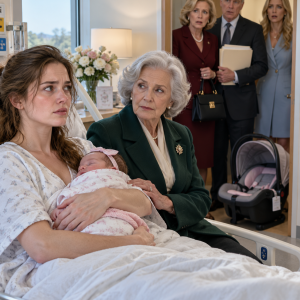
Adrian stepped toward her, then stopped before touching her. He understood that comfort could not be demanded simply because he had finally chosen the right side.
“I should have listened.”
“I tried to tell you.”
“I know.”
Evelyn’s voice sharpened.
“She came into your life with nothing. I protected you from a woman who was falling apart.”
Adrian looked at Lydia, still holding their son despite everything done to weaken her.
“She did not fall apart,” he said. “You isolated her, kept her from sleeping, and taught her to doubt herself. She was protecting Miles while I failed to pay attention.”
A House Full of Witnesses
The doorbell rang. Two investigators entered with uniformed officers, followed by paramedics and Adrian’s attorney, Sarah Keene. Evelyn looked at them as though someone would recognize her name and soften the moment.
“There has been a misunderstanding. I serve on the boards of three hospitals. Call Dr. Waverly. Call Judge Benton.”
One investigator answered evenly.
“Mrs. Harwood, we need you to come with us and answer questions concerning family mistreatment, medication given without consent, and actions involving an infant.”
“Do you know who I am?”
“Yes,” Adrian said. “That is why everything has been documented.”
Paramedics examined Lydia while the pediatrician spoke to Adrian by phone. Miles had a fever and needed evaluation, but his condition appeared manageable. Lydia’s vital signs were weak, and she showed signs of medication she had not chosen to take.
“I didn’t knowingly take anything,” she told them.
Evelyn’s polished manner disappeared.
“After everything I did for you,” she said to Lydia. “You lived in a rented apartment before you married my son. I gave you a home.”
Lydia lifted her eyes.
“I had a home. I had work, friends, and a life I was proud of. You needed me to feel small so you could feel important.”
As officers prepared to escort Evelyn outside, she made one last attempt to divide them.
“Ask her about the locked box in the basement,” she told Adrian. “Ask what she kept from you before the wedding.”
Lydia stiffened.
“No,” Adrian said.
Evelyn stared at him.
“No what?”
“No more accusations meant to keep us divided. If Lydia has something to tell me, she will do it when she is ready. You no longer decide what this family believes.”
Evelyn was escorted from the house past the medical team, security staff, and neighbors standing on their porches. The woman who had spent years maintaining an image of perfect generosity left without the protection of that image.
At the hospital, Miles received treatment for his fever and soon settled against Lydia’s chest. Adrian stayed nearby, but he did not pretend that one night of loyalty could repair months of failure.
Near dawn, Lydia spoke.
“I stopped telling you,” she said. “The first few times you explained her behavior away, I thought maybe I was imagining it. After that, I was afraid speaking would make everything worse.”
“I’m not asking you to forgive me tonight.”
“I can’t.”
“I understand.”
For once, neither of them rushed to fill the silence with an excuse.
The Work of Repair

The months that followed were not transformed by one apology. Adrian moved into the guest room because Lydia needed space. He canceled business travel, handled nighttime feedings, attended medical appointments, and began counseling on his own before asking Lydia to join him. He learned that remorse was not the same as repair.
Lydia recovered slowly. Some mornings she felt like herself; on others, footsteps in the hallway made her tense. She returned to drawing in short sessions, first at the dining table and later in a sunny room Adrian had once used as an office. When she was ready, she redesigned the house. The lilies disappeared, heavy curtains came down, and the nursery was painted in warm green and soft gold.
The legal case brought serious consequences. Evelyn was placed under strict court supervision, ordered into treatment, and prohibited from contacting Lydia or Miles. The boards and charities that once featured her name removed it. Some friends claimed they had never known what she was capable of, though Adrian suspected several had seen smaller examples and chosen not to challenge them.
A year later, Lydia helped create a local support network for mothers facing manipulation or mistreatment from relatives inside their own homes. The group connected women with counselors, family-law clinics, and practical help. Lydia did not share her experience to embarrass Evelyn. She did it because beautiful houses often made outsiders assume everyone inside them was safe.
One afternoon, an ivory envelope arrived with Evelyn’s handwriting on the front. Adrian placed it on the kitchen table without opening it.
“This is your choice,” he said.
Lydia studied it for a long moment, then tore it into four pieces.
“My peace does not require her explanation.”
That weekend they celebrated Miles’s first birthday in the backyard. There were no formal speeches, photographers, or guests invited out of obligation. Lydia’s parents brought a homemade cake. Miles took three uncertain steps across the grass and fell laughing into his mother’s arms.
Adrian watched from the porch. For most of his adult life, he had believed protection meant a large house, reliable security, and enough money to solve practical problems. He now understood that protection could be quieter and harder. It meant noticing when someone’s voice changed. It meant believing the person with less power in the room. It meant setting boundaries even when the person crossing them shared your history and your last name.
That evening, after Miles fell asleep, the house became still.
This time, the stillness was not built from fear or exhaustion. Nothing important was hidden behind it. Lydia sat at her drawing desk with the windows open, and Adrian washed the last birthday plates in the kitchen. They were not pretending to be the family they had been before.
They were becoming something more honest, one ordinary day at a time.